Feyre's arrival in Prythian
A Court of Thorns and RosesFeyre's arrival in Prythian begins as an apparent abduction but functions as a forced bargain: because she killed Andras, a faerie of the Spring Court, Prythian must claim her life under the Treaty. The beast who comes for her offers two forms of payment—death that night or a life spent forever in Prythian, forsaking the Mortal Realm. Feyre chooses the second, not because she trusts her captor or believes the faerie lands safe, but because refusing would expose her family to immediate danger. Her passage across The Wall therefore changes the meaning of survival: it saves her body while severing her from her home and placing her inside the lethal world she has been taught to fear.
The Bargain at the Cottage
Feyre's decision is made under direct threat. The faerie explains that Prythian must claim her life for the life she took, and that he may either gut her or carry her across The Wall to live out the remainder of her days in Prythian. Her father urges her to go. Feyre initially sees no meaningful refuge in either option: every inch of Prythian is believed dangerous to humans, and a life there might mean terror, enslavement, or a slower death. Yet she also understands that the armed stranger has blocked the door, brushed aside her knife, and could destroy her family before finding her again if she attacks or flees.
Her acceptance is consequently strategic rather than submissive. She loosens her grip on her remaining dagger and asks when they will leave, attempting to remove the immediate threat from her family while preserving the possibility of escape later. The faerie answers that they will go at once. Before departing, he retrieves the Ash arrow Feyre had left near the door, sniffs it, snaps it in two, and throws it into the fire. The gesture destroys one of her few weapons and turns the departure into a visible confirmation that resistance has failed. Feyre rides out not as a willing guest but as a mortal hostage whose only bargaining power is the life she has agreed to surrender.
Crossing into Prythian
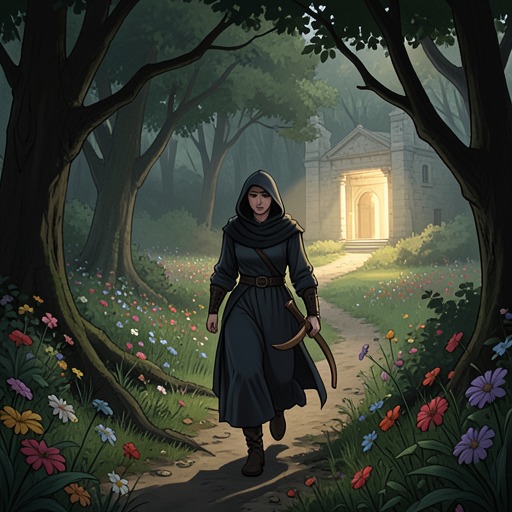
The journey begins at night. A white mare waits unbound beside a tree, remaining calm even when the beast passes close enough to kill her with a single stroke. Feyre mounts after he motions her forward, savoring the horse's warmth against her half-frozen body while following the beast northward toward faerie territory. The movement is physically quiet but psychologically absolute: she is leaving the cottage, her family, and the human world behind without knowing whether the promised life in Prythian will be merciful or merely a different form of punishment.
It takes two days to travel from the cottage to The Wall and enter the southernmost border of Prythian. The gate opens without a porter or sentry, and Feyre's horse follows the beast through it. The absence of a guard does not make the crossing free; the open gate marks a boundary whose authority is already supernatural and complete. Feyre has been transported from a world where she knew the rules of hunger and violence into a realm governed by a Treaty she never signed and by powers capable of claiming her through its terms.
The Boundary and Its New Dangers
Once in Prythian, Feyre's position remains that of an outsider. She imagines herself as little more than a lamb in a kingdom of wolves, and the journey's northward direction confirms that she has entered the territory she once regarded as lethal. Her fear is compounded by uncertainty about what it means to live on the beast's lands: the Treaty forbids faeries from taking humans as slaves, but Feyre worries that the protection may not apply to a human who has murdered one of their kind. The language of the bargain is therefore both her defense and her confinement.
The Wall later becomes visible to her precisely through its invisibility. While riding through the summer forest, her horse abruptly bucks and refuses to proceed; when Feyre dismounts and reaches forward, her hand meets an unseen obstruction cleaving the forest. She learns that faeries can pass through holes in it, at least according to rumor, and leads her horse along its line while repeatedly tapping the surface to ensure that she has not strayed from the boundary. This encounter gives material form to the division that already governs her life. The border is unseen, impermeable to her, and permeable to those who possess the powers and knowledge of Prythian.
Becoming a Witness to the Faerie World
Feyre's arrival does not end with physical relocation. It initiates a prolonged process of discovering that Prythian is populated, organized, and concealed in ways the Mortal Realm does not understand. During the spring celebration associated with Calanmai, she follows drums from the stables on her white mare and finds hundreds of High Fae gathered around a giant bonfire. Their features blur whenever she tries to look directly at them, while appearing more solid at the edge of her vision. She recognizes the effect as a glamour designed to prevent her from seeing them properly, much as her family had been glamoured.
The scene reveals that her new home is not simply a wilderness occupied by monsters. It contains courts, rituals, crowds, magic, and communities beyond the manor, even though Feyre does not yet know where the revelers live. She keeps her hood up to hide her human features, worries that smoke and the scents of the High Fae will not conceal her human smell, and checks that her two knives remain at her sides. Her arrival has therefore placed her in a state of unstable concealment: she is physically inside Prythian but socially and perceptually excluded from it, moving through a celebration that can see her more clearly than she can see its participants.
The Long Consequences of the Crossing
The forced entry into Prythian becomes the first step in a chain of increasingly severe threshold crossings. Feyre's initial bargain places her under faerie jurisdiction; later ordeals under Amarantha turn that jurisdiction into public captivity and make her life the subject of formal challenges. Amarantha offers three tasks to test the depth of Feyre's human loyalty and love, promising that success will free Tamlin, break his curse, and release his court. The trials convert the original logic of the bargain into a spectacle: survival depends not only on courage but on interpreting rules established by a ruler who controls the audience, the stakes, and the penalties.
The arrival also prepares the book's most radical transformation of identity. After the final ordeal, Feyre dies and experiences darkness bordered with gold before returning to breath in the throne room. She discovers that her skin gleams, her fingers seem longer, and her body feels stronger, faster, and sleek. She has become High Fae. The mortal who crossed The Wall under threat of execution thus ends as a being of the realm that once claimed her life. Her arrival is significant not merely because it transports her from one setting to another, but because it begins the dismantling and reconstruction of the categories—human and faerie, captive and participant, death and life—that will define her story.