First Trial: Middengard Wyrm
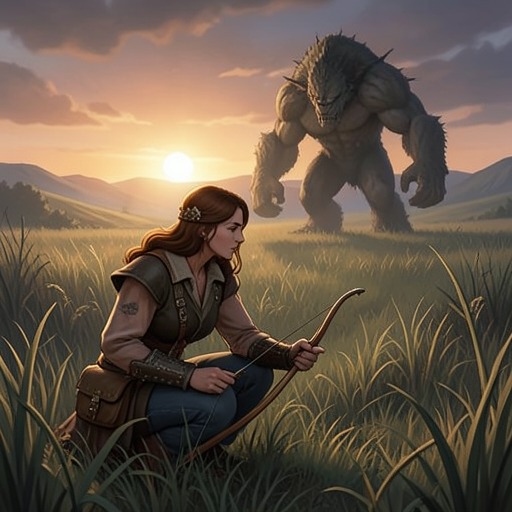
A Court of Thorns and RosesFirst Trial: Middengard Wyrm is the first of the three tasks Amarantha imposes on Feyre Archeron beneath the Mountain. Designed as a spectacle of fear and humiliation, the trial places a human huntress in a muddy underground labyrinth with the gigantic Middengard Wyrm and makes her survival the first proof of the love and loyalty she has pledged to Tamlin. Feyre wins not through superior strength but through observation, improvisation, and a hunter’s ability to turn the creature’s own lair into a weapon against it.
Causes and Conditions
The trial follows Amarantha’s bargain with Feyre. Amarantha offers to break Tamlin’s curse and release him, Feyre, and the Spring Court if Feyre completes three tasks proving the depth of her human love. She also offers a shorter route through Amarantha’s riddle, but an incorrect answer would carry a lethal penalty. The bargain therefore makes each trial both a contest and a legalistic trap: its stated objective is clear, but its true purpose is to expose Feyre to pain, uncertainty, and public judgment while keeping Tamlin’s freedom dependent on her performance.
The setting reflects that coercion. Amarantha has the Attor push through the crowd and bring Feyre to the edge of a trench system roughly twenty feet deep. The trenches form a maze across the chamber, with pits, holes, and passages leading into the underground den. Feyre is not given a weapon suited to the creature; she is thrown into the trench by the Attor and left to face the task under the eyes of the gathered faeries. Amarantha identifies her specifically as a huntress before ordering her to hunt the creature, converting Feyre’s former human skill into the formal rule of the game.
The Hunt in the Labyrinth
When Amarantha commands Feyre to run, the Middengard Wyrm emerges. It resembles a gigantic worm whose front end has become an enormous mouth lined with successive rings of razor-sharp teeth. Its pinkish-brown body surges through the muddy trenches, which are its lair. Feyre flees through the maze, losing momentum whenever she crashes into a wall but recognizing that the creature must also slow down to make the sharp turns. Her knowledge of pursuit gives her the first practical advantage: the Wyrm’s size and speed are terrifying, but they also restrict its movement.
The trial’s first major reversal comes when Feyre realizes that the Wyrm is blind. The crowd’s attention shifts toward the far end of the chamber, where the creature has lost track of her, and Feyre understands that its attack is guided by sound, movement, or other senses rather than sight. The discovery changes her position from hunted prey to concealed strategist. Yet escape alone is not enough. She falls into a hidden pit in ankle-deep mud, survives the impact, and finds herself trapped amid the stench and piles of bones left after the Wyrm has consumed its victims.
Feyre turns the den’s remains into an improvised arsenal. By pressing her hand against the packed-mud wall, she infers that the foul substance is connected to the creature’s digestion and that the bones around her are the remnants of animals whose flesh has been stripped away. She selects two of the largest and strongest bones, each longer than her leg and heavy enough to serve as stakes. She jams them into the wall, then creates a position from which the charging Wyrm can be made to fall into the pit. Her solution depends on reading the environment rather than overpowering the monster: the den itself supplies the materials, and the Wyrm’s own momentum completes the trap.
Death of the Middengard Wyrm
Feyre swings toward the place she has prepared and collides painfully with the muddy ground. Something bites through her arm, but she has no time to stop and inspect the wound. She scrambles deeper into the darkness, takes another bone, and waits as the Wyrm plunges into the pit. The creature strikes the earth and lashes its massive body toward the place where it expects to kill her; instead, a wet crunch announces that it has impaled itself on the bone spikes.
The Wyrm remains motionless, its enormous mouth still open. Feyre needs several heartbeats to understand that it has not merely been stunned but is genuinely dead. She climbs out of the pit carrying the bone like a sword, her left arm throbbing while the crowd’s gasps turn into cheers. The spectators’ reaction marks the public value shift of the event: the arena first treats Feyre as an object of amusement and probable slaughter, then acknowledges her as the victor. The monster’s defeat is therefore also a temporary defeat for the spectacle’s intended script.
Consequences and Significance
Feyre’s victory proves the first condition of Amarantha’s bargain and gives her concrete evidence that the trials can be survived. Her response to Amarantha makes the emotional stake explicit: the pain in her arm becomes something she embraces because it confirms that she has won and has advanced her claim to Tamlin. The trial thus binds physical endurance to the language of love, while Amarantha’s rules attempt to make that love measurable through increasingly theatrical violence.
The event also establishes the pattern of the remaining challenges. Amarantha’s power operates through controlled choices, spectators, threats, and punishments: Feyre is given a task, but the arena is arranged to maximize helplessness and display. Later challenges will take the form of a three-lever puzzle and the execution of three innocent faeries, but the Middengard Wyrm trial is the foundational version of the system. It asks whether Feyre can recognize a hidden weakness, use limited information, and transform an apparently closed environment into a route to survival.
As a threshold event, the trial places Feyre between her former identity as a human huntress and the supernatural world that now judges her. She has already crossed the invisible boundary into Prythian, but beneath the Mountain she must cross a harsher boundary between captive and active participant. The victory does not free her; Amarantha still controls the bargain, and Feyre must face further tasks. It does, however, establish the resourcefulness that carries her through the ordeal and foreshadows the later transformation in which she will pass from mortal life into High Fae existence after sacrifice, death, and rebirth.