Hybern
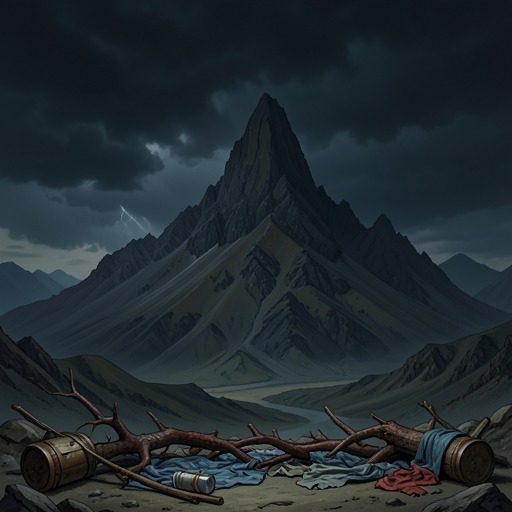
A Court of Thorns and RosesHybern is an island kingdom across the violent western sea, distinct from the court-divided political order of Prythian. It is ruled by a king rather than a High Lord, and the Suriel describes that king as law unto himself. Humans no longer exist in Hybern; the image of a throne made from their bones presents the kingdom as the surviving form of an openly absolutist and violently imperial order. Its importance lies not only in its geography or government, but in the way its unresolved history continues to shape the political crisis of the present.
Geography and Political Structure
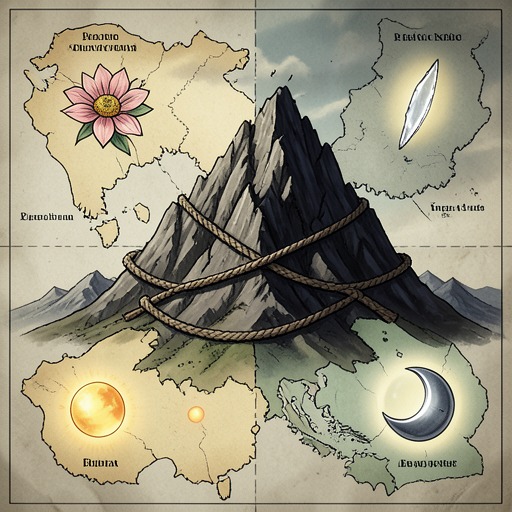
Hybern occupies the large island that remained outside the human territories established by the Treaty. Whereas Prythian is divided among courts and governed by the Seven High Lords, Hybern is presented as a unified kingdom under a single High King. That contrast makes its sovereignty more concentrated: the ruler is not one lord among several, but the final source of law within an undivided realm.
The island’s separation is therefore both physical and political. The Treaty confined the High Fae and faeries to the northern lands while mortals retained the south, but Hybern did not yield territory to humans. Its position at the edge of the world also contributes to its isolation and menace. For Feyre Archeron, the distant island first appears as an unmapped or unavailable portion of the world; the Suriel’s account transforms it into a center of power whose hostility has never been reconciled with the postwar settlement.
Imperial History and Resentment of the Treaty
The kingdom’s past is inseparable from the long history of human subjugation. Before the War, humans had been enslaved by High Fae overlords for millennia, forced to build civilizations and temples through their labor. The War ended only when six mortal queens crafted the Treaty, dividing the world between human and faerie territories and requiring the High Fae to abandon their mortal slaves and withdraw their magic from the human realm.
Hybern’s king resented this settlement. He regarded the Treaty as an imposed limitation: it had forced him to free his slaves and remain confined to his island. His opposition was not merely personal or ceremonial. A century before the main events, he sent trusted commanders and remnants of ancient armies into other faerie courts and kingdoms. These agents spent fifty years acting as spies, courtiers, and lovers, gathering information and testing whether the other ruling powers might support the reclamation of human lands.
The strategy reveals Hybern as an imperial power that operates through intermediaries as well as direct force. Its agents entered foreign courts under social and diplomatic disguises, turning trade, intimacy, and political access into instruments of intelligence. The kingdom’s reach thus extended beyond its shores long before an open invasion was announced.
Amarantha and the Infiltration of Prythian
Amarantha was Hybern’s most lethal general during the War and fought on the front lines against humans and against any High Fae or faeries who defended them. Her later role in Prythian was initially disguised as reconciliation. She traveled from court to court presenting herself as a diplomatic emissary, promising increased trade, communication, and the sharing of resources between Hybern and Prythian. For fifty years she lived as a courtier bound to no court, claiming to make amends for the actions of Hybern and for her own conduct during the War.
That performance allowed Hybern’s commercial and diplomatic traffic to function as a covert military channel. The High Lords accepted Amarantha’s apparent change of heart and did not realize that ships carrying Hybernian goods also transported her personal forces. The King of Hybern himself was unaware of the full scope of her plan, according to Alis’s account, but Amarantha used the access created by Hybern’s trade to build an independent power base in Prythian.
Amarantha ultimately wanted Prythian for herself. She intended to accumulate power there and use the territory as a launching point for an eventual attack on the human world, whether or not the King of Hybern approved. Her conquest began when she drugged the Seven High Lords at a ball held in her honor with a potion stolen from the king’s spell book. Once their magic had been exposed and weakened, she stripped away the powers at their bodily sources and seized control of Prythian within days. The kingdom of Hybern therefore stands behind the history of the conquest without being identical to Amarantha’s regime: its resources, armies, and magical knowledge made her rise possible, while her ambition eventually became partly independent of her king.
Military Threat and Political Alliances
Hybern remains an active threat during Amarantha’s rule. Amarantha gathers the most vicious creatures in Prythian and Hybern under her protection, offering sanctuary even to beings considered too monstrous for the Night Court. The resulting army is intended for an assault on the human territories and any lands beyond them. Rumors of faeries crossing the Wall to attack humans acquire a new political meaning because crossings require Amarantha’s permission; the attacks may therefore be sanctioned operations rather than uncontrolled incursions.
The relationship between Hybern and Amarantha is tense but strategically useful. The Attor reports that soldiers in Hybern believe the High King is displeased by Amarantha’s handling of Feyre Archeron. He had already blamed her madness involving Jurian for costing him the War, and he might not forgive another refusal to assist his cause. Her theft of his spells and seizure of a territory are one matter; failing to support him a second time is another. This intelligence suggests that Hybern expects obedience from Amarantha even while her conquest has served her personal ambitions.
The same report also indicates that Amarantha’s bargain with Feyre has become a political liability. The High King views the situation as evidence that she has made a fool of herself and may be preparing to turn away from Hybern’s objectives. Hybern’s power is therefore not a simple unified enemy front. It is an imperial hierarchy marked by rivalry between a distant king and the general who has converted his methods and resources into her own regime.
Trade, Wealth, and the Human Border
Hybern’s influence is also connected to the unequal economic structure surrounding the Wall. Human territory is too small and poor to maintain a standing army, leaving villagers dependent on the five-hundred-year-old Treaty for protection. Wealthier landowners can hire mercenaries to guard territories bordering Prythian, but even that security is described as an illusion. The border population remains materially exposed to faerie power while relying on rumors, charms, iron, and inherited warnings.
Against this poverty, Hybernian trade appears as both opportunity and danger. Feyre’s father, once called the Prince of Merchants, sent three ships directly to Bharat in an attempt to escape inherited debts; the ships sank before reaching its shores, destroying the family’s wealth and leaving them with only a cottage. Later, after Feyre entered Tamlin’s world, a stranger gave her father gold to invest, the investment doubled, and the supposedly lost ships were found in Bharat with their profits. Tamlin arranged this restoration, but the episode also shows how wealth, shipping, and distant markets can abruptly reshape a human family’s status.
Amarantha’s earlier promises of expanded trade between Hybern and Prythian expose the double character of such exchange. Commerce offers communication and prosperity on the surface, yet the same ships carry troops and facilitate conquest. Hybern’s economic presence is thus a form of imperial infrastructure: goods legitimate access, access produces intelligence, and intelligence prepares military domination.
Narrative Significance
Hybern gives the story’s political danger a deeper historical horizon. The immediate oppression under Amarantha is not an isolated tyranny; it grows from the older systems of slavery, war, territorial division, and failed trust established by the Treaty. Hybern represents the power that never accepted the settlement, while Amarantha represents the infiltrator who turns diplomacy and inherited military violence into personal rule.
Its presence also complicates the apparent boundary between the human realm and Prythian. The Wall was meant to separate worlds, but Hybern’s agents cross political and social borders through ships, courts, espionage, and alliance. The kingdom’s threat is consequently not limited to a future battlefield. It is already present in the structures that connect territories, in the magical knowledge stolen from its ruler, and in the armies assembled under Amarantha’s protection. Hybern functions as both a place and a governing logic: concentrated sovereignty, colonial memory, covert expansion, and the conversion of trade into war.