Kingdom of Hybern
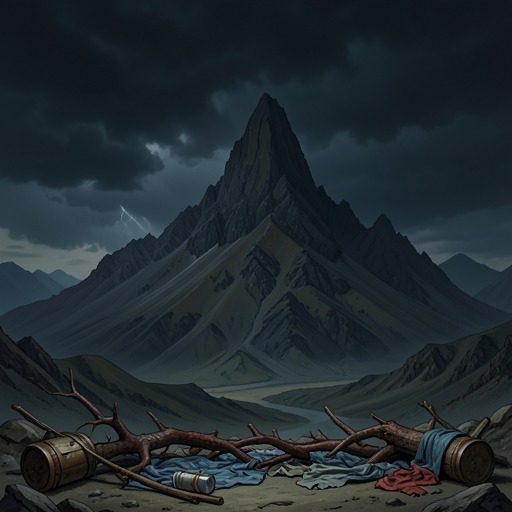
A Court of Thorns and RosesThe Kingdom of Hybern is an island realm across the violent western sea, distinguished from Prythian by its centralized monarchy: it is ruled by a king rather than divided among High Lords and courts. The Suriel describes that king as wicked and powerful, with a throne made from human bones, and states that humans no longer exist in the kingdom. Hybern therefore represents not merely another faerie territory, but a concentrated form of sovereignty built on conquest, enslavement, and the rejection of the limits imposed by the Treaty.
Political Structure and Historical Position
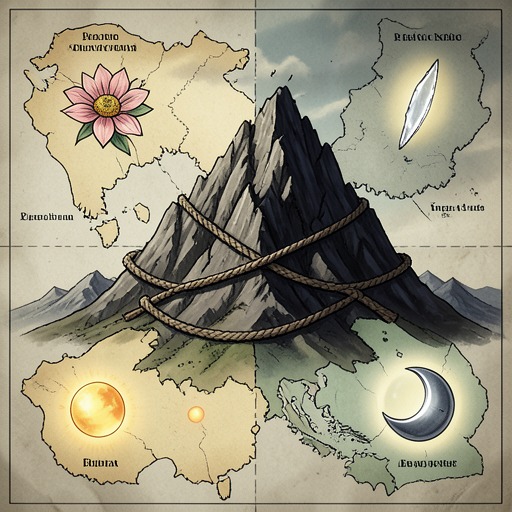
The Kingdom of Hybern retained a political order unlike that of Prythian. Where Prythian was traditionally governed equally by the seven High Lords, Hybern was ruled by a single king who was law within his own territory. Its location on the large island that had yielded no land to humans after the Treaty reinforced its separation from the mortal realm, while its history preserved the older hierarchy in which humans served as enslaved subjects of High Fae overlords.
The Treaty ended the ancient system of human enslavement only after the War had devastated both sides. The mortal realm received the southern territories, while the High Fae and faeries retained the north and withdrew their magic behind the Wall. Hybern’s king resented this settlement because it forced him to release his mortal slaves and confined his power to the island. His hostility was therefore directed not only at a political agreement but at the loss of an imperial structure that had once made human labor and territory available to him.
The King’s Long Strategy
The King of Hybern did not immediately challenge the Treaty through open war. A century before the main events, he dispatched his most trusted commanders, described as deadly warriors and remnants of the ancient armies that had once invaded the continent, to infiltrate faerie courts and kingdoms. For roughly fifty years, these agents acted as spies, courtiers, and lovers, gathering information while presenting themselves as participants in ordinary political and social life.
The operation reveals Hybern’s preferred method of expansion: military power was paired with patient intelligence work and cultural penetration. The king sought to discover which rulers might share his desire to reclaim human lands, while the infiltrators transformed the courts they entered into sources of information and potential leverage. One commander, known as the Deceiver, eventually disobeyed him, but that defection did not end the larger strategy.
Connection with Amarantha
Amarantha was the most important Hybernian agent to enter Prythian. A century before the current crisis, she arrived as an emissary from Hybern and moved from court to court, presenting herself as a promoter of trade, communication, and shared resources. She was called the Never-Fading Flower and spent fifty years as a courtier bound to no single court, claiming that she was making amends for her own conduct and for Hybern’s actions during the War.
Her public diplomacy concealed a history of extreme violence. Amarantha had been the King of Hybern’s most lethal general and had fought on the front lines against humans and against any High Fae or faeries who defended them. Her sister, Clythia, became involved with the mortal commander Jurian, who used the relationship to obtain military information before torturing and killing her. After the Treaty, Amarantha butchered her own slaves rather than release them, demonstrating that her hostility to human freedom was not merely inherited from the Hybernian king but was embedded in her own practice of rule.
The High Lords nevertheless accepted her claim that Clythia’s death had changed her, and they trusted her partly because she opened trade lines between Hybern and Prythian. Those same ships carried Hybernian goods and Amarantha’s private forces. The commercial network thus functioned as a military channel: trade served as the cover through which an occupying army entered Prythian.
Imperial Conquest and the Threat to Humans
Once Amarantha had secured the High Lords’ confidence, she moved against Prythian without relying on superior numbers alone. She waited until the High Lords gathered at a ball held in her honor, drugged their wine with a potion stolen from the King of Hybern’s spell book, and stripped away the powers at the source of their bodies. Their magic was reduced to its most basic elements, allowing her to seize control of Prythian within days.
Her conquest transformed Hybern’s covert project into a new regime. Amarantha did not simply restore the old Hybernian order under the king’s authority; she took Prythian for herself and used its courts, territories, and captured population as the foundation of her own power. For forty-nine years she ruled the land, while the High Lords and much of their courts remained enslaved Under the Mountain. The account leaves the King of Hybern’s exact political response uncertain, but it makes clear that he did not punish her. His failure to act suggests at minimum a tolerated partnership between Hybern’s imperial ambitions and Amarantha’s independent seizure of Prythian.
During Amarantha’s rule, dangerous beings from across Prythian, including creatures considered too terrible even for the Night Court, gathered under her protection. She used this sanctuary to build an army from the most lethal faeries of Prythian and Hybern. The Attor is identified as one example of the forces associated with this military buildup. The same broader policy is linked to reports that increasing numbers of faeries had crossed the Wall to attack humans, implying that such incursions required Amarantha’s permission and formed part of preparations for an assault on the mortal realm.
Relations with the Mortal Realm
For humans living near the Wall, Hybern’s threat was initially distant but materially present. Mortal territories were too poor to maintain a standing army, and their inhabitants depended on the Treaty for protection. Hired swords could guard the lands of wealthy families, but that security was described as an illusion; ordinary humans had been taught from childhood that they could do little against High Fae power.
The Kingdom of Hybern intensified this vulnerability because its grievance was explicitly territorial and human-directed. The King of Hybern wanted to break the Treaty, reclaim the mortal lands, and extend the attack beyond the existing frontier. The possibility that beasts or soldiers were slipping through the Wall turned an old historical settlement into an unstable border. Rumors of attacks, reports of villages destroyed by martax, and the suspected killing of Clare Beddor and her family all acquire a wider political meaning once Hybern’s strategy is known: violence against humans may be reconnaissance, sanctioned terror, or preparation for invasion rather than isolated incidents.
Narrative Significance
The Kingdom of Hybern functions as the hidden imperial center behind the visible disorder of the plot. Its power is expressed through the combination of monarchy, slavery, espionage, commerce, magical warfare, and military proxies. The kingdom’s history also exposes the fragility of the Treaty: an agreement that ended open slaughter could not erase the ambitions of a ruler who regarded liberation as dispossession.
Hybern’s importance lies partly in its distance. Before its king is named, fear appears as rumor, beasts crossing the Wall, and unexplained attacks. The later revelation that Hybern spent decades placing agents inside foreign courts gives those earlier disturbances a coherent cause. It also establishes a contrast between the Treaty’s formal division of worlds and the kingdom’s continuing effort to undo that division through infiltration and force. Even when Amarantha acts independently, her regime carries Hybern’s political inheritance: the restoration of domination over humans by whatever mixture of persuasion, deception, and violence will succeed.