Mortal Realm
A Court of Thorns and RosesThe Mortal Realm is the restricted human territory south of the Wall, the remnant of a divided world in which mortals live under the protection—and the historical shadow—of the Treaty. Its decisive significance is spatial and political: it is presented as a poor, vulnerable homeland whose inhabitants remain close to Prythian despite having little land, limited knowledge, and no reliable defense against the supernatural powers beyond the boundary.
Historical and Political Position
The Mortal Realm exists within the consequences of the War between humans and the High Fae. Long before the present story, humans had been enslaved by High Fae overlords and forced to build their civilizations, temples, and cities through blood and labor. Rebellion across the lands produced such extensive slaughter that six mortal queens crafted the Treaty to end the conflict. The settlement divided the world: the North was conceded to the High Fae and faeries, who carried their magic with them, while the South became the domain of mortals, who were left to make a living from the earth.
The arrangement did not create genuine security. The Mortal Realm is protected only by the promise made by the High Fae five centuries earlier, and the Treaty has become so distant that humans have forgotten the names of their gods. Its continuing force is therefore both legal and fragile. In Feyre Archeron’s understanding, a promise is law, currency, and bond; the same principle that binds her to her family also describes the political protection on which the mortal population depends.
Poverty and Vulnerability
The Mortal Realm is marked by scarcity. Feyre’s family lives in a miserable cottage on damp, meager territory, and her daily existence is shaped by hunger, exhaustion, and the need to provide for her father and elder sisters. The family’s poverty makes the territory’s supposed safety feel hollow: the humans possess neither prosperity nor meaningful control over the land granted to them. The Mortal Realm is not a secure sanctuary but a narrow margin in which survival depends on labor, vigilance, and inherited promises.
Its proximity to Prythian intensifies that vulnerability. No one can explain why humans continued living so near the faerie territories after the War, where so little space had been granted to them and where the Wall contained gaps large enough for lethal creatures to enter. The danger is not merely legendary. Reports circulate of faerie beasts crossing the boundary, including a pack of martax that tore apart half a village. The Mortal Realm’s inhabitants therefore live beside a frontier that is officially closed yet practically porous.
The Wall and Boundary Crossings
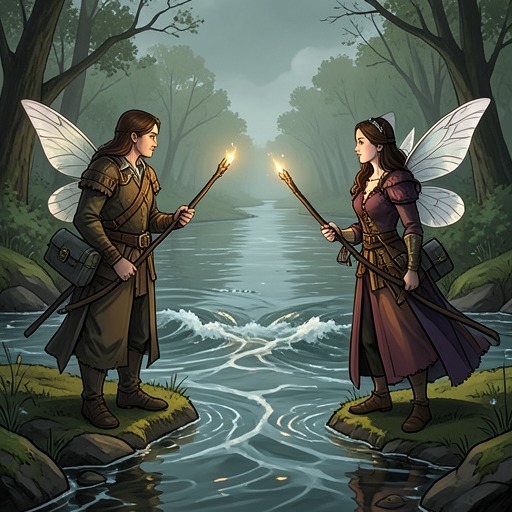
The Wall divides the Mortal Realm from Prythian, but it functions less as an absolute barrier than as an unstable threshold. Rumors describe holes through which faeries can pass, and increasing attacks suggest that the boundary is weakening or being deliberately breached. The mercenary’s warning that creatures may be slipping through turns the Wall from a distant political monument into an immediate source of terror; Feyre considers fleeing south with her family before the threats can reach them.
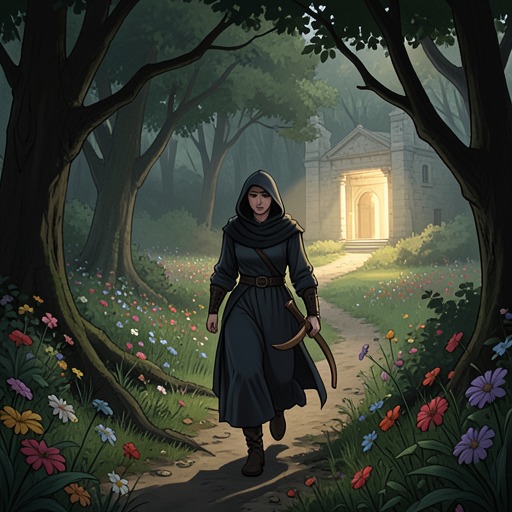
Feyre eventually crosses the Wall under coercion. It takes two days to travel from her cottage to the boundary and enter the southernmost border of Prythian, a passage so strange that she wonders whether she has been held in enchanted sleep. The gate opens without a porter or sentry, and her horse follows the beast who has taken her, making the crossing feel less like an authorized journey than an abduction through an unguarded threshold.
The boundary remains visible through its effects even when it cannot be seen. Later, while riding through the summer forest, Feyre finds that her horse refuses to advance. When she dismounts and reaches forward, her hand meets an invisible obstruction: the Wall cleaves through the forest without a marker or visible surface. The scene reveals the Mortal Realm’s border as an embodied limit, one that can be tested by touch but not understood through ordinary sight.
Contrast with Prythian
The Mortal Realm’s material conditions are sharply contrasted with the Spring Court. From the boundary, Feyre enters a landscape of rolling green land, sunlight, roses, ivy, alabaster architecture, patios, balconies, and staircases. The estate is so expansive and richly colored that her former manor cannot compare. Inside, polished marble, a sweeping staircase, glass doors, and a second garden reveal a level of elegance and wealth that she had never imagined faeries still possessed.
This contrast unsettles rather than comforts her. The estate’s beauty is accompanied by emptiness, silence, a metallic odor, and the growl of an unseen presence. Feyre had known that High Fae once built palaces and temples, but the Mortal Realm’s stories had preserved them primarily as feral monsters with deadly appetites. The grandeur beyond the Wall therefore exposes the poverty of her assumptions as well as the poverty of her home. The passage from cottage to estate is simultaneously a movement from deprivation into abundance and from familiar hardship into an unfamiliar form of captivity.
The Realm’s Relation to the Plot
The Mortal Realm is the point from which Feyre’s obligations and fears acquire their force. Her mother’s deathbed command that the family remain together and look after one another keeps Feyre from abandoning the cottage, even when she imagines walking away and never looking back. The vow binds her to a human household that cannot protect itself, while the Treaty binds the larger human population to a historical arrangement it did not choose.
The realm’s apparent separation from Prythian also proves deceptive. The spreading Blight is initially understood as a disease affecting faerie lands, but Alis reveals that Amarantha is the sickness in those lands and that the collapsing borders are part of her destruction. Feyre recognizes the consequence immediately: if the Blight is Amarantha, then Amarantha is also the threat to the human realm. The Mortal Realm is therefore not outside the central crisis. Its distance from Prythian offers no immunity, because the political and magical collapse beyond the Wall can reach the human side.
Feyre’s later experiences reverse the direction of the boundary’s meaning. She begins as a mortal resident entering Prythian, passes through the manor and the Court Under the Mountain, and ultimately dies in the throne room before returning in a new body. In the final transformation, she rises from darkness and warmth, discovers that her blood and bones are no longer mortal, and realizes that she has become High Fae. The Mortal Realm remains her origin, but it no longer defines the limits of her body or identity. Its boundary has been crossed first geographically, then politically, and finally ontologically.