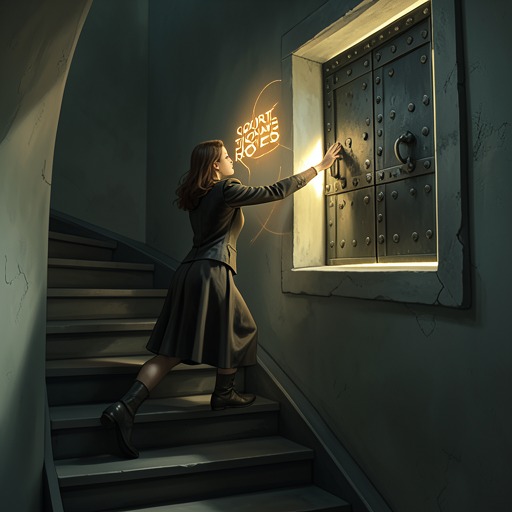
Stay with the High Lord
A Court of Thorns and Roses“Stay with the High Lord” is the Suriel’s central instruction to Feyre Archeron after she traps the ancient seer in the Spring Court. It presents proximity to Tamlin as the only reliable protection against the blight spreading through Prythian, but its repetition gradually changes the expression from practical counsel into a charged refrain about safety, obedience, and the danger of leaving the person who can shield her.
Origin and Meaning
The phrase is delivered during Feyre Archeron’s attempt to obtain answers about the blight that is stealing and altering magic across Prythian. The Suriel refuses to explain where the blight came from and instead tells her to remain with Tamlin, assuring her that she will be safe and warning her not to interfere or seek further answers. It claims that Tamlin will shield her from the shadow over Prythian and that, if she stays close to him, matters will eventually be set right.
The instruction is therefore more than a general expression of loyalty to a ruler. It identifies Tamlin’s physical and political protection as the condition of Feyre’s survival. At the same time, the Suriel’s warning is incomplete: when Feyre presses for the origin of the blight, it reveals that Tamlin does not know she has come to trap a Suriel because he cannot provide the answers she wants. The command carries protection, secrecy, and an implied danger that the High Lord himself cannot fully comprehend.
Repetition in the Spring Court
After the encounter, Feyre treats the Suriel’s words as a rule for living. The dreams that trouble her contain the deaths she witnessed, the deaths she caused, and the pale woman who tore her apart, all watched by a shadow she cannot quite see. Yet as time passes at Tamlin’s Estate, she becomes less afraid and consciously follows the instruction: she stays with the High Lord.
Her daily life gives the command a seductive surface. She paints from dawn until dusk, explores the Spring Court with Tamlin, and returns with new images and colors. The Spring Court appears as rolling green hills, lush forests, and clear lakes in which magic seems to grow through every hollow and rise. Feyre cannot fully capture that magic in paint, but she sometimes paints Tamlin himself, enjoying both conversation and long silences beside him. The expression thus comes to rest not only on danger but also on companionship and an increasingly sheltered existence.
The protection is never absolute. Tamlin is repeatedly called away to face threats along his borders and returns covered in blood that is not his own, sometimes in beast form and sometimes as the High Lord. Feyre does not ask for details; his safe return is enough. Around the manor there is no sign of creatures such as the naga or the Bogge, but she avoids the western woods, even while painting them from memory. “Stay with the High Lord” becomes a boundary around her life: it keeps her near apparent safety while leaving the larger violence of the court only partly visible.
Safety and Courtly Threat
The phrase is reinforced when the Night Court makes a threatening display at Tamlin’s Estate. After Lucien Vanserra deals with the grisly aftermath, Tamlin holds Feyre’s shaking hands and tells her that she is still safe. The Suriel’s command immediately echoes in her mind, linking Tamlin’s reassurance to the earlier supernatural warning.
Tamlin explains the incident as court posturing, saying that the Night Court is deadly but that its lord’s action was only a joke. An actual attack on anyone at the Spring Court, especially Feyre, would create more trouble than it was worth. He promises that they will be ready if the blight harms the land and the Night Court crosses their borders. In this context, staying with the High Lord appears to offer both personal protection and refuge behind the defenses of a threatened court.
The expression also gains force through Feyre’s movement across forbidden boundaries. It begins after she has spent two days traveling from her cottage to the Wall and entering the southernmost border of Prythian, a passage she experiences as an involuntary crossing into an unknown realm. Later, she discovers an invisible wall cleaving through the summer forest: her horse refuses to advance, and Feyre cannot pass despite finding no visible marker. These thresholds make the Suriel’s instruction spatial as well as emotional. To stay with the High Lord is to remain on the protected side of a dangerous transition between the Mortal Realm and the faerie world.
Departure and Reversal
The command becomes ominous when Tamlin sends Feyre away. He tells her that he loves her and frees her from the Treaty in order to keep her safe, because the storm about to break over Prythian is brutal enough that even a High Lord cannot withstand it. As the carriage carries her away from Tamlin and back toward her family, she uses the Suriel’s words to justify remaining where she is: it is wise to stay there, and she must stay.
Yet the instruction now produces doubt rather than certainty. Feyre feels that leaving Tamlin was a very great mistake, regardless of his orders. The expression has become an inward refrain that contradicts the immediate action of the plot: the person who was supposed to be protected by staying with the High Lord has been sent away by that same High Lord. Her father’s tears, the ball arranged in her honor, and the knowledge that her promise to her mother has been fulfilled cannot dispel the shadow gathering over her heart.
This reversal exposes the limits of the phrase. The Suriel’s advice was not false in its immediate logic—Tamlin did intend to protect Feyre—but safety has been separated from choice, knowledge, and belonging. What sounded like a simple command to remain becomes a source of guilt and foreboding once Feyre recognizes that obedience may itself have carried her away from the place where she felt her true life was located.
From Mortal Vulnerability to Transformation
The expression is finally set against Feyre’s passage through the most extreme threshold in the story: death and rebirth. After she is killed in the throne room, she experiences darkness as a thick, inky medium bordered with gold and struggles upward toward Tamlin and toward life. She gasps back into the room, discovers that she has no wounds, and realizes that she has survived after killing the three faeries required by the final trial.
Her survival is not a return to her former condition. Her skin gleams strangely, her fingers appear longer, and she feels strong, fast, and sleek before recognizing that she has become High Fae. Tamlin stands behind her, and the hall responds with breathing, whispering, weeping, celebration, and praise for the power of the High Lords. The Suriel’s command began by positioning Feyre as a vulnerable human who needed the High Lord’s protection; the ending leaves her transformed into an immortal being within the same supernatural order.
The expression therefore functions as a recurring hinge between dependence and change. At first it tells Feyre where safety lies. In the Spring Court it becomes a reassurance repeated against visible and invisible threats. During her departure it turns into a warning she cannot comfortably obey. After her resurrection as High Fae, its original hierarchy has been unsettled: Feyre is no longer merely the human who must stay close to a High Lord, but a transformed participant in the world whose dangers the command once asked her not to confront.