Tamlin
A Court of Thorns and RosesTamlin is the High Lord of the Spring Court, but Feyre Archeron does not initially recognize him as a ruler. She first encounters him in beast form, an embodiment of the mortal world’s inherited terror of Prythian. When he changes before her in a flash of white light, the revelation is not merely that the monster can wear a human shape: it is that the apparently isolated lord of an estate belongs to the ruling nobility of the High Fae. Tamlin therefore stands at the boundary between legend and political reality, sanctuary and captivity, tenderness and violence. His hidden status, restricted power, and eventual defiance of Amarantha shape the central movement of Feyre’s story.
Identity and First Appearance
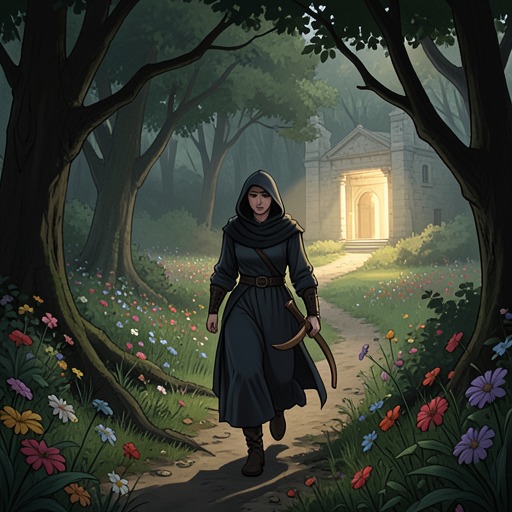
Tamlin is introduced through fear before he is introduced through name or rank. Feyre is brought to an immense Spring Court estate whose roses, ivy, alabaster architecture, patios, balconies, and staircases overwhelm anything she has known in the Mortal Realm. Yet the splendor is empty and silent, and the faint smell of metal beneath the garden’s beauty reminds her that the estate is not a safe country house but a controlled and potentially dangerous faerie space. Inside, black-and-white marble, a sweeping staircase, glass doors, and rooms filled with wealth intensify the contrast between mortal poverty and High Fae magnificence.
At the dining table, the beast becomes a golden-haired man in a flash of white light. His exquisite golden mask is set with emeralds shaped like leaf whorls, leaving his eyes, jaw, and mouth visible. Feyre immediately understands that he is not a lesser faerie but one of the High Fae: beautiful, lethal, and merciless according to the beliefs with which mortals have been raised. The transformation makes Tamlin a literal shapeshifter, but it also establishes his narrative function as a figure whose identity cannot be read from a single outward form.
The estate itself initially conceals his political importance. Feyre assumes she has been taken by a powerful faerie lord, not by one of the seven rulers of Prythian. Only when the Suriel presses her for information does she learn that Tamlin is a High Lord of the Spring Court. The discovery overturns her understanding of every earlier encounter: the beast at the wall, the master of the estate, and the figure whose decisions govern an entire territory are the same person.
The Spring Court and the Limits of His Rule
Tamlin’s authority is real but sharply compromised. Alis explains that Amarantha stole the High Lords’ powers after drugging them at a ball and extracting their magic from their bodies. Tamlin’s diminished condition in the Spring Court is therefore not the full measure of his natural strength; what Feyre has seen is only a remnant of the power he once commanded. Amarantha then seized control of Prythian within days, leaving Tamlin and the other High Lords subject to her rule for forty-nine years.
His estate reflects this contradiction. It is lavish enough to suggest ancient aristocratic power, yet it is strangely empty, quiet, and vulnerable. The walls of the mortal world offer a similar illusion of protection: poor territories cannot maintain standing armies and rely on the Treaty, charms, iron, and inherited warnings. Tamlin’s household is a more magnificent version of that same precarious arrangement. Its beauty signals rank, while its silence and enforced concealment reveal that rank alone cannot defeat the power holding Prythian captive.
Tamlin nevertheless retains capacities that distinguish him from ordinary faeries. When Lucien announces that Tamlin is going to hunt the Bogge, Feyre objects that the creature cannot be killed and that even Lucien cannot face it. Lucien answers that Tamlin can. The statement identifies Tamlin as the household’s decisive protector, even under conditions in which his broader political power has been stripped away. His strength is most legible in action against danger, not in ceremony or public governance.
The Curse and the Bargain with Amarantha
Tamlin’s subjugation is tied to Amarantha’s curse and to a deliberately cruel condition. After Tamlin refused Amarantha’s advances, he insulted her by declaring that he would sooner take a human to his bed or marry a human than touch her, and he invoked her sister Clythia’s love for the mortal warrior Jurian. Amarantha responded by offering him seven times seven years to break the spell that had stolen his power. The required solution was a human girl who hated faeries, possessed ice in her heart, and would kill one of Tamlin’s men in an unprovoked act of hatred.
The condition turned Tamlin’s political imprisonment into a moral trap. The human had to be brought to the Spring Court only after killing one of his sent men across the wall, and the killing had to resemble Jurian’s betrayal of Clythia. Tamlin therefore needed a person whose hatred could satisfy Amarantha’s design, while any attempt to fulfill the curse demanded that an innocent mortal be manipulated into committing a murder. Feyre’s arrival is inseparable from this structure, even though she does not initially know it.
Tamlin had only three days remaining when Feyre left the Spring Court. He nevertheless let her go. At the precise moment when the forty-nine years ended, Amarantha came with her followers, seized Tamlin and much of his court, and carried them Under the Mountain. His decision to release Feyre did not break the curse; instead, it left him exposed to its final consequence. The act shows both the limit of his strategy and the cost of refusing to treat Feyre merely as an instrument of his freedom.
Relationships, Protection, and Concealment
Tamlin’s relationship with Feyre develops through a persistent tension between protection and control. He brings her into the Spring Court, provides food and shelter, and offers her a life far removed from the starvation and damp poverty of the Archeron cottage. Yet he also withholds the truth about his rank, the curse, and the danger gathering around his court. His concealment makes the estate feel like both refuge and prison: Feyre is materially protected while being denied the knowledge necessary to understand why she is there.
His care is also expressed through the transformation of space. The estate offers gardens, paintings, sunlight, and the possibility of creative work, including paints and room to practice. Feyre later realizes that these gifts have been bound to a larger erasure: Tamlin’s magic has glamoured her family’s memories, allowing them to forget her existence. In the rose garden, where Tamlin explains that his father planted the flowers for his mother as a mating present, Feyre confronts the emotional cost of what he has done. He has provided for her family, but provision cannot undo the fact that she has been removed from their lives.
Tamlin’s protective instincts become explicit when danger approaches. He orders Feyre to remain in her chamber while he prepares for a dangerous faerie ritual. His body grows stronger and faster as drums intensify, his neck muscles quivering as though stillness itself causes pain. When Feyre asks whether he is going into battle, he laughs breathily but does not explain the ritual, repeating the command that she stay inside. The scene presents protection as bodily strain and as command: Tamlin tries to keep Feyre alive by controlling her movement and limiting what she can witness.
His connection with Lucien is equally shaped by danger and divided knowledge. Lucien serves as emissary and appears to possess contacts capable of carrying intelligence between courts. When he reports that the Blight has killed two dozen younglings in the Winter Court and is spreading southward, Tamlin reacts with grief and immediate hostility toward the open doorway. The news reveals that Tamlin’s personal crisis exists within a wider emergency affecting multiple courts, while his reaction shows a ruler whose protective responsibility extends beyond the walls of his estate even when his power has been reduced.
Defiance Under the Mountain and Ending
Amarantha’s account of Tamlin’s imprisonment emphasizes that he rejected submission even when submission might have offered temporary peace. She sought to make him her lover and consort, but he refused to let her touch him after what she had done to Lucien. His refusal became more provocative when he compared her sister’s choice of Jurian with his own willingness to choose a human. Amarantha’s curse and the deadline Under the Mountain followed from that defiance.
Under the Mountain, Tamlin’s court becomes part of a spectacle of domination. Feyre is dragged through enormous stone doors into a vast chamber whose pillars depict the histories of Prythian, while High Fae gather in masks and fine clothing around a cruel celebration. Later, when Feyre is escorted toward the arena, the crowd’s laughter, shouting, and unearthly howls turn the cavern into an institution of public punishment. Tamlin’s captivity is therefore not private confinement alone: it is staged before the society Amarantha rules, with bodies, masks, architecture, and spectators all reinforcing her power.
At the climax, Feyre’s apparent death finally strips away Tamlin’s restraint. Lucien removes the fox mask, tears shining in his remaining eye, while Tamlin turns toward Feyre’s dead body. His masked face becomes lupine as he snarls at Amarantha; his fangs lengthen, and when she retreats and whispers a plea, golden light blasts her against the wall. Tamlin then launches himself at her, shifting into beast form with fur, claws, and immense lethal muscle. The transformation that once marked him as a monster now becomes the instrument of revolt. His beast identity is not erased by his love or by political humiliation; at the decisive instant, it is the form through which his suppressed power breaks Amarantha’s control.
Tamlin’s ending thus joins personal attachment to political reversal. The High Lord who was first perceived as an unknowable beast becomes the power that answers Feyre’s apparent death and attacks the queen who has ruled Prythian for forty-nine years. His trajectory is not a simple passage from beast to civilized man. It is a movement from concealed authority, through curse and dispossession, toward a final reassertion of the dangerous strength that the curse had reduced but never extinguished. In Tamlin, the novel makes protection inseparable from secrecy, beauty inseparable from threat, and the restoration of political power inseparable from the return of the animal form first feared.