The Prythian mural
A Court of Thorns and RosesThe Prythian mural is a vast historical map concealed in the library of Tamlin's Estate, and its decisive importance lies in the way it converts inherited myth into visible political geography. When Feyre Archeron encounters it, she does not merely learn where the courts lie: she sees the scale of faerie power, the erasure of humanity from the world's origin story, the violence behind the Wall, and her own village reduced to an almost insignificant point beside the Spring Court. The mural becomes a visual record of a divided world whose borders, hierarchies, and suppressed histories govern Feyre's life.
Discovery and Setting
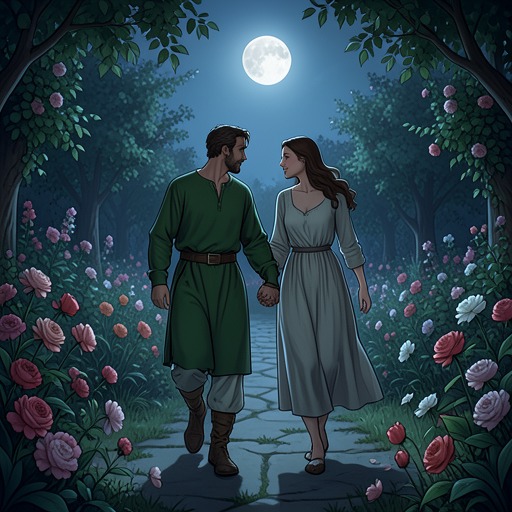
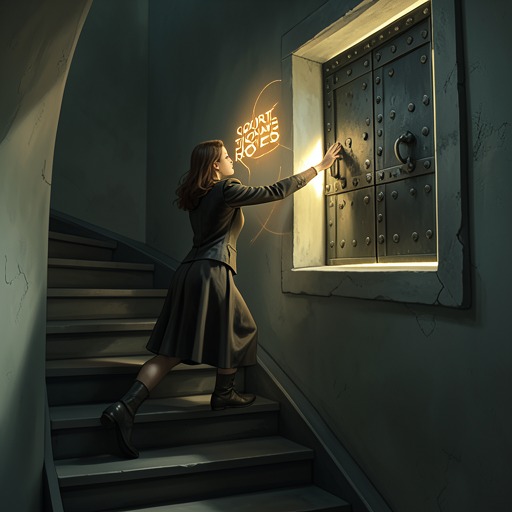
The mural is found in the library of Tamlin's Estate, a residence whose extraordinary scale already unsettles Feyre. The estate spreads across rolling green land, veiled in roses and ivy, with patios, balconies, and staircases emerging from alabaster walls; its woods extend so far that she can barely see their distant boundary. Yet the splendor is accompanied by emptiness, silence, and the faint smell of metal. Inside, black-and-white marble, countless doors, a sweeping staircase, and a second garden make the house seem less like a home than an immense faerie structure whose wealth and hidden purposes Feyre cannot yet comprehend. The library intensifies that impression. Feyre initially calls it a study because the latter word feels less intimidating, but the room is effectively a labyrinth of book stacks with a mezzanine covered wall to wall in books. Following sunlight toward the windows, she looks out over a rose garden and then notices the enormous work extending along the adjacent wall. It is not an ordinary painting but a mural, so large and ambitious that she can scarcely absorb it. Its placement, tucked away where no one appears to view it, makes the work feel both treasured and inaccessible: a history housed within the architecture of the High Fae yet not made for mortal eyes.
The World Shown by the Mural
The mural tells its story through shifting colors, shapes, light, and tone. It begins with a mighty black cauldron held by glowing female hands in a starry, endless night. Golden liquid, marked by small symbols that suggest an ancient faerie language, pours from the cauldron into the void and pools upon the earth to form the world. This opening presents creation as a faerie-centered act and establishes the mural's governing perspective before any human history appears. Its map encompasses the entire known world, including seas and continents beyond Feyre's immediate homeland. Territories are marked by color and by ornate images of the beings who once ruled them. There is no mention of humans and no sign of them in the creation scene; within the mural's implied hierarchy, humanity has been omitted from the world's making and reduced to the status of something beneath notice. Feyre recognizes this absence as an artistic expression of the High Fae belief that the world was made for them. The next major image is a battlefield. Thousands of human soldiers stand in bloodied mud facing faerie hordes, while High Fae in glittering armor and lesser faeries armed with claws and fangs charge toward them. Human arrows and swords appear useless against such opponents. Feyre understands the result before the mural states it directly: the humans did not survive that battle, and the black-and-red smear in the following panel conveys the slaughter. The mural therefore does not soften the War; it makes human vulnerability an image that Feyre can almost physically inhabit.
Borders, Courts, and Political Geography
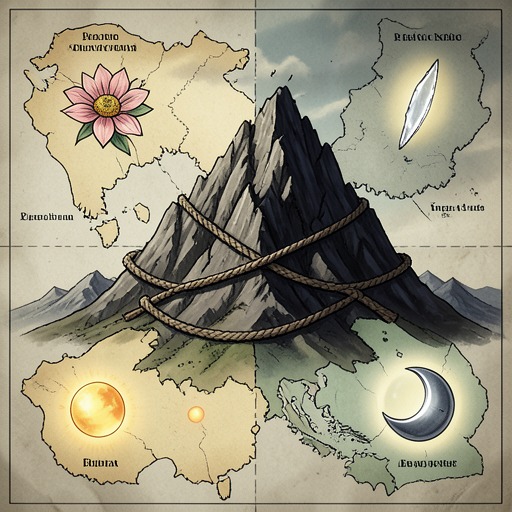
A later panel shows a much-reduced faerie realm. The northern territories have been divided to make room for the High Fae, who lost lands south of the Wall, while everything south of it is rendered as a vague blur. The omission is pointed: the faerie realm receives detail, color, and political definition, whereas the mortal world is nearly unrepresented. Even after territorial concessions, however, the High Fae retain an enormous northern expanse, revealing a concentration of power far greater than the mortal communities south of the boundary can comprehend. The island containing Feyre's village has fared relatively well from Prythian's perspective, because only its bottom tip has been given to humans. Most of that sacrifice falls upon the southernmost of the seven territories, the Spring Court, painted with crocuses, lambs, and roses. Feyre locates the rough area of her village and the woods separating it from the Wall, then traces the short distance upward into Spring Court lands. The journey that takes two days in lived experience appears tiny beside the power represented on the mural, making the border feel less like protection than an intimidating compression of mortal space. The six other courts form a patchwork farther north. Autumn Court, Summer Court, and Winter Court are readily identifiable, followed by the glowing Dawn Court and the gold, yellow, and blue Day Court. Above them lies the sprawling Night Court, set among frozen mountains, darkness, and stars. Small eyes and gleaming teeth appear within its shadows, giving the region an image of lethal beauty. The mural thus organizes Prythian not merely as a map but as a hierarchy of atmospheres, symbols, and implied dangers, with the courts differentiated by both geography and emotional effect.
The Central Mountain and Withheld Knowledge
At the heart of the mural stands a small snowy mountain range dominated by a mammoth solitary peak. The peak is bare of snow and life, as though the elements themselves refuse to touch it. No label or explanatory image identifies it, and Feyre assumes that anyone for whom the mural was intended would already know its importance. This unexplained center contrasts with the otherwise elaborate cartography: the mural offers vast amounts of information while reserving its most central feature behind cultural knowledge Feyre does not possess. That omission marks the limits of Feyre's access to faerie history. The mural teaches her the layout of Prythian and the existence of its courts, but it also reminds her that the knowledge belongs to the society that produced it. Its audience is not human, and its silences are as meaningful as its images. Feyre leaves with one practical conclusion—that she must never go north—but the mural has already done more than provide a warning. It has shown her that the world around the mortal border is organized by powers too large for her community's charms, iron bracelets, inherited rhymes, or faith in the Treaty to control.
Historical and Narrative Significance
The mural's history gains further force when set beside the mortal account of the War. Humans had once been enslaved by High Fae overlords and compelled to build their civilizations, temples, and wealth. Rebellion across many lands produced such destruction that six mortal queens forged the Treaty, after which the Wall divided the world: the north belonged to the High Fae and faeries, while the south was left to mortals, who were forced to survive from the earth. The mural does not present this history as an even exchange. Its creation scene, absent humans, and detailed faerie-centered geography expose the perspective of a ruling culture, while the battlefield and diminished faerie map reveal the violence that made the boundary possible. Later revelations about Amarantha make the mural's political divisions still more ominous. Amarantha spent fifty years moving between courts under the guise of a neutral courtier, promising trade, communication, and shared resources while Hybernian ships carried her private forces. Forty-nine years before the present, she drugged the seven High Lords at a ball, stripped away the powers at their source, and seized Prythian within days. She then gathered the most vicious faeries, including creatures too terrible even for the Night Court, while building an army for a future assault on the human territories. Against that background, the mural's map is not static decoration. It is a diagram of the lands contested by conquest, betrayal, and military preparation. The work also stands in contrast to the spaces through which Feyre is later forced to move. The library allows her to look, read, and assemble knowledge, even though the books and faerie language expose her illiteracy. By contrast, the carved chambers beneath the mountain display countless stories of Prythian on their pillars while Feyre is dragged into a crowd of High Fae and lesser faeries; the arena below is a muddy, torch-lit space where armed escorts need not shackle her because the surrounding crowd itself enforces captivity. The mural offers a moment of orientation before those later spaces turn knowledge into spectacle and the body into property. Its enduring significance lies in that tension: it is an object of beauty that reveals domination, a map that helps Feyre locate herself, and a record whose omissions force her to recognize how thoroughly history has been drawn from the victor's side.