Under the Mountain
A Court of Thorns and RosesUnder the Mountain is the sacred mountain at the heart of Prythian and the subterranean court from which Amarantha rules the conquered land. First glimpsed on the Prythian mural as a solitary, lifeless peak, it later becomes the destination of captivity, political revelation, and public cruelty: a hidden palace beneath the mountain where the High Lords are held, the Spring Court is gathered, prisoners are starved, and violence is turned into entertainment.
Geography and Sacred Status
Under the Mountain occupies the center of Prythian, at the core of the land’s living map. The mural shows it as a small, snowy mountain range dominated by a mammoth solitary peak, bald of snow and life, as though the elements themselves refuse to touch it. It is the only feature on the map that yields no explanation, a place whose importance seems assumed rather than presented to human understanding. Its central position gives it an almost cosmological quality: the surrounding courts appear to spread around it, while its blank, hostile peak resists the color and vitality associated with the rest of Prythian.
The mountain is far from the Spring Court and still farther from the Wall separating the faerie and mortal realms. Its apparent remoteness is partly deceptive, however. Alis leads Feyre Archeron to a slender cave in a hollow between hills and identifies it as an ancient shortcut to Under the Mountain. The passage was once considered sacred, but is now abandoned and feared. Alis describes it as the route to which all dark and miserable roads eventually lead, transforming the mountain from a distant landmark into an inescapable destination within the political and moral geography of Prythian.
Amarantha’s Court and Political Function
Under the Mountain is the palace built by Amarantha after she seized Prythian. She had entered the courts as an emissary from Hybern and spent fifty years presenting herself as a conciliatory figure, promising increased trade, communication, and the sharing of resources. Known then as the Never-Fading Flower, she lived as a courtier bound to no single court while secretly bringing her forces into Prythian through the trade routes she had opened. Once the High Lords trusted her, she poisoned them at a ball held in her honor, stripped away the powers that originated within their bodies, and conquered Prythian within days.
After the conquest, Amarantha built her palace beneath the sacred mountain and became known as the Deceiver. Under the Mountain therefore functions not merely as a residence but as the administrative and theatrical center of an imperial regime. The seven High Lords’ former system of equal rule is replaced by the authority of a single High Queen, while the defeated courts are reduced to subjects. The mountain’s concealed position reinforces that political transformation: power has withdrawn from the open territories and gathered beneath the land itself, away from ordinary sight and beyond the reach of mortal knowledge.
Amarantha’s rule also turns the mountain into a military base. The most wicked faeries in Prythian, including creatures considered too terrible even for the Night Court, gather under her protection. She uses them to build an army and prepares to attack the mortal territories, potentially breaking the Treaty that ended the War. The attacks by faeries crossing the Wall are consequently linked to the power centered at Under the Mountain; the weakening borders and incursions are not an independent sickness but part of Amarantha’s deliberate expansion.
Architecture and Courtly Spectacle
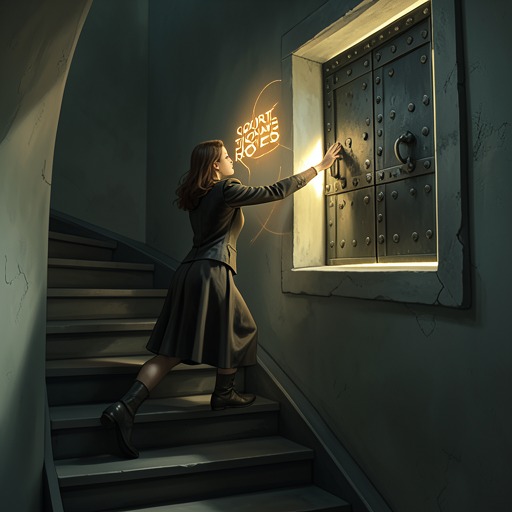
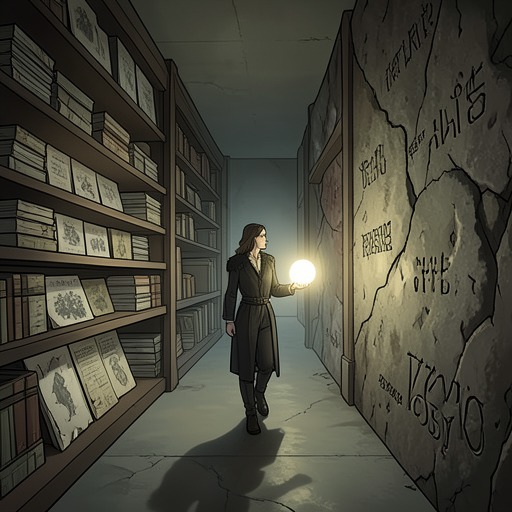
The approach to Under the Mountain leads through two enormous ancient stone doors, taller than Tamlin’s manor, into a chamber carved from pale rock and supported by countless pillars. The pillars are covered not with abstract ornament but with carved faeries, High Fae, and animals moving through different environments and states. The walls preserve countless stories of Prythian, making the chamber a monumental archive of the world’s history even as the ruling court violates the order that history represents.
Jewelled chandeliers hang between the pillars and scatter color across the red marble floor. The magnificence is inseparable from menace. A crowd fills the chamber, some dancing to strange, irregular music and others conversing in fine clothing; masks glitter among faces that blur into sharp teeth and unnatural features. The setting resembles a celebration, but the apparent festivity is a mechanism of domination. Under the Mountain makes wealth, beauty, history, and violence occupy the same room, so that political submission can be staged as courtly entertainment.
At the center of this spectacle is Amarantha’s black throne. Feyre Archeron sees the High Queen lounging upon it after the Attor throws her into the chamber. Amarantha’s beauty is precise rather than divine: red-gold hair braided through a golden crown, snow-white skin, ruby lips, and ebony eyes marked by a permanent sneer. The throne and the crowned figure upon it give the mountain a visible center of authority, while the surrounding crowd supplies the watching public through which that authority is repeatedly confirmed.
Dungeons, Captivity, and Bodily Control
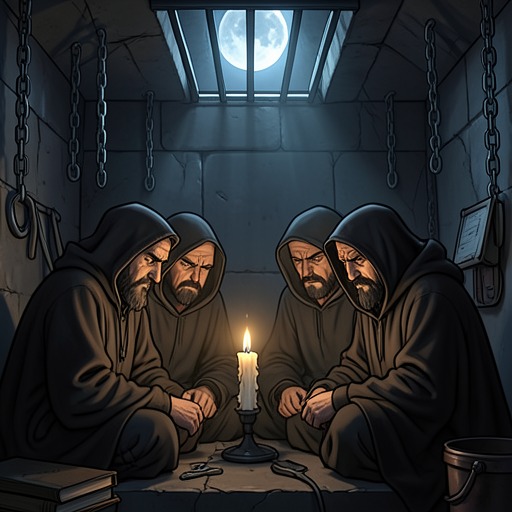
Under the Mountain contains dungeons in which prisoners are isolated, deprived of information, and physically weakened. After Feyre Archeron is taken there, she is given only three miserable meals of stale bread and water, at irregular intervals, and is eventually dragged from her cell by two squat, red-skinned faeries. Her hunger becomes part of the system of control: by the time the cell door opens, she no longer has the strength or desire to resist, and survival requires her to submit to being moved.
The dungeon also produces a distorted form of agency. While being escorted through the corridors, Feyre Archeron studies cracks in the walls, details in tapestries, and odd turns in the passage, trying to construct a mental map of a possible escape. She notes that the throne room has no windows because it lies underground and calculates that, if she escaped with Tamlin, the ancient cave through the mountain might offer the best route out. The architecture thus confines the body while forcing the captive to become an observer of its own prison.
The court’s prisoners are not hidden from everyone. In the throne-room approach, Feyre Archeron passes beneath Clare Beddor’s rotting body and sees the assembled court, including members of the Spring Court. The juxtaposition is deliberate: the living, richly dressed audience remains clean and fed while a dead human body is displayed as part of the passage into the court. Under the Mountain converts death into a warning and makes spectatorship a condition of political life.
Arena and Narrative Significance
The mountain’s arena extends the same logic of captivity into public performance. When the full moon rises, Feyre Archeron is taken through a passageway filled with the reverberations of a teeming crowd. Her escort does not need drawn weapons because the setting itself guarantees that she cannot escape. The passage opens into a vast torch-lit cavern, either carved from rock or formed by nature, whose muddy, slick floor makes movement difficult. Lesser faeries and High Fae crowd around her, shouting and grinning with a shared excitement that makes even the High Fae appear feral.
Under the Mountain therefore changes the meaning of space at every threshold. The mountain first appears as an unexplained peak on a map, then as a sacred cave and secret route, then as a jeweled court, dungeon, and arena. Each enclosure narrows access, controls visibility, and places bodies under observation. Masks, glamour, underground darkness, guarded corridors, and the absence of windows all separate captives from reliable knowledge, while the carved histories and ceremonial wealth attempt to give oppression the appearance of an established civilization.
Its decisive significance lies in this union of grandeur and imprisonment. Under the Mountain is the spatial form of Amarantha’s conquest: a palace built beneath the symbolic center of Prythian, where the old political order is confined, the mortal world is threatened from below, and suffering is displayed as royal power. The mountain’s lifeless peak, hidden court, starving cells, and roaring arena make it both the heart of the regime and the place where that regime’s violence can no longer be disguised as trade, tradition, or glamour.