Winter Court
A Court of Thorns and RosesThe Winter Court is one of the seven territories of Prythian, occupying a recognizable place in the northern portion of the realm. Although it is associated with ice, cold, and a distinctive courtly identity, its importance in the narrative is not merely geographical. Reports from the court reveal that the blight is killing younglings, destroying magic, and spreading southward, while its High Lord’s participation in resistance shows that the court is also one of the principal sites of opposition to Amarantha’s rule.
Place Within Prythian
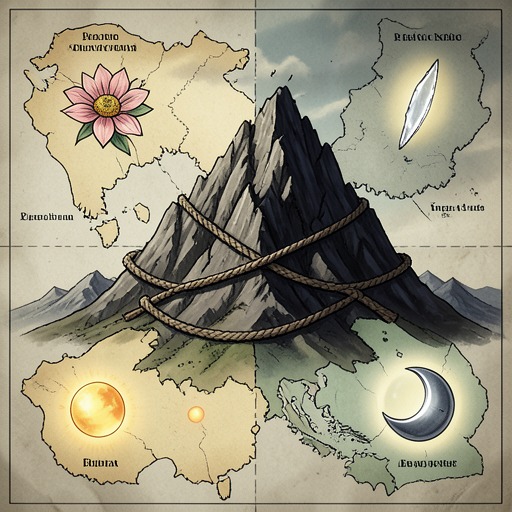
The Winter Court appears on the painted map of Prythian as one of the six territories surrounding the Spring Court. From the human side of the map, Feyre Archeron can easily distinguish Autumn, Summer, and Winter, while the Dawn Court and Day Court glow farther north and the immense Night Court occupies the frozen mountains and darkness beyond them. Winter therefore forms part of a larger political and ecological patchwork rather than standing as an isolated kingdom. Its position contributes to the sense that Prythian is divided into courts with sharply contrasting climates, landscapes, and systems of power.
The court is also part of the political order created after the War. The Treaty divided the world between mortal lands and the territories of the High Fae and faeries, leaving the seven courts to be governed by their High Lords. The Winter Court’s existence within that arrangement is consequently tied to the wider history of conquest, negotiated borders, and inherited sovereignty. What appears from a distance as a separate frozen territory is also one component of a realm whose political independence has been profoundly damaged by Amarantha.
The Blight and Its Victims
The clearest account of the Winter Court comes through Lucien Vanserra’s intelligence from a contact there. The news is devastating: the blight has killed two dozen younglings in the court. It burned through their magic and then broke apart their minds, and no one in the Winter Court could intervene once the affliction had turned toward them. The deaths are presented not as an isolated illness but as a force that overwhelms the court’s ability to protect its own children, making the loss both biological and political.
The report also places the Winter Court within a spreading pattern of destruction. Other courts are being struck hard, but the Night Court remains untouched, while the blight appears to be moving farther south with every attack. The Winter Court thus becomes the first concrete measure of the disaster’s human cost within Prythian: its younglings are not abstract casualties of a distant crisis, but the evidence that the affliction can erase lives, consume magic, and leave an entire community helpless.
This apparent ecological catastrophe is later reinterpreted as deliberate political violence. Alis explains that there is no independent blight; Amarantha is the sickness in the lands. She has weakened the borders, sent creatures against the courts, and tested whatever strength remains to their High Lords. The Winter Court’s suffering therefore reveals the way authoritarian power can disguise assault as calamity. What initially seems like an uncontrollable force is connected to a ruler who treats the courts as experimental ground and their inhabitants as expendable subjects.
Rebellion Against Amarantha
The Winter Court is named among the courts that attempted to resist Amarantha. Alongside the Day Court and Summer Court, it sought aid after Amarantha had bound the High Lords to their lands and made meaningful resistance difficult. The rebellion never developed into open war. Its leaders tried instead to send messengers through human visitors who entered Prythian, including young women associated with the Children of the Blessed, hoping that appeals for assistance might reach other faerie territories.
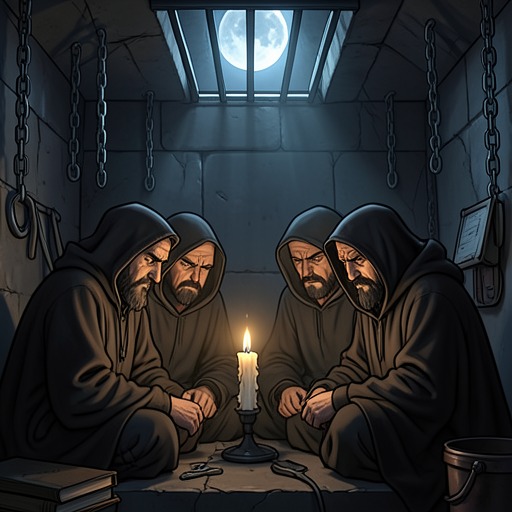
Amarantha intercepted those messengers before they could leave the shores. Afterward, she butchered the rebellious High Lords and most of their families, while their successors became too frightened to challenge her. The Winter Court’s inclusion in this failed resistance establishes it as a court that did not simply accept Amarantha’s domination. At the same time, its defeat demonstrates the structural weakness imposed on every court: the High Lords’ powers had been stripped or compromised, their movements were controlled through their bond to the land, and the sovereign authority that should have protected their people had been turned against them.
The court’s resistance also gives political meaning to the later news of its dead younglings. It is not only a victim of the blight but a territory punished within a broader system of coercion. The destruction of its children and the suppression of its leadership belong to the same history of domination, in which Amarantha combines surveillance, military power, magical restraint, and exemplary violence.
The High Lord and the Court’s Political Meaning
At the end of the struggle under the Mountain, the High Lord of the Winter Court appears among the rulers who approach Feyre Archeron. He is identified by his pale skin, white and gray clothing, and a crown of shimmering ice. Like the High Lords of the Summer Court, Dawn Court, and Day Court, he places a glittering kernel of power upon Feyre and joins in restoring her after Amarantha’s defeat. Tamlin receives this gesture with a bow of gratitude, making the Winter Lord’s offering part of the collective act through which the courts acknowledge Feyre’s sacrifice and participate in her transformation.
The scene contrasts the court’s earlier condition with the possibility of renewed sovereignty. Earlier, the Winter Court’s children had died while its people were unable to stop the blight, and its leadership had been associated with a defeated rebellion. Later, its High Lord stands publicly among the surviving rulers and contributes power to a new beginning. The court is not shown as restored in practical detail, but its presence in this ceremony marks its continued political existence and its participation in the liberation of Prythian.
Narrative Significance
The Winter Court serves as a northern witness to the cost of Amarantha’s regime. Its frozen identity gives the map a stark visual and seasonal contrast, but the court’s deeper function is to convert distant geography into immediate stakes. News from the Winter Court proves that the blight kills younglings; its role in the rebellion proves that the courts have attempted to resist; and its High Lord’s final gift confirms that the court remains part of the collective order Amarantha tried to destroy.
Its trajectory also shifts the reader’s understanding of the crisis from natural disaster to organized oppression. The Winter Court first appears as a named territory on a map, then as a devastated community, then as a suppressed political actor, and finally as one of the courts taking part in Prythian’s recovery. Through that progression, the court embodies both the vulnerability of the realm’s separate peoples and the possibility that their fragmented powers can be joined against a common tyrant.