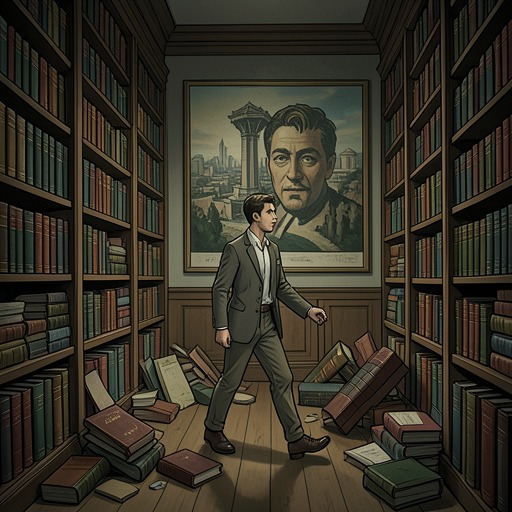
Alleras
A Feast for CrowsAlleras, called the Sphinx, is a young acolyte at the Citadel whose exceptional skill and carefully guarded identity give the Oldtown prologue its atmosphere of intelligence, ambiguity, and foreshadowing. He is introduced through action rather than exposition: while others debate dragons, he calmly prepares an arrow, demonstrates mastery of his bow, and speaks of a surviving Targaryen line with confidence that unsettles the conversation.
Identity and Background
Alleras is a slight, comely youth with light-brown skin, tight black curls forming a widow’s peak, and large black eyes. His appearance is marked by a mixed ancestry that others have condensed into his nickname. His father was a Dornishman and his mother a black-skinned Summer Islander, leaving him with skin dark as teak and eyes compared to onyx. The name “the Sphinx” was given to him by Lazy Leo, who connected Alleras’s composite heritage to the mythical creature assembled from different parts: a human face, a lion’s body, and a hawk’s wings.
That comparison also captures Alleras’s narrative position. Like the green marble sphinxes beside the Citadel’s main gate, he is visually striking and difficult to read. His identity is presented as a combination of recognizable elements that do not resolve into a simple category, making his nickname both a description and a warning that appearances may conceal a larger riddle.
Skill and Introduction at the Quill and Tankard
Alleras’s first substantial appearance centers on an archery exercise beside the river. When Mollander throws a withered apple, Alleras takes an arrow from his quiver, nocks it, and urges that the apple be thrown. The apple splashes into the river untouched, but the failure does not diminish Alleras’s authority. Instead, he answers the disappointment with a maxim: “The day you make them all is the day you stop improving.” The remark presents excellence not as perfection but as continued discipline.
His equipment reinforces that impression. Alleras’s longbow is made from goldenheart, a rare and fabled wood from the Summer Isles. Pate once tried to bend it and failed, while Alleras handles it with ease, unstrings it, and places it in a leather case. The contrast establishes physical strength beneath his slender appearance and makes the bow an emblem of a talent that other observers can admire without fully understanding.
Alleras also distinguishes himself through taste and manner. While the others drink the fearsomely strong cider for which the Quill and Tankard is renowned, he prefers the strange, sweet wines of his mother’s country, even though such wines are expensive in Oldtown. His preference keeps his maternal origins present in the scene and separates him from the group without requiring open conflict. His soft Dornish drawl likewise links him to one side of his heritage while his dark complexion recalls the other.
The Dragon’s Three Heads
After the apple falls untouched, Alleras declares, “The dragon has three heads.” Roone treats the statement as a possible riddle because sphinxes in tales speak in riddles, but Alleras denies that it is one. Armen the Acolyte responds with historical and heraldic skepticism: no dragon has ever had three heads except on shields and banners, and the Targaryens are supposedly dead.
Alleras then counters that the Targaryens are not all dead because the Beggar King had a sister. In the immediate conversation, this refers to the known surviving Targaryen claimant and supplies the prologue with a sudden shift from tavern speculation to political possibility. His certainty is important: he does not present the matter as idle fantasy, and his words make the dragon a living question rather than merely a symbol on a banner.
The phrase about three heads remains deliberately ambiguous. It may be read as prophecy, dynastic calculation, or coded knowledge, but the scene provides no full explanation. Its force comes from the tension between Alleras’s denial that he is speaking in riddles and the unmistakably riddle-like effect of his words. The Sphinx is most characteristic when he insists on plainness while making the surrounding world more mysterious.
Encounter with Samwell Tarly
Alleras later appears in the Citadel’s bureaucratic world, where Samwell Tarly is waiting to secure assistance for the Night’s Watch. While Sam struggles with the delay, Alleras advises him to slip Lorcas a penny or wait three days. He explains that a silver stag would persuade Lorcas to carry Sam up to the Seneschal, noting that Lorcas has been an acolyte for fifty years and hates novices, particularly those of noble birth.
The exchange reveals Alleras’s practical intelligence as clearly as the archery scene reveals his physical skill. He understands the informal economy governing access within the Citadel and converts that knowledge into immediate help for a stranger. When Sam asks how Alleras recognized his noble birth, the question leaves the encounter poised between observation and concealed knowledge. Alleras’s role here is not only that of a talented archer or a cryptic speaker, but also of a socially perceptive guide who can read institutions and people quickly.
Narrative Role and Significance
Alleras combines several apparent opposites: delicacy with strength, youth with competence, direct speech with riddling implications, and visible mixed ancestry with an identity that remains narratively veiled. His nickname makes this doubleness explicit. A sphinx is assembled from unlike parts, and Alleras likewise becomes a figure through whom the Citadel’s learned confidence is tested by information that it cannot comfortably classify.
His actions give the prologue a compact pattern of warning and promise. The missed apple leads to a lesson about improvement rather than defeat; the goldenheart bow displays a rare capacity concealed in a slim body; and the declaration about a three-headed dragon turns casual talk into a sign that dynastic and prophetic forces may be gathering beyond the Citadel. His assistance to Samwell Tarly then places that intelligence in the path of the Night’s Watch, connecting Oldtown’s scholarly institution to the wider dangers and political uncertainties of the realm.
Alleras is therefore significant less because the supplied scenes resolve his secrets than because they make secrecy structurally visible. He appears to know more than he explains, yet his knowledge is expressed through concrete competence, local familiarity, and carefully chosen statements rather than theatrical revelation. The result is a character who functions as both ally and enigma: a figure whose presence makes the surrounding world seem larger, more ancient, and less securely understood.