Citadel
A Feast for CrowsThe Citadel is the great center of learning in Oldtown, but its importance extends beyond scholarship. It is a working institution of archmaesters, maesters, acolytes, novices, scribes, ravens, books, and ceremonies, organized through buildings and traditions that preserve knowledge while also making access to it difficult. For Samwell Tarly, the Citadel is at once a place of refuge, labor, intimidation, and possible revelation: its archives contain the learning he seeks, while its authorities are the people he must persuade to recognize a threat that others may dismiss.
Setting and Architecture
The Citadel stands within Oldtown, whose streets Samwell Tarly experiences as a maze of wet cobblestones, mist-shrouded alleys, balconies, windows, and dark doorways. The gates are marked by two towering green sphinxes, each combining the body of a lion, the wings of an eagle, and the tail of a serpent; one bears a man’s face and the other a woman’s. Beyond them lies Scribe’s Hearth, where Oldtown’s inhabitants seek acolytes to write wills and read letters, while nearby stalls buy and sell books. The arrangement presents the Citadel not as an isolated school but as a public institution woven into the city’s daily legal, commercial, and literary life.
Inside, Samwell Tarly consults a hand-drawn map to find the shortest route to the Seneschal’s Court, evidence of both the institution’s scale and his uncertain place within it. The path divides near the statue of King Daeron the First, whose raised sword points toward Dorne. At the Weeping Dock, acolytes help an old man into a boat bound for the Bloody Isle, a mother boards with a crying infant, cook’s boys gather frogs, and novices hurry toward the septry. These scenes make the Citadel a passage through many forms of service and learning, populated by people at different stages of institutional life.
Libraries, Tunnels, and Ravenry
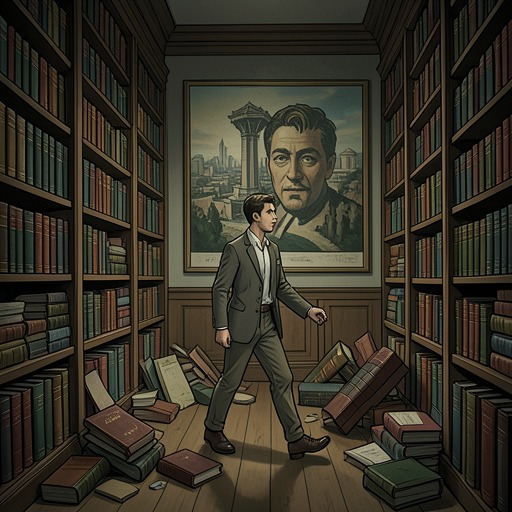
The Citadel’s knowledge is stored in demanding physical spaces. Samwell Tarly reads about the Others in a dusty subterranean library, where every turned page sends small puffs of dust into the air and moving stacks of books raises grey clouds. He becomes so absorbed that he loses track of whether he ate his bean-and-bacon soup yesterday or that same day. The hard chair cuts into his thighs, his calves suffer pins and needles, and he imagines sleeping in a cell hidden behind chests filled with loose pages separated from their original books. The scene defines scholarship here as both intellectual immersion and bodily endurance.
The underground passages are known to the brothers as the wormways. Carrying books and scrolls beneath one arm and a candle in the other, Samwell Tarly climbs their steep steps toward the surface, stopping by the tenth step to shift his load. The Citadel’s learning therefore has an almost literal underworld: its knowledge is reached through darkness, dust, cramped chambers, and difficult ascent rather than through effortless contemplation.
The Ravenry, on the Isle of Ravens, is reached by a weathered wooden drawbridge over the Honeywine. Alleras tells Samwell Tarly that it is the oldest building at the Citadel and that, in the Age of Heroes, it was supposedly the stronghold of a pirate lord who robbed ships descending the river. Moss and creeping vines cover its walls, ravens occupy its battlements in place of archers, and the drawbridge has not been raised within living memory. The old fortress has thus been transformed from a site of violence and control into a center of communication, though its martial silhouette remains.
A weathered weirwood stands in the Ravenry’s yard, its carved face obscured by purple moss and many of its branches dead, while a few red leaves still rustle where ravens perch. Droppings speckle the ground, and the birds fill the tree and the arched windows overhead. The Ravenry’s atmosphere combines age, decay, persistence, and incessant animal activity. Archmaester Walgrave’s chambers lie in the west tower below the white rookery, whose white ravens are kept apart from the black ones because the two groups quarrel constantly.
Learning, Ritual, and Restricted Knowledge
The Citadel’s intellectual culture is governed by formal tests and specialized knowledge. Before an acolyte says his vows, he must keep vigil in a vault without a lantern, torch, lamp, or taper. The only permitted light is an obsidian glass candle. The candidate must spend the night in darkness unless he can light it, and those who attempt the feat may cut their fingers on ridges said to be sharp as razors. Their bloody hands become the physical sign of an effort that has failed; wiser candidates sleep or pray until dawn, but every year some stubborn students attempt to master what are called the higher mysteries.
Glass candles are among the Citadel’s worst-kept secrets. They are said to have been brought from Valyria to Oldtown a thousand years before the Doom of Valyria. Samwell Tarly has heard that four exist—one green and three black—and that all are tall and twisted, though he has never seen one burn. Their secrecy stands in tension with the Citadel’s public identity as a repository of knowledge: some truths are preserved openly in books, while others survive as rumor, ritual, and guarded institutional memory.
The Citadel’s authority is also represented by its archmaesters. Samwell Tarly once believed that serving Archmaester Walgrave with the ravens would earn him a black iron link, since Walgrave was reputed to have forgotten less about ravencraft than most maesters ever knew. Instead, Walgrave could no longer grant the link. Though he remained an archmaester by courtesy, age and mental decline had reduced him to dependence: he needed meals fetched, chambers swept, and help dressing, and acolytes had found him weeping in the Library after losing his way back to his rooms. Maester Gormon sat beneath the iron mask in Walgrave’s place, the same Gormon who had previously accused Samwell Tarly of theft.
Samwell Tarly and the Citadel
For Samwell Tarly, the Citadel is inseparable from duty. He spends long periods in its library because books absorb him so completely that the pages seem to open into another world, a quality he associates with Maester Aemon, who loved books before losing his sight. Yet Samwell Tarly cannot simply retreat into study. Maester Aemon has been weak and needs help, particularly with the ravens; although Clydas is present, Samwell Tarly considers himself younger and better with the birds. His learning is therefore balanced against care for an aging mentor.
The institution also confronts him with the social and familial identity he has tried to escape. Returning to Oldtown aboard the Cinnamon Wind, Samwell Tarly fears being recognized by enemies or friends of his father, Randyll Tarly, whose reputation is known but not loved in the city. Passing the young novices near the Weeping Dock, he imagines that he should have come to the Citadel at their age under a false name, where he might have disappeared among them. He supposes that his father could have pretended Dickon was his only son and would have searched for Samwell Tarly only if Samwell had taken a mule. The Citadel consequently appears as both an imagined alternative life and a place where his inherited name remains inescapable.
The Citadel becomes more consequential when Maester Aemon instructs Samwell Tarly to tell the archmaesters what he knows. Samwell Tarly initially considers postponing the visit to the Seneschal until the following day, but instead follows Alleras across the drawbridge to the Isle of Ravens. The movement from hesitation to action gives the Citadel a narrative function beyond setting: it is the threshold where private knowledge must become institutional testimony. The ancient buildings, skeptical authorities, and accumulated records are the obstacles through which Samwell Tarly must carry the warning entrusted to him.
Narrative Significance
The Citadel embodies the promise and limitation of organized knowledge. Its scribes serve ordinary townspeople, its acolytes maintain communication through ravens, and its libraries preserve accounts of the Others and the past. At the same time, its most unsettling mysteries are hidden in vaults and chambers, its rituals reward endurance as much as understanding, and its senior authority may be physically present while mentally diminished. The institution is therefore not a simple emblem of wisdom. It is a layered system in which learning can protect the world, remain trapped in obsolete forms, or be controlled by those who decide what counts as credible knowledge.
Its architecture reinforces that ambiguity. The sphinxes at the gates suggest riddles and guarded entry; the wormways bury scholarship beneath the surface; the Ravenry preserves a pirate stronghold as a house of messages; and the moss-covered weirwood joins living remnants to immense age. Against this backdrop, Samwell Tarly’s movement through the Citadel is a movement from inward absorption toward public responsibility. The place does not merely contain books and scholars. It tests whether knowledge can leave its vaults, cross its institutional boundaries, and become action in the world beyond Oldtown.