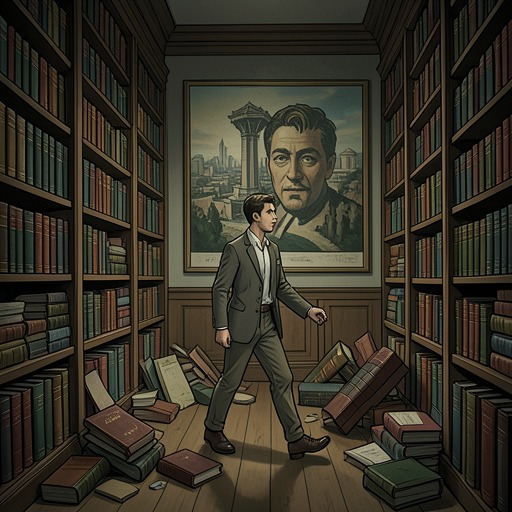
Dareon
A Feast for CrowsDareon is a singer of the Night's Watch and a sworn brother known to Samwell Tarly as both companion and deserter. His story moves from grievance to opportunity, then from opportunity to rejection: he is offered a respectable purpose as a recruiter, abandons the black, quarrels violently with Sam, and is later reported dead in Braavos. Through him, the narrative contrasts the difficult responsibilities of service with the seductions of money, sex, status, and imagined freedom.
Identity and Position
Dareon belongs to the Night's Watch but has always resisted the identity imposed by the black. He claims that he was innocent of the rape that sent him to the Wall and maintains that he should have been serving at a lord's court, singing for his supper. His self-conception therefore rests on a distinction between punishment and vocation: he regards the Watch as an unjust sentence, while treating music and courtly life as the role for which he was meant.
Jon Snow gives that grievance a practical answer by naming Dareon a recruiter in place of Yoren, who has vanished and is presumed dead. The appointment would take Dareon across the Seven Kingdoms, where he would sing of the valor of the Night's Watch and periodically return to the Wall with new recruits. It offers travel, performance, and a recognized function without simply erasing his abilities. Samwell Tarly imagines that the new assignment should make Dareon happier, because it grants him the public life he has always claimed to desire.
Friendship and the Breaking of the Vow
Dareon's connection with Samwell Tarly is framed by shared service. In Braavos, Sam identifies him to a woman at the Happy Port as his sworn brother, and Dareon responds by calling Sam the Slayer and affirming the same bond. The setting immediately exposes the distance between the title and the conduct: Dareon is drunk, surrounded by sexual display, wearing the black cloak as part of an encounter with a naked woman, and presenting the situation as entertainment rather than as a violation of his obligations.
The meeting becomes a direct confrontation when Sam tells Dareon that Maester Aemon is dying and insists that Dareon come with him. Dareon refuses, saying that he is finished with both Sam and the black. He removes the cloak from his bride and throws it at Sam, suggesting that it might keep the old man warm while declaring that he will soon be dressed in velvet, and later in furs, with enough money to live well. The discarded cloak becomes the clearest physical sign of his decision: a garment meant to signify communal duty is reduced to a rag and a possible blanket.
Sam's response is immediate and uncontrolled. He strikes Dareon, tackles him, and beats him through a tavern brawl in which anger temporarily overcomes his usual fear. The fight is not merely a quarrel between friends. It converts a dispute about Aemon, the Night's Watch, and the meaning of brotherhood into bodily violence, leaving the relationship beyond ordinary reconciliation. Dareon's refusal to return to the dying Maester Aemon makes his claimed freedom inseparable from abandonment.
Desire for Another Life
Dareon's behavior in Braavos gives concrete form to the future he once described in the abstract. He has money, a woman on his lap, an audience ready to flatter his reputation as a singer, and a setting in which the Watch's rules seem remote. Yet the scene also reveals how unstable this imagined freedom is. He is not shown building a new vocation or earning a secure place at court; he is spending his resources in a pleasure house and boasting that velvet, furs, and continued indulgence are close at hand.
His performance of prosperity depends on the black cloak he has renounced. He uses his identity as a Night's Watch brother to introduce Sam and to preserve a connection with the heroic image of the order, even as he rejects the duty that image requires. This contradiction sharpens the irony of his apostasy: he wants the prestige associated with service without accepting its sacrifices. His song, charm, and sexual confidence function as social tools, but none of them can restore the brotherhood he has deliberately discarded.
Death and Retrospective Meaning
Later, Arya Stark is required to identify the truth behind several pieces of information and states that Dareon is dead. She describes him as the black singer who slept at the Happy Port, confirms that he was really a deserter from the Night's Watch, and reports that someone slit his throat and pushed his body into a canal while taking his boots. The detail about the boots is treated with grim practicality, emphasizing the material desperation of the world around him: even a dead man's footwear has value.
Dareon's death is reported rather than dramatized, so the narrative denies him a final heroic scene or a return to the Wall. His last witnessed action is rejection, and his end is learned afterward as a compressed fact. The contrast is severe. He had imagined a future of velvet, furs, and courtly success, but the surviving account reduces that promise to a corpse in a canal, stripped of useful boots. His ending does not prove that every deserter must meet the same fate, but it closes the path he chose with an image of anonymity and dispossession.
Narrative Significance
Dareon's small arc parallels the book's wider concern with the difference between stories people tell about themselves and the obligations their actions reveal. He presents himself as a wronged singer destined for a better life, while Sam sees the immediate human cost of his refusal: Maester Aemon is dying, and a sworn brother chooses pleasure over attendance. The narrative neither grants Dareon the romantic freedom he desires nor turns his death into a grand moral spectacle. Instead, it lets the discarded cloak, the tavern fight, and the canal carry the judgment.
His role also complements the account of broken men given by Septon Meribald. Meribald explains how war strips common people of home, kinship, stable identity, and concern for anything beyond the next meal or drink. Dareon is not presented as one of those battlefield survivors, but his story likewise concerns the collapse of a shared identity. He moves from a brotherhood with vows to an isolated pursuit of immediate comfort, and the result is not liberation but vulnerability. In that sense, Dareon embodies a different kind of breaking: not the shattering caused by battle, but the abandonment of a community followed by the loss of any durable place within the world.