Qyburn
A Feast for CrowsQyburn is a former maester whose exile from the Citadel does not diminish his confidence in his own abilities; instead, it frees him to practice a form of knowledge that ordinary institutions reject. His decisive significance lies in the union of healing, anatomical experimentation, and political service. Where conventional maesters impose ethical boundaries, Qyburn treats forbidden inquiry as the source of exceptional power, making himself indispensable to Cersei Lannister precisely because he is willing to cross lines that others will not.
Identity and Exile
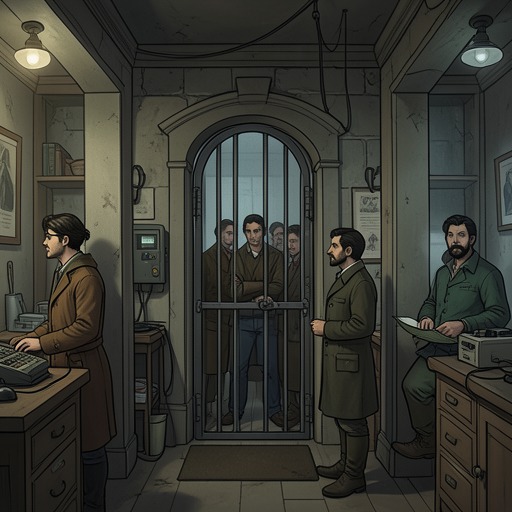
Qyburn first appears as a grey-haired man brought before Cersei Lannister after Jaime Lannister has gone down a tunnel to investigate a shaft. He claims that he was a maester, but Cersei immediately notices the absence of the chain that would publicly confirm the office. He is tall and slightly stooped, still physically capable, with bold blue eyes and a naked throat. His face is familiar to Cersei, though she cannot place it at once, and his self-presentation combines deference with an unmistakable awareness of his own worth.
Qyburn identifies himself as the man who treated Jaime Lannister’s hand. That detail establishes him as more than an itinerant healer: he has already entered the Lannisters’ private history through one of its most consequential injuries. His medical skill gives him access to the family’s bodies and vulnerabilities, while his lack of a chain marks him as someone operating outside the Citadel’s recognized order.
His explanation for that exile is both confession and boast. He says that the archmaesters are cowardly “grey sheep,” and that he had been as skilled a healer as Ebrose but wanted to surpass him. The Citadel, he explains, had spent centuries opening the bodies of the dead to study life; Qyburn instead opened the bodies of the living. For this crime, the archmaesters shamed him and forced him into exile. Yet he presents the punishment as proof of his superiority, claiming that he understands life and death better than any man in Oldtown.
Medical Knowledge as Political Power
Cersei’s response to Qyburn reveals why his transgression attracts her rather than repels her. When she considers how to deal with the poison affecting an opponent, Qyburn suggests that knowledge of poison would be useful and gestures toward combating the black arts without completing the thought. His method is not merely to heal an injury but to understand the mechanism of harm and turn that understanding against an enemy. Medicine becomes indistinguishable from counter-magic, interrogation, and assassination.
Cersei therefore gives him Gregor Clegane, known as the Mountain, to treat. She orders Qyburn to conduct his work in the black cells and, when Gregor dies, to bring her his head, since Tywin Lannister had promised it to Dorne and Prince Doran Martell would prefer to kill him himself. The assignment places Qyburn at the intersection of royal policy, vengeance, and experimental medicine. His task is ostensibly treatment, but its intended endpoint is the delivery of a corpse’s head for political satisfaction.
Qyburn’s position differs sharply from that of Pycelle. Cersei regards Pycelle as a source of cautions and objections, whereas Qyburn offers forbidden expertise without the institutional restraints that make ordinary counsel inconvenient to her. His usefulness depends on precisely what makes him dangerous: he is willing to treat knowledge as a weapon, and he has no Citadel chain left to bind him to the standards of the men who expelled him.
Service to Cersei Lannister
Qyburn’s service expands from medical experimentation into the construction of royal power. After the danger surrounding Loras Tyrell, he tells Cersei Lannister that, should Ser Loras fall, she will need another worthy member of the Kingsguard. Cersei imagines replacing Loras with someone young, swift, strong, and gallant enough to make Tommen Baratheon forget him, but Qyburn has a different kind of champion in mind.
The champion Qyburn proposes will compensate for a lack of gallantry with devotion. Qyburn describes him as someone who will protect Tommen Baratheon, kill Cersei’s enemies, and keep her secrets, while no living man will be able to withstand him. The promise is deliberately broader than the duties of a healer. Qyburn offers Cersei a private instrument of enforcement: a protector whose value lies not in honor or public admiration but in obedience, secrecy, and overwhelming force.
This proposal clarifies Qyburn’s political identity. He does not merely serve the crown through a specialized craft; he helps Cersei replace fragile institutions with controlled personal instruments. The Kingsguard’s public ideal is gallantry and sworn honor, but Qyburn’s champion is defined by devotion and lethal effectiveness. His language exposes a conversion of royal protection into clandestine power, with Qyburn acting as the architect of that conversion.
Knowledge, Forbidden Objects, and the World Beyond Orthodoxy
Qyburn belongs to a wider pattern in which dangerous knowledge survives beyond official institutions. The Citadel’s glass candles are said to have come from Valyria before the Doom, and the candles are associated with mysteries that ordinary acolytes cannot master. The records concerning the Others likewise preserve knowledge of dragonglass, fire, and the ancient weapons of the Long Night despite uncertainty and institutional skepticism. Qyburn’s own history echoes this tension: the Citadel possesses the authority to define acceptable knowledge, but its rejected practitioners and forbidden subjects may hold information that becomes crucial when conventional certainty fails.
The physical objects associated with hidden knowledge make that tension visible. A glass candle is tall, twisted, and razor-ridged, while the black candle in Archmaester Marwyn’s chamber stands three feet high, slender as a sword, and burns without being consumed. Its flame does not flicker, and its light distorts color, making whites shine like snow, yellows like gold, and shadows appear as holes. Qyburn is not shown using such an object, but his career occupies the same boundary between sanctioned learning and feared mystery: his authority comes from practices that the established order condemns yet cannot entirely eliminate.
Narrative Role and Thematic Significance
Qyburn is characterized through a productive contradiction. He is a healer who studies death, an exile who claims greater knowledge than the institution that expelled him, and a servant whose usefulness depends on independence from accepted rules. His apparent humility before Cersei is therefore not simple submission. It is a professional posture that allows his forbidden expertise to enter the center of power.
His scenes also unsettle the boundary between cure and creation. Cersei sends him to tend the Mountain, but the surrounding instructions anticipate death; Qyburn’s medical assignment is inseparable from the making of a political object. Later, his proposed champion is described less as a person than as an answer to a sovereign’s anxieties: protection for Tommen Baratheon, death for enemies, and silence for secrets. Qyburn’s knowledge thus produces not only treatment but instruments of rule.
The character’s thematic force comes from the irony that institutional condemnation does not remove dangerous knowledge from the world. By casting out Qyburn, the Citadel denies his methods legitimacy, but Cersei Lannister gives those methods a new patron and a political purpose. Qyburn becomes the embodiment of knowledge severed from communal restraint: brilliant enough to be useful, transgressive enough to be feared, and perfectly suited to a regime that increasingly values secrecy and coercion over public trust.