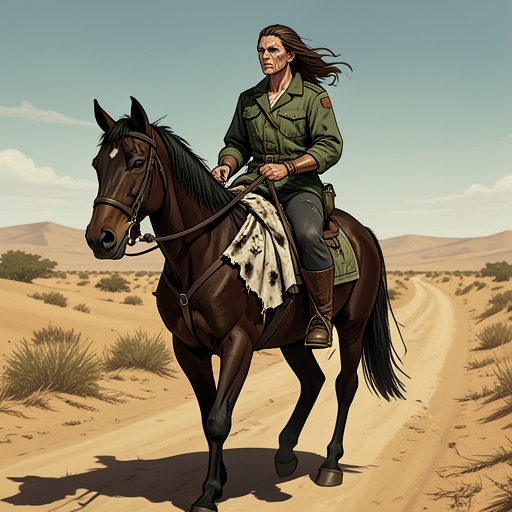
Sandor Clegane
A Feast for CrowsSandor Clegane, commonly called the Hound, is presented through conflicting reports as both a feared instrument of violence and a damaged man whose final suffering invites pity. He served Prince Joffrey as a sworn shield, fought without taking pride in service or joy in victory, and was driven above all by hatred of his brother, Ser Gregor Clegane. After Sandor’s collapse and disappearance, the riverlands fill with rumors that he has become an outlaw; the decisive correction comes from the Elder Brother, who says that Sandor died beside the Trident and that another scavenger committed the crimes attributed to him. His story therefore turns on the unstable boundary between a man, the name imposed on him, and the legend that outlives him.
Identity and Reputation
Sandor’s public identity is inseparable from the Hound, a figure associated with Prince Joffrey’s household and with fear. He had been Joffrey’s sworn shield for many years, and his deeds, whether good or ill, had become common knowledge even as far away as the Quiet Isle. The title reduces him to an image of menace, but the accounts surrounding him resist any simple division between monster and victim. He is remembered as someone who served without finding honor in service, fought without delighting in victory, and drank to drown pain rather than to celebrate triumph.
His defining hatred was directed toward his elder brother, Ser Gregor. The Elder Brother describes Sandor’s dream of killing his brother as the fuel that kept him alive, even though the hope itself was ignoble and morally terrible. That purpose was taken from him when Prince Oberyn of Dorne wounded Ser Gregor with a poisoned spear. Sandor’s violence thus had a private center: beneath the reputation of the Hound stood a man whose life had been organized around an inherited wound and the imagined completion of revenge.
Sandor and the Rumors of the Riverlands
Reports from the riverlands claim that Vargo Hoat’s remaining men are still abroad and that Beric Dondarrion has been hanging Freys. Within this dangerous landscape, Sandor’s name is attached to a savage raid on Saltpans. Survivors supposedly saw a roaring brute wearing a hound’s head helm; the story credited him with killing a dozen men and raping a twelve-year-old girl. The rumor is plausible because it fits the image already attached to him, and the Hound’s reputation makes the accusation travel faster than any certainty about the man himself.
The correction is exact rather than sentimental. The Elder Brother says he buried Sandor personally and can identify the grave. He covered the body with stones to protect it from carrion eaters and placed the helm atop the cairn as a marker. A later traveler took that marker for himself, turning the sign of Sandor’s grave into a false identity. The man responsible for the Saltpans crimes was therefore not Sandor Clegane, though the Elder Brother insists that the riverlands contain many scavengers who are dangerous enough without being mistaken for wolves or dogs.
This misidentification exposes how war manufactures reputations. A helm, a remembered silhouette, and a preexisting story are enough to make one man answer for another’s crimes. The Hound becomes less a verified individual than a transferable label, carried from corpse to corpse and attached to whatever violence the frightened survivors cannot otherwise explain.
The Broken Men and the War That Makes Them
The discussion of Sandor’s alleged outlawry occurs within Septon Meribald’s account of broken men. Meribald distinguishes ordinary outlaws from soldiers shattered by war. Singers may romanticize the outlaw who leaves the law to oppose a wicked lord, but many outlaws are greedy, malicious men who care only for themselves. Broken men are different: they deserve pity even when they remain dangerous.
Meribald describes how common-born men are taken from homes they have scarcely left, armed with sickles, sharpened hoes, or crude mauls made by lashing stones to sticks. Brothers march with brothers, sons with fathers, and friends with friends, carrying eager dreams of wealth and glory. Battle destroys those expectations. They watch relatives die, see friends trying to hold in their entrails, endure repeated wounds, hunger, ruined shoes, rotting clothes, and disease from bad water. When supplies fail, they steal boots, cloaks, and weapons from corpses, then begin stealing from living smallfolk whose former lives resemble their own.
The transformation is gradual but devastating. Soldiers slaughter sheep, take chickens, and eventually carry off daughters. Their kin disappear, their banner becomes unfamiliar, and home ceases to be a place they can reach. When armored knights charge them with what Meribald calls the iron thunder of battle, the man breaks: he runs, crawls over the dead, or hides in darkness. Survival narrows to a spoiled haunch of meat or bad wine enough to drown fear for a few hours. The broken man becomes more beast than man, and the traveler must fear him without forgetting the conditions that made him.
Sandor’s reputation is framed by this account without being reduced to it. The evidence does not establish that he became a broken man in Meribald’s technical sense, but it places his alleged crimes inside a society where war has produced countless displaced and brutalized survivors. The distinction between Sandor and the Saltpans killer matters precisely because the landscape is full of men who can plausibly wear his violence as a disguise.
Death, Mercy, and the Survival of the Hound
The Elder Brother says that Sandor died by the Trident after Prince Oberyn’s attack had already deprived him of the revenge he had lived for. Drawn by Sandor’s cries, the Elder Brother found him feverish and in pain. Sandor begged for the gift of mercy, but the Elder Brother was sworn not to kill again. Instead, he bathed Sandor’s brow with river water, gave him wine, and applied a poultice to his wound. Those efforts were too little and too late; the Hound died in his arms.
The account changes the meaning of Sandor’s death. He is not shown dying in the triumphant violence associated with his reputation, nor is he granted a redemptive victory over Ser Gregor. He dies helpless, asking another man to end his suffering, while the man who tends him refuses to kill but does not refuse compassion. His final scene replaces the Hound’s theatrical brutality with bodily weakness, failed treatment, and human care.
Yet the Hound does not disappear cleanly from the story. The Elder Brother’s warhorse, Stranger, remains in the stables. The horse had been found beside the river and is renamed Driftwood, since the original name is considered blasphemous. The animal still kicks and bites, and the Elder Brother fears that it has its former master’s nature. For Brienne, the horse becomes the concrete sign that confirms what she had not understood: Sandor Clegane is dead. Later, when Brienne hears that the Hound is dead and buried but insists that she saw him in the woods, the contradiction shows how quickly death becomes rumor and how stubbornly the Hound’s image continues to move through the riverlands.
Narrative and Thematic Significance
Sandor’s story is built through recollection and testimony rather than through a sustained direct viewpoint. Cersei remembers Joffrey’s fear and shame in connection with his brother’s name; Jaime speaks of kingslaying while confronting his own sin; and other characters encounter the consequences of war through stories about outlaws and broken men. These fragments surround Sandor with moral comparison. He is placed beside Joffrey’s cruelty, Ser Gregor’s violence, the common soldier’s collapse, and the compassion of the Elder Brother.
The most important contrast is between the name and the person. “The Hound” suggests a fixed nature, as though Sandor’s violence were an essence. The stolen helm reveals instead that the identity can be appropriated by another man. At the same time, the Elder Brother’s description preserves Sandor’s genuine darkness: he was a bitter, tormented sinner who found no comfort in service, victory, love, or forgiveness. The correction of the Saltpans rumor does not make him innocent; it makes judgment more precise.
Sandor therefore occupies an unsettling middle ground. He is neither the romantic outlaw imagined by singers nor merely the beast invoked by frightened witnesses. He is a man shaped by hatred, war, and suffering, capable of terrible deeds yet distinct from crimes falsely assigned to him. His death offers no conventional return or heroic restoration. What survives is the disputed legend, the grave whose marker was stolen, the warhorse named Driftwood, and the question of whether a feared identity can ever be separated from the damaged human being who bore it.