Small Council
A Feast for CrowsThe Small Council is the court’s central administrative forum, where the queen and her councillors convert royal authority into policy. Its decisive significance in these episodes lies in the gap between its formal appearance as a governing institution and its practical use by Cersei Lannister: she seeks to make every office answer to her, employs the council to remove enemies without public declarations, and exploits conflicts among Dornish law, royal succession, ancient precedent, the Night’s Watch, and the Faith of the Seven.
Composition and Control
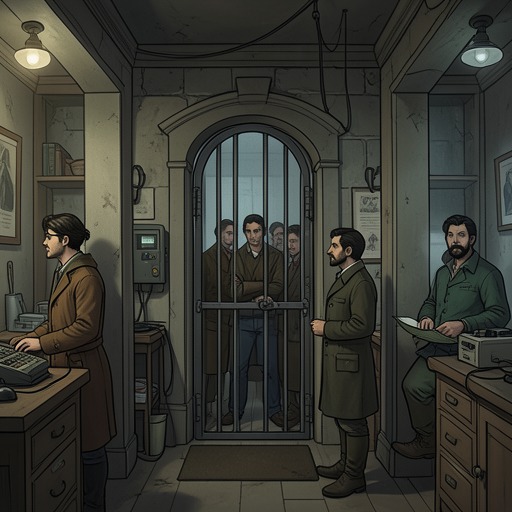
A Kingsguard knight stood outside the council chamber whenever the Small Council met. On one such occasion, Ser Boros Blount held the door while Cersei entered late and exchanged controlled pleasantries with the assembled councillors. The ceremonial setting suggested continuity and order, but Cersei’s private judgment of the gathering revealed a different reality: she believed she had uprooted the men beholden to her uncle and brothers and replaced them with figures whose loyalty would belong to her. Cersei also altered the language of office. Rather than retain the traditional titles that placed “masters” beside the queen, she gave her councillors new styles borrowed from the Free Cities, symbolically denying them an authority independent of herself. Orton Merryweather became justiciar, Gyles Rosby lord treasurer, and Aurane Waters, the young Bastard of Driftmark, grand admiral. Ser Harys Swyft became Hand of the King. Swyft’s appointment illustrates how the council’s personnel served as political leverage rather than evidence of competence. Soft, bald, obsequious, and delighted by his promotion, he was too dim to understand that he was effectively a hostage. Because his daughter was married to Cersei’s uncle, Kevan Lannister had an additional reason to hesitate before opposing the queen. The Hand therefore embodied Cersei’s governing method: a weak official could be useful precisely because family ties made resistance costly.
Policy as Personal Strategy
The council’s deliberations repeatedly transform public policy into private strategy. Qyburn proposed that King Tommen send one hundred men to the Wall, ostensibly to strengthen the Night’s Watch but in truth to remove Jon Snow from command. Cersei immediately understood the proposal’s concealed purpose and adopted it with satisfaction. The plan depended on appearing helpful while arranging an enemy’s death, allowing the queen to treat assassination as administration. She specifically preferred a dagger to an open declaration, because covert action would avoid the risks of naming the conflict publicly. This episode also shows the council operating through layered meanings. Qyburn presented an apparently charitable response to the Night’s Watch’s long-standing need for men; Cersei supplied the concealed political objective; and the resulting policy would make Jon Snow vulnerable while preserving the crown’s appearance of duty. The council thus became a place where official language masked coercive intent. The meeting also included reports that sailors from the east were speaking of dragons. The rumor entered the chamber as a seemingly minor matter raised by Aurane Waters, but its presence beside decisions about the Wall shows how the council was expected to register threats beyond the capital even while Cersei concentrated on immediate personal enemies. Its agenda could contain strategic intelligence, yet the queen’s attention remained shaped by her own contests for power.
Law, Succession, and Competing Authorities
The Small Council’s political world is not governed by a single uncontested law. The question of Myrcella Baratheon’s succession exposes the conflict between the customs of the Seven Kingdoms and the legal order preserved in Dorne. Tyene Sand argued that Myrcella, as older than her brother, should inherit the Iron Throne under Dornish law. The argument rested on the agreement made when King Daeron married Princess Myriah and brought Dorne into the kingdom: Dornish law would continue to rule in Dorne. Because Myrcella was physically in Dorne, that local law could be invoked as a direct political claim. The succession dispute also drew on historical precedent. When the argument that a son comes before a daughter was challenged, the counterexample was the first Viserys’s intention that his daughter Rhaenyra succeed him. Ser Criston Cole, the Lord Commander of the Kingsguard, had instead supported Prince Aegon, divided the Kingsguard against itself, and helped bring about the civil war later called the Dance of the Dragons. The historical episode supplied more than background: it demonstrated that questions of succession become wars when institutional officers decide that custom, ambition, or personal judgment overrides a designated heir. The same dispute connected hereditary rights to gendered authority. The claim that Myrcella was more fit to rule was answered with the assertion that a son came before a daughter, while the opposing argument asked why that rule should exist and whether a daughter should surrender her inheritance to younger brothers. The Small Council’s wider significance therefore includes its position at the intersection of written or inherited law, regional custom, royal command, and the political power to enforce one interpretation over another.
The Crown and the Faith
The council’s relationship with the Faith of the Seven developed through deliberate bargaining. When the High Sparrow invoked King Maegor’s laws, which had required the Faith to lay down its swords, Cersei rejected the assumption that an old royal decree remained binding merely because it was ancient. She insisted that Tommen was king now and suggested that Maegor’s laws could be undone. Her proposal was not initially an act of devotion; it was a calculated attempt to draw the High Sparrow into a bargain. The High Sparrow accepted the opening by advocating the rebirth of the Faith Militant and the restoration of the ancient orders of the Sword and Star. He presented armed religious authority as an answer to centuries of prayer and claimed that permitting it would prove Tommen a true and rightful king to every godly man in the Seven Kingdoms. Cersei welcomed the political effect while taking care not to appear eager, preserving the posture of a monarch granting a favor rather than a ruler seeking an alliance. Cersei then attached a financial demand to the religious concession. She reminded the High Sparrow that the crown owed the Faith 900,000 dragons, more precisely 900,674 dragons, and suggested that the debt might be forgiven if the old restrictions were set aside. The exchange turned religious restoration into a transaction involving sovereignty, armed force, and royal credit. It also demonstrated the council’s capacity to manufacture an emergency solution that transferred power away from the crown even as Cersei believed she was using the Faith for her own purposes. The later treatment of Ser Osney Kettleblack reveals the danger of that bargain. Cersei protested that the Faith had no right to condemn a man to death, but the High Septon answered that Osney’s alleged crimes had changed under interrogation and that he now denied ever touching Margaery Tyrell. The scene shows the authority Cersei had helped empower operating beyond her control: the council could authorize or negotiate institutional changes, but it could not guarantee that the revived religious power would remain subordinate to royal wishes.
Institutional Contrasts and Significance
The Small Council’s formal setting gives competing voices a common room, yet the episodes do not present it as a genuinely deliberative body. Cersei fills it with dependents, places Qyburn among the councillors after he has taken the position formerly associated with Varys, and uses familial vulnerability to restrain Kevan Lannister. Advice is welcomed when it confirms her preferred design, especially when a proposal offers concealment, leverage, or a new weapon against an opponent. At the same time, the council’s decisions expose the limits of centralized command. The succession debate cannot be settled by royal confidence alone because Dornish law and historical precedent provide rival claims to legitimacy. The Wall cannot be treated simply as a distant military institution because its commander is also a political target. The Faith cannot be safely revived as an instrument of the crown because religious law carries its own source of authority and its own capacity to punish. The Small Council therefore becomes a miniature of the realm’s larger constitutional crisis. Royal administration, regional law, military obligation, religious jurisdiction, debt, and private vengeance are repeatedly folded into the same deliberations. Cersei’s attempt to make the council an extension of herself produces short-term control, but it also multiplies the independent powers she must eventually confront. Its most consequential function is consequently double-edged: it concentrates decisions in the queen’s hands while creating policies whose effects escape the chamber and reshape the balance between crown, Faith, military orders, and competing claims to lawful rule.