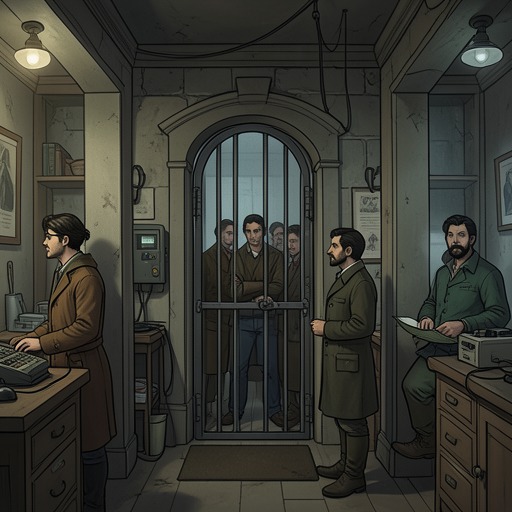
The Iron Bank of Braavos
A Feast for CrowsThe Iron Bank of Braavos is presented less as a visible building than as a distant institution whose power reaches into the finances and decisions of King’s Landing. Its decisive significance lies in the contradiction at the heart of the crown’s policy: a government burdened by Robert’s debts tries to preserve its immediate military power by withholding payment from the creditor most capable of making that delay costly.
A Distant Creditor with Immediate Power
The bank remains physically removed from the court, “far across the sea,” and this distance encourages Cersei Lannister to treat it as a problem that can be deferred. Yet the institution’s absence is not weakness. Its influence is measured through the crown’s anxiety over unpaid sums and through the caution of those who understand that credit can become a political weapon. The bank therefore operates in the narrative as an unseen power: it need not appear in King’s Landing to shape the Small Council’s choices.
The crown’s financial position is already strained by the legacy of Robert’s rule. Cersei acknowledges that crown incomes are substantial but insufficient to keep pace with Robert’s debts. Her proposed solution is not repayment or retrenchment, but suspension: she decides to defer the money owed to both the Faith and the Iron Bank of Braavos until the war ends. The bank is consequently placed inside a broader emergency economy in which military necessity is used to justify postponing obligations.
The Fleet and the Decision to Delay Payment
Aurane Waters proposes the construction of ten new dromonds as the beginning of a royal fleet. The proposal immediately exposes the conflict between military expansion and fiscal solvency. Pycelle asks where the coin will come from, while Lord Gyles Rosby’s coughing struggle to articulate the shortage makes the court’s financial weakness physically evident. Cersei resolves the dispute by directing that the money saved through delayed repayment be used for the new fleet.
The decision converts debt into naval power. Instead of allowing the crown’s revenues to service existing obligations, Cersei redirects them toward ships intended to strengthen the regime during wartime. Her policy is presented as a calculation of urgency: the fleet is a visible instrument of defense and control, whereas the bank’s claim appears distant and postponable. The choice nonetheless increases the danger that the crown’s military project rests on damaged credit.
The Warning of “Its Due”
Pycelle objects that the decision will cause more trouble than Cersei understands, explicitly naming the Iron Bank. Cersei answers with the Lannister maxim that debts will be paid, but she places repayment under her own timetable, insisting that the bank must wait respectfully. Her confidence depends on the assumption that distance gives the crown time and leverage.
Pycelle counters with the bank’s own saying: “The Iron Bank will have its due.” The repetition transforms a financial principle into a threat. Cersei’s phrase asserts aristocratic authority and control over timing; the bank’s phrase asserts an impersonal institutional certainty. The exchange creates an irony that the court cannot dispel through rhetoric: the crown may declare its intention to pay, but the creditor’s power lies in deciding whether postponement is acceptable.
Cersei nevertheless orders Aurane Waters to begin building the dromonds, and the instruction is accepted without resolving the underlying debt. The immediate consequence is a fleet program launched on borrowed credibility. The bank’s significance thus extends beyond accounting: its unpaid claim shadows the crown’s military ambitions and exposes the fragility beneath official confidence.
Debt as Political Leverage
The Iron Bank’s presence belongs to a wider pattern in which money, military force, and political authority cannot be separated. The crown needs coin to maintain the gold cloaks and to pursue war, yet the same revenues are inadequate even before new ships are commissioned. Delaying payment temporarily frees resources, but it also makes the government more dependent on force and more vulnerable to any creditor able to exploit its financial weakness.
The bank’s distant location sharpens this tension. Cersei imagines that remoteness protects the crown from immediate consequences, while Pycelle’s warning implies that institutional memory and financial reach can overcome geography. The scene gives the bank a nearly proverbial identity: it is not characterized through a named official or a displayed army, but through the certainty attached to its claim. Its power is the power to make a promise of repayment meaningful even when the debtor wishes to redefine the promise as postponement.
Narrative Significance
As a location, The Iron Bank of Braavos is important precisely because the narrative renders it through absence, reputation, and consequences. It stands outside the court’s walls, yet its debts enter the Small Council’s deliberations alongside fleets, armies, and royal succession. The bank’s unseen presence makes the political world larger than the immediate scene: decisions made in King’s Landing are constrained by an institution across the Narrow Sea.
Its confrontation with Cersei also establishes a contrast between personal rule and impersonal credit. Cersei relies on command, family reputation, and the promise that “A Lannister pays his debts”; the bank is represented by a maxim that promises collection regardless of a ruler’s confidence. The resulting tension gives the institution a role larger than that of a lender. It embodies the delayed but inescapable return of obligations that wartime power attempts to suppress.