Tyrion Lannister
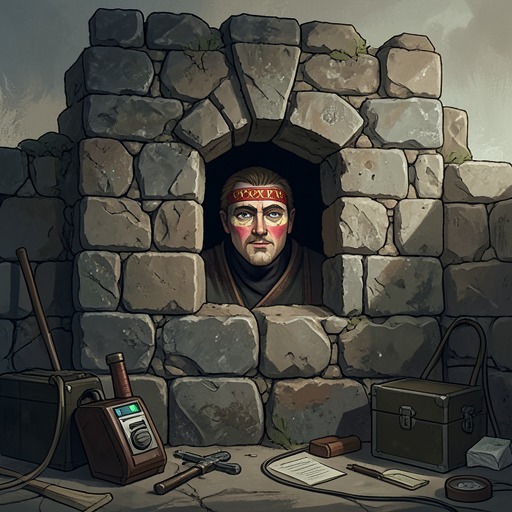
A Feast for CrowsTyrion Lannister, also called the Imp and the Halfman, is defined in this evidence less by physical presence than by the consequences of his disappearance. He is locked in a black cell, accused of killing King Joffrey Baratheon, and believed by Jaime Lannister to have killed their father, Tywin Lannister. Yet Tyrion’s last confrontation with Jaime complicates the charge: he admits the killing while also exposing Cersei Lannister’s sexual betrayals and the bitterness that has made him appear monstrous. His absence therefore becomes a political weapon, a family wound, and an unresolved question about guilt, motive, and loyalty.
Identity and Reputation
Tyrion’s public identities are built from hostile diminutives. The Imp and the Halfman reduce him to a bodily difference, while his enemies turn that difference into a moral judgment. In Cersei Lannister’s mind, the imprisoned dwarf is readily associated with treachery and murder, even when the immediate evidence does not establish his involvement. Her suspicion shows how completely Tyrion has become a ready-made explanation for danger: a hidden passage in the Red Keep leads her to imagine him crawling from behind a tapestry in Tommen Baratheon’s bedchamber with a blade in hand, although she also concedes that he is locked in a black cell and therefore could not have caused the present attack.
The contrast between imprisonment and imagined mobility gives Tyrion an almost Gothic presence. Cersei sees secret doors, concealed chambers, and a malformed figure moving through the castle’s hidden spaces; the architecture turns her fear into a physical image. Tyrion’s actual absence matters less than the symbolic role assigned to him. He is treated as the concealed enemy who might emerge from any unguarded opening, and his body is made into a shorthand for conspiracy, even when the castle’s own secrets point toward other possibilities.
The Murder of Tywin Lannister
The clearest account of Tyrion comes through Jaime’s sleepless recollection of their last exchange. Jaime remembers Tyrion grinning beneath the stub of his nose while torchlight played across his face, then speaking with calculated malice. Tyrion accused Cersei of lying and sleeping with Lancel Lannister, Osmund Kettleblack, and possibly Moon Boy; he also declared that he was the monster others claimed him to be and explicitly said that he had killed Tywin’s son. The confession is devastating because it joins a concrete admission to a wider indictment of the family’s hypocrisy.
Jaime’s memory preserves an important distinction. Tyrion never said that he had meant to kill their father. Jaime believes that, had Tyrion stated such an intention, he would have stopped him; in that imagined alternative, Jaime—not Tyrion—would have become the kinslayer. Tyrion’s words therefore leave motive unresolved while making responsibility unmistakable. The scene does not erase the murder, but it prevents the event from becoming a simple act of villainy. Tyrion accepts the fact of killing while forcing Jaime to confront the conditions, accusations, and family betrayals surrounding it.
The phrase that returns to Jaime is the Lannister principle that a debt must be paid. Jaime had used it when discussing the possibility of freeing Tyrion, regardless of whether Tyrion was innocent or guilty. The remembered confession makes that maxim unstable. A debt can mean punishment, family obligation, vengeance, or repayment for injuries long concealed. Tyrion’s disclosure turns the Lannister language of obligation against the household that claims to embody it.
Cersei’s Political Use of Tyrion
Cersei does not merely fear Tyrion; she deploys the idea of him. When Qyburn proposes sending a hundred men to the Wall ostensibly to reinforce the Night’s Watch but in truth to remove Jon Snow from command, Cersei immediately recognizes the value of concealed violence. She treats Tyrion’s supposed hostility as part of the broader threat landscape in which enemies should be dealt with by a dagger rather than an open declaration. Although Tyrion is not present in the council chamber, his reputation helps shape the queen’s political imagination: hidden enemies, secret movements, and lethal solutions all become easier to justify when associated with figures such as him.
Cersei’s assumptions about Tyrion also reveal the instability of her own reasoning. In the Red Keep, she first suspects Stannis Baratheon or the Tyrells when she finds the secret door near Tywin’s bedchamber, then returns imaginatively to Tyrion because he fits the role of the concealed monster. Her certainty is repeatedly interrupted by facts she cannot assimilate. The dwarf is imprisoned; the passage is real; Tywin is dead; and the castle contains more hidden routes than she understands. Tyrion’s name thus functions as both accusation and evasion, allowing Cersei to project danger outward while avoiding the deeper disorder within her family.
Relations and Narrative Function
Tyrion’s relationship with Jaime is marked by love, resentment, and an irreversible disclosure. Jaime’s decision to consider freeing him is framed through the family maxim that a Lannister pays debts, suggesting that obligation survives even where trust has collapsed. Tyrion’s final remembered words attack the family’s sexual and political deceptions, but they also address Jaime as someone capable of understanding the difference between intended murder and killing under pressure. Their exchange is consequently neither a reconciliation nor a clean repudiation. It is a brutal encounter in which the brothers remain bound together by blood, guilt, and competing interpretations of duty.
His relationship with Cersei is even more openly adversarial. Tyrion’s accusation that she has been sleeping with Lancel and Osmund Kettleblack strikes at the legitimacy of her authority as well as at her personal fidelity. Cersei’s hatred, in turn, makes Tyrion useful as a scapegoat for threats she cannot fully identify. The siblings mirror one another in their readiness to interpret the other as monstrous, yet Tyrion’s confession also makes him the one who names the concealed corruption beneath the family’s public image.
Tyrion’s significance extends beyond the Lannister household. Maester Aemon’s belief that Daenerys Targaryen fulfilled the prophecy of one born amid salt and smoke is repeated by Samwell Tarly, who contrasts her with Stannis Baratheon, Prince Rhaegar Targaryen, and the infant prince whose head was dashed against a wall. Tyrion is not part of that prophetic claim, but his absence belongs to the same network of displaced succession, contested legitimacy, and uncertain survival. Across the narrative, his name appears beside questions of kingship, hidden identity, and the limits of official judgment.
Absence, Guilt, and the Unresolved Ending
The evidence leaves Tyrion’s immediate fate unstated. He may have escaped by ship with Varys, sharing a flagon of Arbor gold in the cabin of a galley, but this is Jaime’s speculation rather than confirmed knowledge. That uncertainty is central to Tyrion’s narrative position. He is simultaneously a prisoner in Cersei’s account, a possible fugitive in Jaime’s imagination, and a confessed killer whose motives remain only partly disclosed.
His absence also creates a sharp contrast with the rituals and public crises surrounding him. Aeron Greyjoy revives Emmond through the kiss of life and presents return from death as proof of the Drowned God’s favor; Cersei presides over Tommen’s modest wedding to Margaery Tyrell while mourning Joffrey; and the ironborn gather at Nagga’s Hill to choose a new king after Balon Greyjoy’s death. Tyrion participates in none of these scenes directly, yet his unresolved status belongs to the same world of death, succession, and political re-creation. Unlike Emmond, he is not visibly restored; unlike a crowned king, he is not publicly reauthorized. He remains suspended between condemnation and escape.
The result is a character whose decisive power lies in what others cannot settle about him. Tyrion has killed Tywin, but the evidence does not supply a simple motive. He is called a monster, yet his accusations expose the monstrosity of those judging him. He is physically confined, yet he moves through the minds of queens, brothers, and political actors as an imagined conspirator. His story, as represented here, ends not with a public verdict but with an unstable conjunction of confession, flight, and family debt.