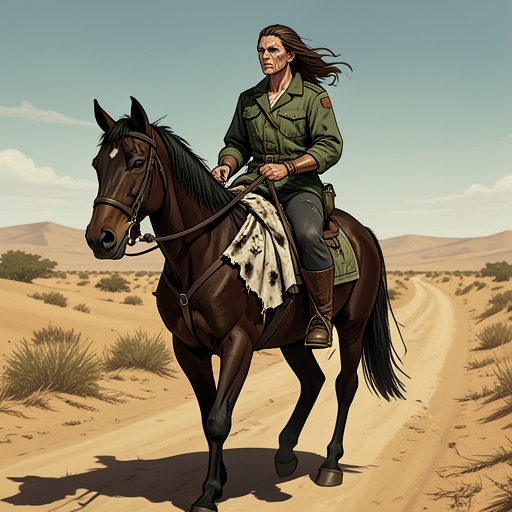
Westeros's postwar devastation
A Feast for CrowsWesteros's postwar devastation is the enduring condition left by the wars: a realm in which ruined buildings and abandoned fields coexist with returning trade, hurried reconstruction, new weapons, and violence that has entered ordinary life. Its deepest expression is the transformation of common people into “broken men,” but its consequences reach from village roads to the royal council, where recovery itself becomes a struggle over labor, money, authority, and force.
The Human Cost of War
Septon Meribald gives the clearest account of how the devastation is made. Most soldiers begin as common-born people who have scarcely traveled beyond their birthplace. Brothers march with brothers, sons with fathers, and friends with friends, carrying crude weapons such as sickles, sharpened hoes, or stones lashed to sticks. War first appears to them as an adventure promising wealth and glory, but battle replaces that expectation with hunger, wounds, exhaustion, and the sight of relatives and companions dying.
The damage is cumulative rather than confined to one defeat. A man may survive many battles and still break in the next. Lords who brought soldiers to war are killed, new commanders claim the survivors, wounds are reopened before they heal, shoes disintegrate on the march, clothing rots, and bad water produces illness. The soldiers gradually lose the protection of a recognizable home and banner. Their friends and kin disappear, strangers surround them, and the lord for whom they fight does not know their names.
Once ordinary means of survival fail, violence becomes habitual. Soldiers take boots, cloaks, and helmets from corpses, then steal from living smallfolk whose former lives resemble their own. They slaughter livestock, seize food, and eventually carry off women. When the knights charge, the accumulated terror turns the soldier into someone who runs, crawls away over corpses, or hides in darkness. Home, kings, lords, and gods recede behind the immediate need for spoiled meat or bad wine. The broken man lives from meal to meal, “more beast than man,” and remains dangerous even while deserving pity.
Ruined Landscapes and Uneven Recovery
The countryside bears the same history in material form. Jaime Lannister rides through riverlands where scarcely a field remains unburned, a town unsacked, or a woman untouched by predation. At the lands of the Wode brothers, only blackened beams remain of the halls, and no members of the family or smallfolk appear. Outlaws shelter beneath one ruined keep in a root cellar, showing how destroyed estates become refuges for displaced and violent men.
The devastation is not irreversible, but recovery is visibly provisional. Maidenpool, once a desolation of empty streets and burned homes, has begun to revive. Burned structures have been removed; vegetables grow in former building lots; merchant tents and knights' pavilions fill other spaces; new houses rise; a stone inn replaces a wooden one; and the town sept has received a new slate roof. The sounds of saws and hammers accompany the rebuilding, while soldiers are put to work instead of being left idle. The harbor has also regained movement, with traders, a galley, a galleas, a large cog, and fishing boats returning to port.
Other settlements show how fragile such renewal remains. Darry has changed hands repeatedly, suffered a burning, and been sacked at least twice, though its gates, stable, steps, and window shutters are being replaced. Within its walls, however, military occupation and social fear persist: crossbowmen patrol the ramparts, armed peasants carry scythes, staves, hoes, and axes, and men marked with red seven-pointed stars mingle with the garrison. Reconstruction therefore does not restore the prewar order. It produces defended, suspicious communities in which the boundary between civilian and combatant has blurred.
Authority, Justice, and Militarization
The political response to ruin is contradictory. Jaime Lannister presents the execution of an outlaw wearing the remains of a crimson cloak as justice, yet the act takes place amid a landscape where war has erased lawful institutions and left no Wode family or local population to govern. His satisfaction reveals how easily punishment can substitute for restoration: hanging a survivor of the wreckage offers a momentary sense of order without repairing the conditions that created it.
The royal government responds to insecurity by seeking more force. Aurane Waters proposes beginning with ten new dromonds to create a fleet of the crown's own, even as Pycelle asks where the money will come from and Lord Gyles can scarcely speak through his coughing. The proposal turns postwar weakness into an argument for naval expansion, while the unresolved question of payment exposes the fiscal ruin beneath the military ambition.
The same crisis enables the restoration of the Faith Militant. The High Sparrow describes the reborn orders of the Sword and Star as an answer to centuries of prayer and promises that the Warrior would cleanse the sinful realm. His appeal presents armed religion as both spiritual renewal and a source of legitimacy for King Tommen. Cersei Lannister, meanwhile, tries to use that restoration to secure forgiveness of the crown's debt to the Faith, estimated at 900,000 dragons and corrected to 900,674. Devotion, debt, and armed authority thus become inseparable parts of the postwar settlement.
Memory, Responsibility, and the Realm's Future
The devastation is contested through competing explanations. The High Sparrow has walked among villages that once depended on him for marriages, absolutions, and the naming of children; those villages have vanished, their gardens replaced by weeds and thorns and their roadsides littered with bones. Cersei Lannister attempts to assign such atrocities to northmen, Lord Stannis, and demon worshipers, but the accusation is complicated by reports of “bands of lions” and by crimes committed by the Hound, once sworn to her own house. The ruined realm therefore resists a simple division between innocent victims and a conveniently named enemy.
Meribald's testimony supplies a counter-history to noble accounts of campaigns and banners. It follows the ordinary soldier from eager enlistment through deprivation, bereavement, moral disintegration, and homelessness, then insists that pity and fear must coexist. His own past gives the account personal authority: he was taken to war too young, followed his brothers, and lost them through fever, a mace blow, and the consequences of wartime rape. The devastation is consequently not only what can be seen in burned buildings. It is also what remains in survivors who no longer possess a home, a stable identity, or a credible way back.
The postwar realm is therefore caught between repair and reproduction. Soldiers rebuild Maidenpool, but armies still occupy settlements; trade returns, but roads remain nearly empty and dangerous; rulers seek ships and money, while councils fracture and regencies are contemplated; the Faith offers moral purification through armed orders, while its own leaders recount the suffering of the poor. Westeros's postwar devastation matters because it shows that the end of a campaign does not end war's effects. Ruin persists in the land, in institutions, in memory, and in the habits of people forced to survive after the banners have moved on.