
The Compass and Chance
A Journey to the Centre of the EarthThis thread traces how chance, storm, magnetism, and later observation shape the expedition’s understanding of its route.
increasing Bearing strength in each event
 decreasing
Bearing strength in each eventdecreasingA Route Estimated by Instruments

A Route Estimated by Instruments
Direction and distance
Professor Hardwigg records compass readings and estimates the party’s depth and horizontal distance. Henry uses maps to infer that the travelers have moved beneath the sea and far from Iceland.
These calculations offer an intelligible route through spaces the explorers cannot see from above. Yet they rely on instruments functioning consistently and on the party maintaining reliable records.
Precision has conditions
The travelers can calculate only from the observations they possess. A missing reading or unrecognized change in the compass may affect the entire reconstruction.
The narrative treats measurement as powerful but conditional, not as a guarantee that the explorers know exactly where they are.
The Storm’s Unrecorded Course
The Storm’s Unrecorded Course
Observation interrupted
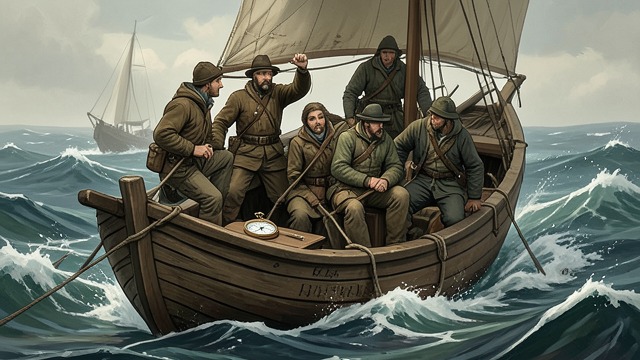
The storm is so violent that the travelers cannot maintain ordinary records of direction, speed, or time. The raft races across the sea while wind and water prevent clear communication.
Professor Hardwigg’s customary measurements are unavailable precisely when the route changes most dramatically. The storm replaces calculated navigation with endurance and chance.
An uncertain landing
When the party reaches shore, they cannot immediately determine how far they have been carried. Their earlier estimates provide a starting point, but several days of unrecorded motion make their actual location uncertain.
The absence of data becomes a narrative event in its own right: the explorers must reconstruct what they could not observe at the time.
The Compass Points Back

The Compass Points Back
A startling bearing
Professor Hardwigg checks the compass and sees the needle point toward the shore, contrary to the direction he expected. He concludes that the storm has carried them back across the Central Sea.
The reading overturns his earlier estimates and produces a sharp conflict between intention and apparent location. The travelers treat the compass as reliable because it has previously guided them.
A wrong conclusion from a real reading
The compass is not damaged in the ordinary sense, but its magnetic behavior has changed. The travelers do not yet understand that the storm’s electrical globe has altered the needle’s polarity.
The device’s reading is genuine while the assumption used to interpret it is wrong.
The Magnetic Cause
The Magnetic Cause
A clue carried forward
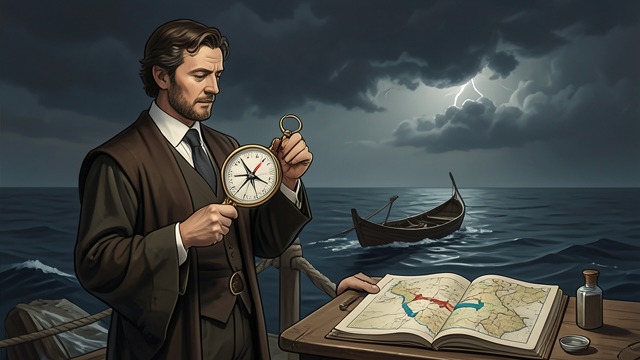
The compass points in a way that the travelers cannot reconcile with their apparent surroundings. Professor Hardwigg’s uncertainty persists even after the shore exploration reveals Saknussemm’s passage.
The storm’s fireball had passed across the raft and magnetized iron equipment. At the time, its extraordinary effects were experienced as immediate danger rather than recorded as an explanation of the compass.
Cause separated from effect
The later account links the storm’s electrical event to the altered bearing. The compass is therefore not merely a navigation tool; it is evidence of an earlier physical event whose significance became clear only afterward.
The delay between cause and interpretation shows how discovery may depend on revisiting an observation after circumstances change.
The Explanation at Home

The Explanation at Home
A lingering anomaly
The compass continues to trouble Professor Hardwigg after the travelers return. Public recognition does not satisfy him while a central detail of the route remains unexplained.
Henry examines the instrument and notices that its needle points south rather than north. He recalls the storm’s electrical globe and understands that it reversed the compass’s poles.
Knowledge restored through hindsight
The discovery reassures the Professor and makes the expedition’s confusing return route intelligible. An observation ignored or misunderstood during danger becomes useful in the calmer setting of home.
The final explanation gives the story a modest scientific resolution without claiming that every underground phenomenon has been solved.
From the early tunnel descent through the approach to the Central Sea
August 21 through the storm’s end
The morning after the Central Sea shipwreck
After the storm, before the party reaches the volcanic escape
Six months after the expedition, in the Professor’s study
