
The Expedition’s Instruments
A Journey to the Centre of the EarthThis thread traces how scientific tools promise to measure and illuminate the underground world, then prove limited, damaged, or misleading.
increasing Bearing strength in each event
 decreasing
Bearing strength in each eventdecreasingA Kit for the Unknown
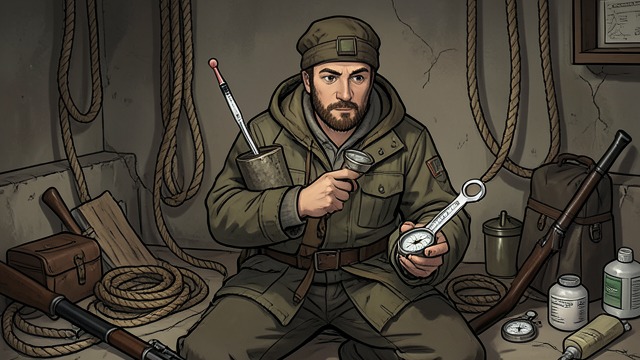
A Kit for the Unknown
Instruments carried below
Professor Hardwigg equips the expedition with a thermometer, pressure instruments, compass, chronometer, electric lamps, and geological tools. The equipment expresses a belief that careful measurement can make the unknown legible.
The party also carries ropes, weapons, provisions, and medical supplies, combining scientific observation with practical survival. Yet its preparations already contain assumptions, especially the expectation that underground water will soon be available.
Confidence and vulnerability
The instruments are carefully selected but cannot predict every hazard or guarantee the party’s route. Their usefulness depends on power, careful handling, and correct interpretation.
The expedition begins with tools that signify mastery while its most basic resource remains uncertain.
Readings in the Shaft
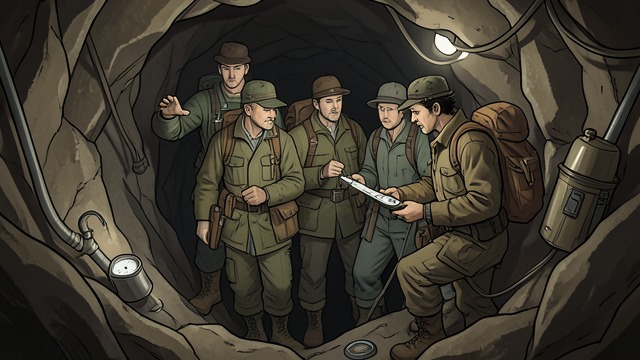
Readings in the Shaft
Measurement gives position
The travelers consult their instruments after reaching the bottom of the first shaft. The barometer suggests they have descended to approximately sea level, prompting Professor Hardwigg to revise how he describes their progress.
The thermometer and later pressure readings support estimates of depth and atmospheric conditions. Measurement helps the explorers distinguish a vertical descent from movement through a more horizontal tunnel.
Numbers need interpretation
Henry and the Professor draw different conclusions from the same readings about heat and the earth’s interior. The instruments report conditions, but theories decide what those conditions mean.
Their observations make the journey more precise without making its scientific interpretation uncontested.
Electric Light Underground

Electric Light Underground
A portable day
The Ruhmkorff electric lamp illuminates the tunnel, allowing the travelers to inspect lava, crystals, and rock formations. The device makes a landscape of darkness available to observation while avoiding the danger of open flame in combustible gases.
Light encourages scientific attention and gives the explorers practical confidence as they move through unfamiliar passages. Its steady use makes the underground journey possible in places where ordinary daylight cannot reach.
Dependence on a device
The lamp remains vulnerable to damage and power failure. When Henry becomes lost, its failure intensifies the crisis, and later catastrophe destroys much of the expedition’s equipment.
Technology extends human perception but cannot make the environment safe or promise that the extension will remain available.
A Compass Misleads
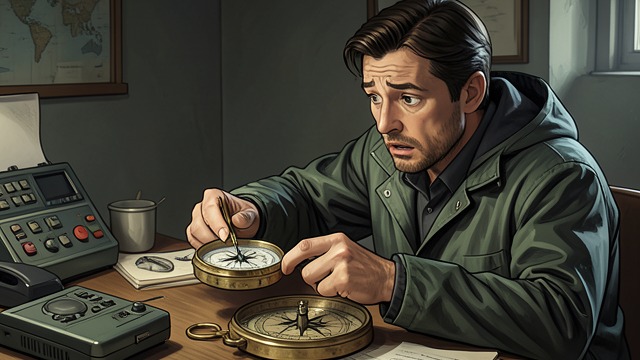
A Compass Misleads
An instrument contradicts expectation
After the storm, Professor Hardwigg checks the compass and finds that the needle points toward the shore rather than along the expected course. He concludes that the raft has been driven back across the sea.
The instrument seems precise, but the reading conflicts with their intended route and the assumptions used to estimate their position. Its authority becomes a source of fresh uncertainty.
A delayed explanation
Six months after the return, Henry notices that the compass now points south. He connects the change to the electric globe that magnetized iron aboard the raft during the storm.
The compass’s apparent failure becomes understandable only through a later inspection, showing that tools can preserve a record of environmental events while also distorting navigation.
The Lost Apparatus
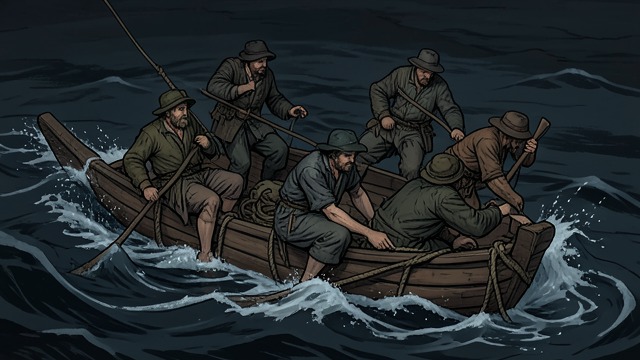
The Lost Apparatus
Measurement gives way to endurance
The explosion and ensuing flood destroy or scatter most of the expedition’s equipment. The travelers retain few instruments as the raft is swept through darkness and rising water.
Professor Hardwigg’s plans had relied on measurements, maps, and carefully packed tools. In the flood, the party’s immediate task is to hold on and survive, not to record a precise route.
Limits of scientific control
The instruments cannot stop the torrent or calculate a safe escape from it. The survivors reconstruct their position only after reaching the surface and reconsidering the compass’s behavior.
The loss of apparatus does not erase the value of observation, but it reveals that scientific inquiry depends on fragile material conditions.
The final packing before leaving Reykjavik
On the morning after the descent through the shaft
June 29 and 30, during the initial tunnel exploration
From the post-storm survey to the examination six months later
During the August 27 flood and the ascent that follows
