Coal period
A Journey to the Centre of the EarthThe Coal period is presented as a passage in geological time made visible beneath the Earth: the travelers recognize it first as a blackened stratum, then encounter a cavern whose walls preserve the sequence of its formation. The narrator turns that underground landscape into a natural archive, describing the heat, vegetation, burial, and chemical change through which coal accumulated. The period also belongs to the novel’s larger movement through deep time, where changing rocks and fossil life make the Earth’s past appear as a route the expedition can physically traverse.
Recognition in the strata
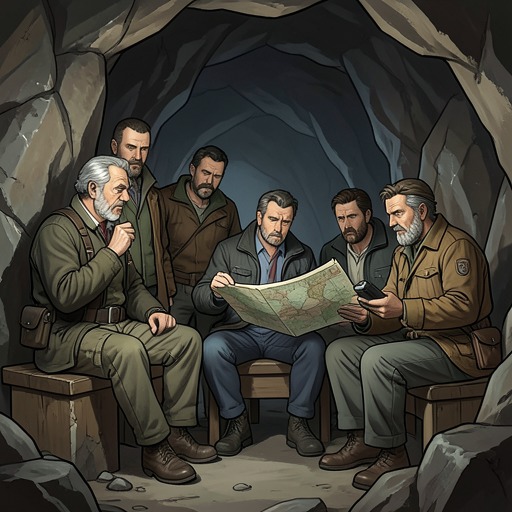
The transition becomes unmistakable when the narrator leans against a narrow stretch of dark tunnel and withdraws his hand blackened. The rock that had reflected the lamps has given way to coal, and he identifies the formation as the Coal period. This is not an abstract label imposed on an unseen past: the traveler’s soot-darkened hand supplies immediate, bodily evidence. The recognition follows the earlier passage through transition rocks and fossil-bearing marble, where the narrator had read changes in the strata alongside changes in animal life. His route through the tunnel thus becomes a sequence of geological classifications, each new material revising the age and character of the ground around him.
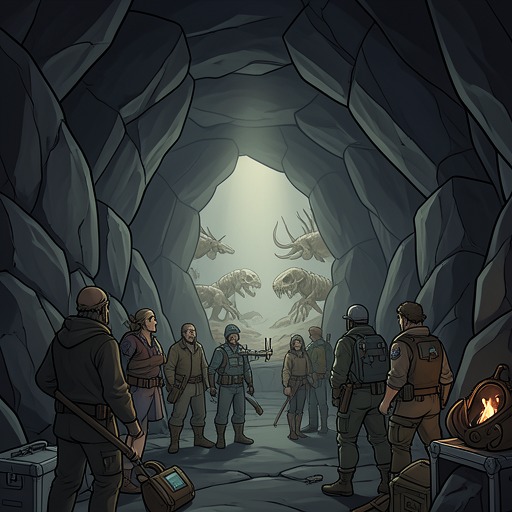
The next morning, after a night of thirst and poor rest, the party advances again. Twenty minutes into the march, the tunnel opens into a vast natural excavation, roughly a hundred feet wide and a hundred and fifty high. Its scale rules out an ordinary mine: the narrator judges that human excavation could not have produced such a space without bringing down its roof. Instead, he imagines a violent subterranean upheaval splitting the Earth apart. The cavern gives the Coal period an architectural presence: the travelers are not merely passing a seam but entering a rupture in which the history of the formation is exposed.
A landscape that records its making
The cavern walls, in the narrator’s reading, preserve the phases of the Coal period. Coal seams alternate with sandstone and compact clay, the latter appearing compressed by the weight above. The visible layers serve as evidence from which a geologist could reconstruct the sequence of deposition and pressure. What had first registered as darkness and obstruction becomes legible as an ordered record; the party’s descent turns geological structure into something encountered at human scale.
The narrator explains the ancient environment as one of enormous vegetation sustained by tropical heat and persistent humidity. A dense atmospheric vapor surrounded the Earth and kept the Sun’s rays from reaching the surface; climates had not yet developed, and, in his account, uniform heat extended from pole to equator. He considers whether that heat came from within the Earth and declares that a fierce internal fire was active in its depths. Plants without sunlight had no buds, flowers, or fragrance, yet their roots drew vigorous life from the heated ground. The narrator describes the vegetation not as a modern forest but as immense herbaceous growth, turfs, briers, and mosses, with relatively few plants that could be called trees.
Coal’s origin follows from this abundance and from the transformations recorded in the strata. The narrator links the plants’ growth to a crust repeatedly disturbed by the seething mass beneath it: fissures opened and upper layers collapsed. Plant matter accumulated under water, first becoming turf and then, through gases and subterranean fermentation, undergoing mineralization. The coal seams in the cavern are therefore the material consequence of an ancient living world, transformed by burial and geological processes into fuel.
Deep time, evidence, and scale
The passage places the cavern within a much larger chronology assembled through observation. Earlier in the same underground journey, the narrator identifies a transition in the rock and sees fossils that seem to mark a more developed order of animal life than the trilobites encountered before. The Coal period then presents another kind of evidence: not a single fossil specimen but immense layers of transformed vegetation. Together, the changing strata and their contents make time spatially traversable. The travelers move through formations that the narrator reads as successive stages in Earth’s history, while the reader encounters that history through the changing surfaces of the tunnel.
The novel’s geological imagination also sits beside nineteenth-century disputes about the antiquity of life and humanity. Before the expedition, Professor Hardwigg had been engaged in the debate over the Moulin-Quignon jawbone, found fourteen feet below the soil with stone tools and carved flints. The authenticity and age of the find were contested, and the narrator recounts how further human remains and worked objects were being used to argue for a much older human past. He says that some geologists assigned humanity an antiquity of more than a hundred thousand years, placing human beings before the mastodon and alongside ancient animals. That debate is distinct from the Coal period’s account of plant matter becoming coal, but both make deep time a question of how material traces are interpreted: a layer, fossil, or worked bone must be read before it can support a claim about the past.
In this way, the Coal period is not only a setting on the expedition’s underground route. It is an extended demonstration of geological reasoning in narrative form: touch identifies the coal, the cavern’s dimensions suggest a natural rupture, its layers invite reconstruction, and the narrator’s account connects those visible remains to an ancient environment. The sequence also places scientific explanation under pressure from experience. Professor Hardwigg elsewhere insists that facts can overrule theories, while the expedition’s observations repeatedly give abstract geological claims a tangible form. The underground archive is both evidence and spectacle, asking the reader to imagine the immense processes that a blackened hand and a wall of seams make visible.
Buried abundance and human use
The coal in the cavern is abundant but, the narrator concludes, almost certainly unusable as a commercial resource. Its deposits lie deep within the Earth, and mining them would cost more than their extraction could repay. The contrast is pointed: the layers are immense enough to seem inexhaustible, yet their very depth makes them inaccessible to ordinary industry. In the narrator’s view, the world already offers coal close to the upper crust, so the underground reserves can remain untouched.
He extends that contrast into a prediction about consumption, estimating that the world’s coal reserves would be exhausted in about three centuries if people found neither more economical lighting than gas nor a cheaper source of motive power than steam. The estimate is part of the novel’s historical voice, not a timeless scientific conclusion. It connects the imagined ancient accumulation to the industrial uses of the narrator’s own age, making the cavern’s remote vegetation relevant to contemporary energy consumption. The Coal period thus joins two scales that the expedition’s descent brings into contact: the vast duration required to form the seams and the comparatively brief span in which human industry might consume them.