Discovery of the prehistoric human remains
A Journey to the Centre of the EarthThe discovery of the prehistoric human remains is the expedition’s sudden encounter with a human body in a subterranean fossil field, where the explorers have just entered a vast accumulation of ancient life. For Professor Hardwigg, the recognizable skull and remarkably preserved body transform an abstract dispute about human antiquity into an object that can be seen and touched. The find links the underground journey to contemporary debates over whether humans lived alongside prehistoric animals, while the explorers’ own reactions reveal how powerfully physical evidence can unsettle established expectations.
Setting: A Landscape of Deep Time
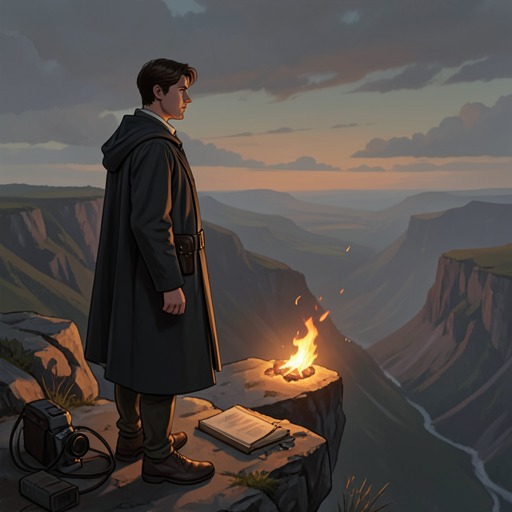
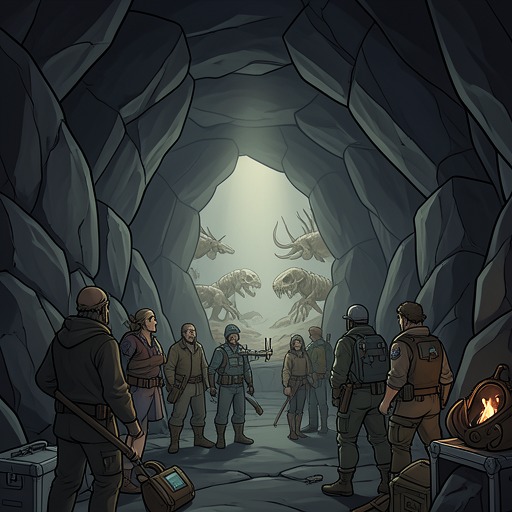
The discovery follows a marked change in the terrain. After tracing the Central Sea’s edge for about a mile, the explorers reach ground that appears violently upheaved: hollows and hillocks break up the landscape, and they struggle across fractured granite mixed with flint, quartz, and alluvial deposits. Then a plain of bones opens before them, an immense cemetery whose barrows extend toward a distant horizon obscured by brown fog. The landscape makes geological disturbance legible as a physical scene, with the uneven ground and scattered remains suggesting an older history beneath the familiar surface of the Earth.
The bone field is described as roughly three square miles in extent and as containing nearly the whole history of animal life. Its scale overwhelms the ordinary business of collecting specimens: the explorers walk over fossil remains that museums prize even in rare fragments, while the narrator imagines that a thousand naturalists like Cuvier could not reconstruct the full range of organisms represented there. The place is not merely a store of curiosities. Its immense accumulation gives the explorers the impression of generations of life gathered into one landscape, making the past seem present and materially accessible.
The Human Remains
Amid the animal fossils, Professor Hardwigg suddenly picks up a skull and recognizes it as human. He calls Harry’s attention to the discovery; Harry is as astonished as his uncle. The Professor’s excitement is not simply a response to an unusual specimen. The explorers have reached a point where a human presence in the deep past, previously encountered in scientific arguments, appears before them as a physical body.
They advance about twenty yards and find a human skull that the narrative identifies as belonging to the Quaternary period. It is recognizable and unusually well preserved: the skin is stretched and parchment-like, the teeth remain intact, and abundant hair is still visible. Harry wonders whether a soil of an unusual kind might have preserved it for countless ages, but he cannot answer the question. The remains thus provide a striking observation without settling the precise process that produced their condition.
For a time, neither explorer can speak. They raise the body and set it upright; to their excited imaginations, its hollow eyes seem to look back at them. The scene’s force lies in the confrontation between an ancient human presence and the two living observers. The Professor, usually talkative, is temporarily silenced by the discovery; when he recovers, scientific excitement displaces the immediate circumstances of the journey. The find has changed the explorers’ attention from the vast cavern around them to the history embodied in the remains.
The Contemporary Scientific Dispute
The narrative places this underground discovery beside a recent controversy over human fossils. On March 28, 1863, workers in the Moulin-Quignon quarries near Abbeville, France, found a human jawbone fourteen feet below the ground, accompanied by stone hatchets and worked flints. The report circulated across France, England, and Germany. Supporters, including Milne-Edwards and De Quatrefages, argued for the bone’s authenticity, while other prominent geologists accepted the find as evidence of human existence in the Quaternary period.
The claim remained contested. Elie de Beaumont argued that the Moulin-Quignon soil belonged to a less ancient stratum than the diluvium and rejected the idea that humans had lived alongside Quaternary animals, in keeping with Cuvier’s position on that question. Professor Hardwigg had joined the majority who defended the older dating and argued against de Beaumont. The narrative also reports that further jawbones found in the sands of caves in France, Switzerland, and Belgium, alongside tools and remains of people of different ages, strengthened the case for Quaternary humanity. These details establish why Hardwigg greets the underground body not as an isolated oddity but as a discovery with consequences for a live scientific debate.
The text extends the debate further back in time through evidence then attributed to Tertiary or Pliocene deposits. These finds were not human bones, but fossil animal bones that appeared to have been shaped by human hands. The narrative presents this material as part of a changing scientific picture in which some scholars assigned humanity an antiquity exceeding one hundred thousand years, placing humans before the mastodon and alongside the southern elephant. This is the period’s scientific framework as the story presents it, not a claim that the novel establishes as modern consensus. Against that background, the body in the bone field appears to Hardwigg to carry exceptional weight: it seems to make visible the question that the earlier discoveries had raised.
Proof, Interpretation, and the Professor’s Response
Hardwigg’s first response is wonder: he stands with his arms raised toward the granite vault, unable for a time to speak. Once he begins to address Harry, he invokes the scientific controversy and insists that the evidence before them should rule out doubt. His case rests on direct observation: the body is present, visible, and tangible, and it is not merely a skeleton but a complete, preserved human form. The remains therefore function in the scene as more than an object to classify; they become the basis for a forceful claim about what scientific inquiry must acknowledge.
That conviction does not mean every question has been answered. Harry has wondered how the body could have been preserved, and the Professor proposes that, if he had sulfuric acid, he could remove the earthy particles and the shells incrusted over it. He has no such solution with him, but he believes the body will disclose its own history. The distinction between what the explorers can observe and what they can explain remains important: the human identity is apparent to them, while the conditions and duration of preservation are left unresolved.
The discovery also reverses the usual distance between scientific authority and evidence. Earlier in the journey, Harry’s geological observations and measurements have brought him into disagreements with his uncle over what theory predicts and what the senses report. Here, both recognize a human body, but Hardwigg’s excitement turns observation into a public argument, as though he were addressing learned colleagues and pupils. The scene’s claim is vivid but situated: it records what the explorers believe the remains demonstrate within the scientific debate described by the narrative.
Significance in the Expedition
The human remains give the fossil field a sharper meaning. Before the skull appears, the plain represents the accumulated history of animal life; with it, that history includes a direct human presence. The explorers’ movement across fractured strata and fossils has led them into a landscape where the time of geology is no longer only inferred from rock and specimen. It is encountered in the recognizable form of a human body, making the expedition’s passage through deep time personal as well as scientific.
The event’s significance also comes from the contrast between scale and intimacy. The bone plain extends for miles and contains a record too extensive for naturalists to reconstruct, yet the decisive discovery is a single skull found in Hardwigg’s hands. The vast cemetery supplies the context; the individual remains concentrate its meaning. For Hardwigg, the find appears to vindicate his commitment to the antiquity of humanity, while Harry’s unanswered question about preservation keeps observation distinct from complete explanation. The scene consequently makes the subterranean world both a field of discovery and a test of how far evidence can carry scientific conclusions.