Escaped from the earth's core by volcanic eruption and reached Stromboli
A Journey to the Centre of the EarthThe expedition’s escape from the Interior of the Earth turns a volcanic eruption from an apparent death sentence into its only means of return. Carried upward on a raft through a conduit filled first with water and then with eruptive matter, Harry, Professor Hardwigg, and Hans survive a violent ascent and emerge at Stromboli, more than twelve hundred leagues from Sneffels. The ending reverses the expedition’s direction and scale: the party that entered the earth through one volcano is expelled into daylight by another.
The eruption becomes an escape route
The turning point comes when Professor Hardwigg identifies the force carrying the party upward as an eruption. Harry hears the diagnosis as a sentence of imminent destruction: he imagines the travelers being hurled from a crater among burning lava, rocks, cinders, and scoriae. The Professor instead calls the eruption their one remaining chance to escape the Interior of the Earth. His composure does not make the danger less real; it changes what the danger means. A process that should destroy them may also return them to the surface.
The Professor’s confidence echoes an earlier difference between his reliance on scientific authority and Harry’s insistence on what observation appears to show. Harry had objected that scientific teaching made a journey into the earth impossible, citing the expected rise in temperature with depth. Later, he challenged the Professor with geological limits, the predicted heat at their depth, and the fossils and shell they encountered. The eruption reverses the terms of that dispute without resolving every scientific question: the party’s survival depends not on a settled theory of the earth, but on reading the particular conditions of the passage. Earlier, the Professor had treated the volcano’s ordinary vapor activity as evidence that an immediate eruption was unlikely; now an active eruption supplies the route out.
The ascent through the volcanic conduit
As the party rises, Harry distinguishes the mounting heat from the general increase in temperature he had expected with depth: he attributes it to local volcanic action. The force of the ascent, he recognizes, comes from vapor accumulated and compressed below, exerting hundreds of atmospheres. The vertical gallery widens, dark corridors open to either side, and vapor pours from them; flashes of fire make the upward passage seem as dangerous as the depths they have left.
The water carrying the raft eventually disappears. Professor Hardwigg explains that a paste of lava has taken its place, lifting the travelers along with it toward the crater mouth. The air becomes nearly unbearable, with the temperature estimated between 189 and 190 degrees Fahrenheit. The raft is not simply riding a steady current: the volcano erupts intermittently, and Professor Hardwigg says they must breathe as it does. After a pause, the upward heave resumes at the minute he predicts, forcing the travelers to cling to the raft’s beams. He infers that they are in an accessory conduit, receiving the countershock of the principal channel, rather than in the volcano’s main chimney.
The ascent overwhelms Harry. He becomes delirious, and Hans’s powerful arms keep him from striking his head against the granite of the shaft. In his confused recollection, detonations shake the rock, the raft spins on hot lava, cinders fall around them, and flames wrap the party. The narration breaks off into lost time and an image of Hans surrounded by fire; the return to consciousness comes only after the ordeal has carried them to the crater’s flank.
Daylight, rescue, and the island’s name
When Harry opens his eyes, Hans has one hand gripping his belt and is supporting Professor Hardwigg with the other. Harry is bruised, but alive. He lies on a mountain slope less than two yards from a yawning gulf, where a small misstep could have killed him. Hans has saved him while he was insensible. Professor Hardwigg, by contrast, appears almost displeased to find himself back on earth, a final contrast between the guide’s practical rescue and the Professor’s single-minded investment in the journey.
The landscape establishes that the travelers have not merely escaped the shaft but reached an inhabited, fertile world. Above them, a crater periodically throws out flame, pumice, cinders, and lava with loud explosions; below, eruptive material slopes toward groves containing olives, fig trees, and grapevines. After the travelers ask a shepherd the island’s name, he answers, “Stromboli,” and runs off. That name transforms their uncertain location into recognition: they have reached a volcanic island in the Mediterranean, far from the Icelandic entrance to their subterranean route.
Return to the surface and its consequences
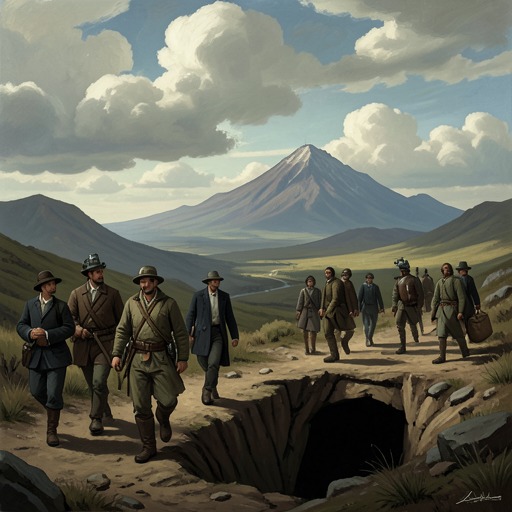
The party’s arrival at Stromboli gives geographical form to the journey’s reversal. They entered the earth through a volcano at Sneffels and emerged through another, more than twelve hundred leagues away. Harry contrasts the region of perpetual snow they had left with the greenery and blue Sicilian sky around them. Their passage has not followed a conventional return route across the underground world; the eruption has transported them from its depths to a distant surface landscape.
After eating fruit and drinking fresh water, they continue toward Stromboli’s port. They decide not to explain how they arrived, fearing that the superstitious inhabitants might take them for demons vomited from the infernal regions. Instead, they pass as unfortunate shipwrecked travelers. The expedition is therefore completed not by a public account of its extraordinary passage, but by a practical disguise suited to ordinary life on the island. The volcano that threatened to annihilate them has delivered them to safety, but the survivors conceal the very means of their return.