Fourth period
A Journey to the Centre of the EarthThe Quaternary is the geological period that gives the explorers’ subterranean discoveries their most consequential human dimension. In the novel, it is not merely a label for an ancient layer of time: it is the disputed age of human remains, first established through contemporary scientific controversy and then apparently made present by a remarkably preserved body. The contrast between the period’s remote antiquity and the explorers’ direct encounter turns geological time into evidence they can see, touch, classify, and argue over.
Geological time made visible
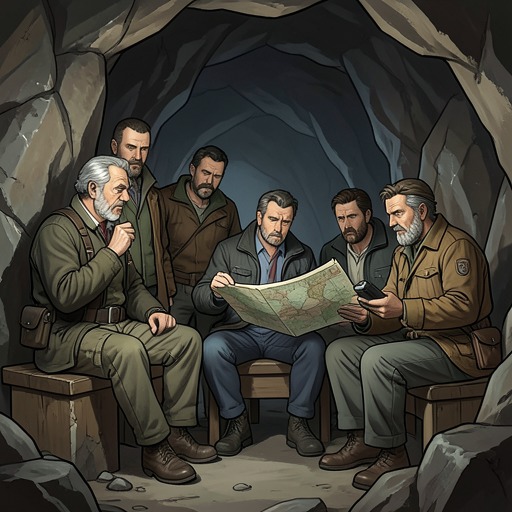
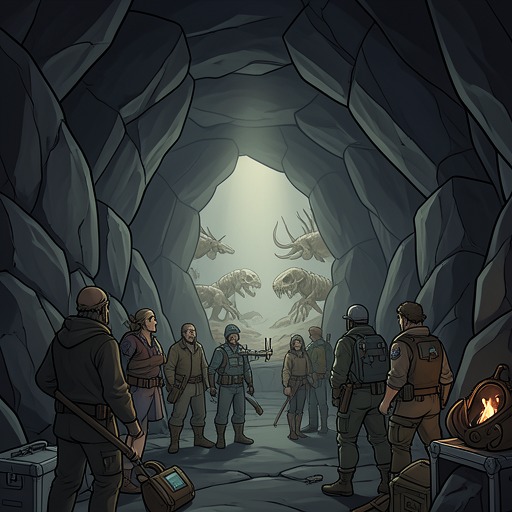
The expedition reads the changing rocks as a sequence of Earth’s past. In a gallery of sloping and sometimes vertical walls, the narrator recognizes a transition in the strata and identifies them with the Silurian period. As the journey continues, the rocks and their fossils seem to register successive stages in the history of life: trilobites give way to remains of what he considers a more developed animal order, including a fish associated with the first form of the reptile. The strata thus operate as more than scenery. They make deep time legible to observers moving through it, even as their readings of the evidence do not always agree.
The changing geological record also unsettles the explorers’ expectations about their route. The gallery’s direction becomes uncertain, and its transition character persists rather than providing a clear indication of where they are going. The narrator interprets the fossils as warnings that animal life is ascending toward humanity, while Professor Hardwigg remains determined to proceed. This movement from ancient fossils toward human remains gives the journey a temporal as well as a physical direction: the explorers appear to travel through successive histories of life.
A nineteenth-century dispute over human antiquity
The Quaternary acquires its particular importance through the contemporary argument about whether humans lived alongside its animals. A jawbone discovered at Moulin-Quignon, near Abbeville, in 1863, was found fourteen feet below the soil with stone hatchets and carved flints. The discovery attracted attention across France, England, and Germany. Supporters argued that the bone was authentic and that it established human existence in the Quaternary; Professor Hardwigg belonged to the majority who defended that interpretation.
The claim remained contested. Elie de Beaumont argued that the Moulin-Quignon soil belonged to a less ancient deposit, not to the diluvial formation, and rejected the idea that humans had been contemporary with Quaternary animals. Meanwhile, further jawbones and other human remains found in sands in France, Switzerland, and Belgium strengthened the case for Quaternary human existence. Reports of worked fossil animal bones from still older, Tertiary deposits prompted some scholars to propose a deeper antiquity for humanity, though those objects were not human bones. The novel presents this debate as an active process of changing evidence and competing interpretation, not as settled knowledge that can simply be carried unchanged into the underground world.
The body as evidence
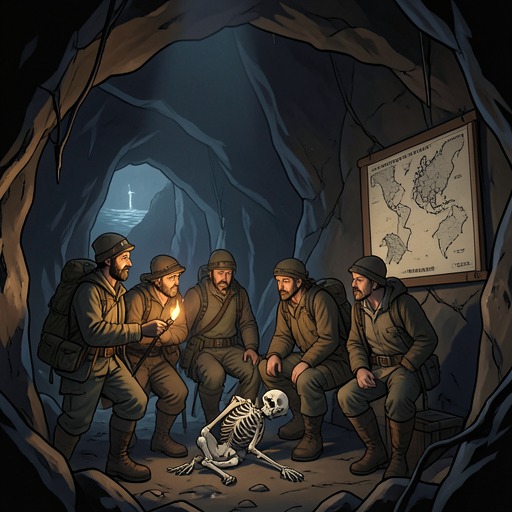
Against that background, the discovery of a human figure belonging to the Quaternary appears to vindicate a claim that had been argued over above ground. After advancing about twenty yards, Professor Hardwigg and the narrator find what the narrator recognizes as a human skull. Its skin is stretched and parchment-like, its teeth intact, and its hair abundant; the body is described as complete and apparently preserved. The explorers raise it upright, where its hollow eyes seem, to their startled imaginations, to look back at them.
The scene transforms an abstract controversy into an encounter with a material object. Professor Hardwigg, normally eager to speak, is initially overcome by emotion. He then turns the discovery into a public scientific demonstration in his imagination, addressing an audience of learned men and invoking the dispute over whether Quaternary humans existed. His presentation treats physical presence as decisive: the body can be seen and touched, unlike claims resting solely on disputed interpretation. His proposed means of removing the earth and shells encrusted over it—a solution of sulphuric acid—is unavailable, but he insists that the body can still tell its history.
Observation, theory, and the limits of certainty
The Quaternary discoveries belong to a wider pattern in which instruments, fossils, and direct observation challenge established expectations. Earlier, the narrator questions the possibility of following Saknussemm’s route because scientific teaching makes such a journey seem impossible. Professor Hardwigg answers that he cares nothing for theories. Later, a thermometer reading of 27.6 degrees leads him to reject the predicted extreme underground heat and to invoke Humphry Davy in support of his trust in observation. These episodes make the expedition’s scientific claims a matter of practice: a theory is tested against what the travelers measure or encounter.
Yet the preserved body does not erase uncertainty. Its apparent age and completeness produce astonishment, but the narrative also recalls how human antiquity had been established through disputed finds, revised interpretations, and arguments over geological context. Professor Hardwigg’s exultant certainty is therefore part of the scene’s drama, not a substitute for the questions it raises. The Quaternary marks the point at which an argument about humanity’s place in geological time becomes an encounter with apparent human presence, while leaving visible the difference between observing an extraordinary object and establishing every claim made about it.