Gretchen
A Journey to the Centre of the EarthGretchen, Professor Hardwigg’s goddaughter and Henry Lawson’s beloved fiancée, is the expedition’s absent but defining personal stake. Left in Hamburg while Henry and the Professor travel beneath the earth, she does not direct the explorers’ route; instead, her encouragement, the name given to a harbor in her honor, and the prospect of their marriage shape how Henry experiences both departure and return. At the end, she becomes Henry’s wife and joins the household in the Königstrasse, turning the perilous voyage back toward a life shared at home.
Identity and Place in the Household
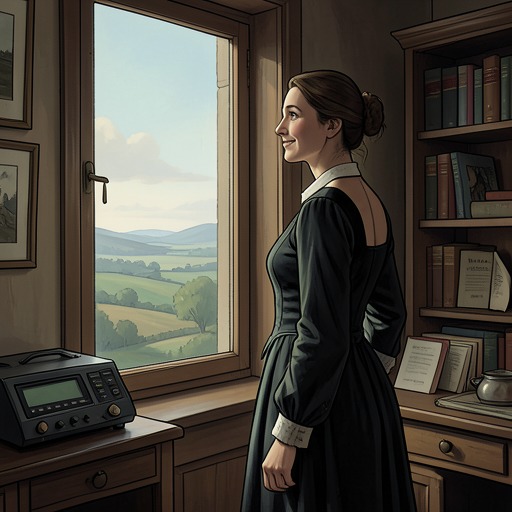
Gretchen is the Professor’s goddaughter and one of the few inhabitants of his old house on the Königstrasse in Hamburg. The Professor is wealthy and owns the house, but Henry considers Gretchen the best of his possessions—a possessive way of describing his affection that also establishes how central she is to his sense of home. The household consists of Gretchen, the old cook, the Professor, and Henry; she is not a distant figure introduced only as a future prize, but part of the intimate domestic world from which the expedition departs.
Henry and Gretchen are already affianced and love one another sincerely. The Professor, absorbed in scientific matters, knows nothing of their engagement. That difference in knowledge gives their relationship a private dimension: Henry’s thoughts can be elsewhere even while the Professor is intent on the scientific puzzle before him. When the Professor studies Saknussemm’s cryptogram, Henry’s attention drifts to Gretchen’s portrait and to when she will return. The adventure’s intellectual beginning is therefore already shadowed by his personal attachment.
Encouraging the Expedition
After the Professor commits himself to the journey, Henry’s first confidence in the enterprise falters. On his way home, the prospect seems like a nightmare, and he doubts the decision he has just made. Meeting Gretchen brings him back into the emotional world of the expedition: he embraces her warmly and tells her what is planned. She listens in awe, initially unable to speak, but her silence gives way not to protest but to enthusiasm.
Gretchen calls the proposed journey magnificent and says that, if she were a man, she would consider it an honor to accompany the Professor. She regards the expedition as worthy of her godfather and tells Henry that she envies him. Her response overturns his expectation that she would be the first to condemn what he calls a mad enterprise. It is decisive precisely because it comes from the person whose opposition would matter most to him: her approval supplies the last emotional confirmation he needs as the Professor prepares to leave.
An Absence Carried Underground
Though Gretchen does not accompany the party, Henry carries her as an imagined destination. When the explorers enter a difficult upward passage, he takes comfort in believing that their course may be leading back to the earth’s surface. Each step encourages him to imagine his marriage with her. The thought is not a reliable measure of their direction, but it shows how quickly the possibility of home becomes the personal meaning he attaches to a geological sign.
Later, at a depth that seems immeasurable, Henry tries to summon the world he has left behind. Hamburg, the house on the Königstrasse, and Gretchen return vividly to his imagination, yet seem almost unreal amid his isolation and despair. He pictures the ship, Iceland, and Mount Sneffels as scenes in a panorama, while the prospect of finding his companions and regaining the surface appears beyond human power. Gretchen belongs to the remembered world that makes the gulf between the underground and ordinary life emotionally legible.
The connection becomes painfully concrete after the storm drives the explorers eastward. Henry realizes they have passed beneath Germany, beneath Hamburg, and beneath the very street containing everything he loves. He is only forty leagues from Gretchen, but those leagues consist of hard, impenetrable granite. The short horizontal distance emphasizes the impossibility of reaching her: proximity on the map cannot overcome the earth separating them.
Port Gretchen and the Return
Gretchen’s name enters the expedition’s geography when Henry proposes naming a harbor Port Gretchen. The Professor accepts the suggestion, and Henry understands the naming as a way of attaching the memory of the woman he loves to their adventurous journey. It is a small act of commemoration within a vast, strange landscape: the explorers give a place in the subterranean world a name that carries their domestic world with it.
When Henry and the Professor finally return to Hamburg, Gretchen shares in the astonishment and joy of the reunion. She tells Henry that, now he has returned as a hero, there is no reason for him to leave her again, and she weeps with happiness. The line answers the separations that have structured Henry’s journey: the imagined marriage that comforted him underground becomes a reunion in fact. Gretchen, who had urged him onward before departure, now welcomes him back from the expedition.
The ending makes their relationship part of the household’s changed reality. Gretchen gives up her position as the Professor’s ward and takes her place in the Königstrasse house as both his niece and Henry’s wife. Her story thus closes the circuit between adventure and home: she is first the private attachment Henry carries into the unknown, then the name preserved on the underground map, and finally the partner with whom he shares the life to which he has returned.