Hardwigg Refuses to Abandon the Expedition
A Journey to the Centre of the EarthHardwigg Refuses to Abandon the Expedition is the crisis in which Professor Hardwigg’s determination to reach the Interior of the Earth collides with Harry’s judgment that the party must turn back. With their water exhausted and Harry only briefly revived by a few drops, Hardwigg rejects retreat as defeat at the moment he considers success near, and tells Harry to leave with Hans while he continues alone. The episode turns their disagreement about the expedition into an immediate question of life, death, and whether they will abandon one another.
The crisis of water and retreat
Harry’s proposal follows a short-lived recovery: the water has eased the constriction in his throat and inflammation of his lips enough for him to speak, but it has not resolved the shortage. He concludes that the journey must end and urges an immediate return to Sneffels, hoping they can make their way back to daylight. The prospect is not an abstract change of plan; the exhausted travelers have to consider whether they can survive the return.
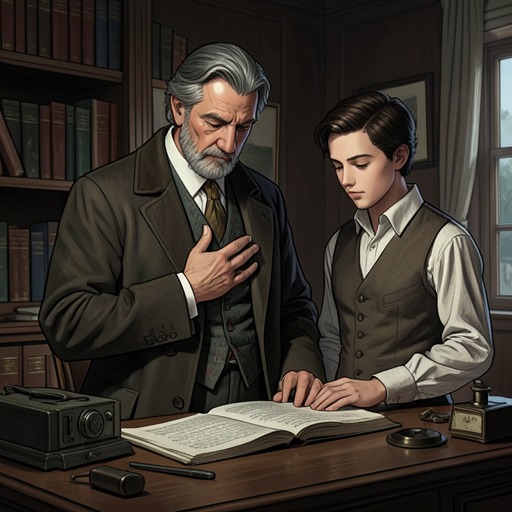
Hardwigg initially appears to hesitate. As Harry insists that they must turn back without losing a moment, the Professor lowers his head and avoids meeting his nephew’s eyes. His question, spoken almost to himself, about whether they must really go back leaves room for the danger to register. Yet the pause does not become consent: he interprets Harry’s despair as a failure of courage rather than as a practical response to their circumstances.
Hardwigg’s refusal
Hardwigg asks whether a few drops of water have truly failed to restore Harry’s energy and courage. Harry challenges him in turn, asking whether he is not discouraged himself. The Professor answers by invoking the expedition’s apparent proximity to success: he will not have it said that he retreated just as they were on its verge. His refusal is therefore bound to his conception of the undertaking as something that must be carried through, not merely to a disagreement over how much danger the party can bear.
That resolve becomes more severe when Hardwigg tells Harry to go with Hans and says he will continue alone. He insists that he undertook the perilous adventure and will carry it to the end, even if that means never returning to the surface. The offer reverses the immediate pressure: Harry had called for a collective retreat, while Hardwigg recasts the choice as whether Harry will leave him behind. His outburst is a threat to the expedition’s unity as much as a declaration of personal resolve.
Harry and Hans at the decision point
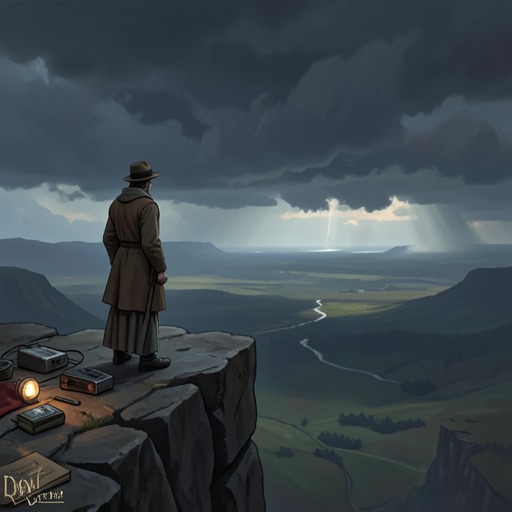
Harry cannot accept the proposal simply as a way to save himself. He is torn between the instinct to flee and his unwillingness to abandon his uncle at the bottom of the abyss. The narration emphasizes the physical change in Hardwigg’s manner: his previously tender voice becomes harsh and menacing as he struggles against what seems impossible to him. The emotional bond does not erase the danger; it is precisely what makes the choice harder.
Hans watches calmly, knowing what is at stake between the two men, and waits for a signal. He is prepared either to go upward with Harry or resume the journey inward with Hardwigg. His composure contrasts with their agitation, but it does not settle the dispute: the guide leaves the decision to them, and the proposed separation remains a choice none of them has yet carried out.
A pattern of argument and authority
The confrontation continues a broader tension in the expedition between accepted scientific teaching and Hardwigg’s confidence in what the journey may reveal. Harry has argued that established theory makes passage into the Earth’s interior impossible, citing the predicted increase of heat with depth; Hardwigg has answered that he cares nothing for theories. His refusal to turn back under pressure likewise places resolve and firsthand pursuit above the limits Harry draws from scientific knowledge.
Their exchanges elsewhere show that the disagreement is not simply between a scientist and an irrational skeptic. Hardwigg himself offers a reasoned account of volcanic warning signs: steam vents become more active before an eruption and disappear during one, while normal steam activity and the absence of heavy atmospheric pressure or dead calm indicate no immediate eruption. At the same time, his manner makes scientific authority sound like a command to obey. The episode’s conflict thus sits within a recurring strain between calculation, observation, and the Professor’s unyielding confidence.
Evidence, inference, and the expedition’s stakes
Harry’s resistance also rests on tangible observations. When he picks up an almost perfect shell resembling that of a present-day animal, Hardwigg identifies it as a trilobite shell but refuses to draw the conclusion Harry presses him to consider. The exchange gives their scientific dispute a material object: the shell is evidence that Harry wants interpreted, while Hardwigg’s composure keeps observation from immediately changing his course.
A similar argument follows their estimate that they are sixteen leagues, or fifty miles, underground. Harry invokes the scientific limit on the Earth’s crust and points out that known laws of increasing heat would predict an extreme temperature at that depth. Rather than simply prolonging the argument, he accepts Hardwigg’s calculations for the sake of reasoning and asks to draw a definite conclusion from them; he also considers whether refractory lava might insulate the passage from the expected heat. These disputes sharpen the stakes of the refusal: Hardwigg’s confidence drives the expedition onward, while Harry tests that confidence against physical evidence and the dangers it implies.
At the decision point, no return or final separation has yet occurred. Hardwigg’s refusal preserves the inward direction of the expedition only by placing Harry and Hans under pressure to choose between following him and going back. Its force lies in that unresolved choice: the scientific quest is now also a test of whether persistence can remain a shared undertaking when survival appears to demand retreat.