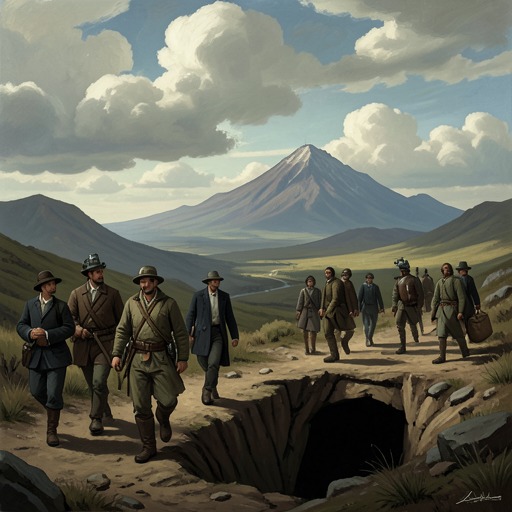
Hardwigg’s Expedition to the Centre of the Earth
A Journey to the Centre of the EarthHardwigg’s Expedition to the Centre of the Earth is the journey undertaken by Professor Hardwigg, Henry Lawson, and Hans Bjelke after the Professor resolves to follow Saknussemm’s directions underground. Its defining tension is between a plan founded on confident interpretation and a world that resists it: the expedition proceeds by instruments, records, and classifications, but must repeatedly submit its theories to immediate evidence and the material hazards of the route.
Decision and Departure
The expedition becomes a practical commitment with startling speed. After dinner, Professor Hardwigg orders his portmanteau made ready and says that Henry’s must be prepared as well: they are to start at once. Henry, horrified by the prospect of descending toward the centre of the Earth, decides that scientific arguments are the only ones likely to influence his uncle. He challenges the journey as impossible, citing the accepted expectation that heat rises with depth and would make the Earth’s interior incandescent. Professor Hardwigg brushes aside theory in favor of Saknussemm’s indicated entrance and an opportunity to pursue it.
The departure is fixed for daybreak two days later. Henry learns of the preparations from the ropes, rope ladders, torches, gourds, iron clamps, crowbars, alpenstocks, and pickaxes filling the garden—equipment enough, he thinks, for ten men. His fear does not alter the decision. Gretchen, Henry’s cousin and affianced wife, supports her father’s resolve; at five o’clock in the morning the post chaise waits at the door, and Gretchen and the old cook receive the house keys. The travelers leave with scarcely a pause for goodbyes. The expedition thus begins not with Henry’s assent, but with his uncle’s determination carrying him across the threshold.
Iceland and the Chosen Route
In Iceland, the party’s progress depends on both institutional access and local assistance. On landing, Professor Hardwigg presents letters from Copenhagen to Baron Trampe, the island’s governor, who places himself at the Professor’s disposal. The party also meets M. Finsen, the mayor, and M. Fridriksson, a professor of natural science in Reykjavik. Fridriksson’s Icelandic and Latin allow him to converse with Henry in a way the other unfamiliar languages around them do not. The travelers are lodged in two rooms of his three-room house, while their baggage astonishes the town’s inhabitants.
Henry’s view of Reykjavik emphasizes the contrast between the inhabited town and the landscape that will draw the expedition onward. The town lies on a flat, marshy plain between two hills, beside a lava field descending in terraces toward the sea; across Faxa Bay rises the glacier of Sneffels. Its longest street runs along the shore among red-painted wooden trading huts, while another leads toward a small lake and the residences of the bishop and other non-commercial residents. The Valkyrie is the only ship at anchor. Professor Hardwigg, however, has little interest in what lies above ground: what matters to him is what lies below.
The route to the mountain is governed by observation as well as by Saknussemm’s instructions. At the summit of Sneffels, Professor Hardwigg explains that Scartaris is the name of the peak on which they stand and treats the surrounding geography as a guide to the descent. At noon, the shadow falls on the edge of the central pit. He recognizes this as the sign that they have found the entrance and urges the party forward into the Interior of the Earth. Hans responds with a calm word of assent. Although the entrance is identified at noon, the travelers’ watches show that they are not fully ready until thirteen minutes past one: the moment of discovery and the practical commencement of the descent are distinct.
Observation, Instruments, and Revision
Inside the Earth, Professor Hardwigg’s notebook turns travel into a running record. After a meal of biscuit and dried meat, with water flavored by Schiedam, he takes out the notebook intended for memoranda and sets his instruments in order. Its entries begin with the date, Monday, June 29, and a chronometer reading of 8:17 in the morning. Recording does not eliminate uncertainty, but it gives the expedition a framework for comparing what its members encounter with what they expected.
That comparison directly unsettles the Professor’s earlier confidence about heat. When Henry reports the thermometer’s reading as 27.6 degrees, Professor Hardwigg calculates that it is 1,474.4 degrees below the temperature his theory predicts. He responds by declaring the supposed proportional increase in temperature an exploded error and invoking Humphry Davy’s view of the Earth’s interior. Henry yields to the evidence of his senses while remaining surprised. The exchange marks a change in the expedition’s reasoning: the Professor had rejected Henry’s theoretical objection as no reason to abandon the journey, but now uses a measured reading to revise the theory that had informed that objection.
The expedition also makes observation a collaborative practice. In the Central Sea, Hans takes the tiller of the raft, having ingeniously fitted it with a rudder; his skill as a guide, duck hunter, and sailor makes him responsible for steering. As the party leaves the small port where the raft was built, Professor Hardwigg proposes names for it, including Henry’s. Henry offers another suggestion, so the act of naming becomes part of the travelers’ attempt to describe and claim a route through unfamiliar geography, rather than a purely private gesture by the leader.
Discoveries and the Measured Sea
The underground journey yields unfamiliar life as well as unfamiliar terrain. When the party catches a fish, Henry initially identifies it as a small sturgeon. Professor Hardwigg examines it feature by feature: its flat head, rounded body, bony scales on the lower extremities, toothless mouth, highly developed pectoral fins, and lack of a proper tail. Although its order resembles that of the sturgeon, the differences matter more than the resemblance. After patient examination, the Professor classifies it as belonging to a family extinct for ages, previously known only from fossil remains in Devonian strata. The encounter turns a catch into evidence that the expedition is confronting life beyond the familiar modern world.
The sea is likewise made intelligible through measured distance. Before the party finally leaves an island, Henry calculates their progress and enters the figures in his journal: they have traveled 270 leagues, more than 800 miles, since leaving Port Gretchen. They are 620 leagues from Iceland and, according to the calculation, directly beneath England. These numbers place the travelers’ underground movement in relation to recognizable surface geography, even as the sea itself remains a feature of the subterranean world.
Reversal and the Limits of Instruments
Measurement cannot guarantee control. During a passage marked by boiling water and excessive heat, Henry examines the compass as a last resort. Its needle jumps from pole to pole, circles, and then jerks back again. The instrument that should stabilize direction instead registers an upheaval, making the expedition’s orientation uncertain precisely when the surrounding conditions seem most dangerous. The compass’s behavior is not a detached puzzle: it connects a physical disturbance in the rock and water to an immediate failure of the travelers’ navigational reference.
Across the expedition, instruments and records are indispensable but not sovereign. The chronometer establishes a time, the thermometer forces a theoretical correction, the journal converts distance into a claim about position, and the compass’s erratic needle warns that familiar orientation has broken down. Likewise, fossils invite classification but exceed Henry’s first guess. The route’s repeated pattern is therefore not the simple triumph of scientific certainty: Professor Hardwigg’s resolve gets the travelers moving, while observation, local knowledge, instruments, and terrain continually qualify what they can claim to know. The expedition’s decisive significance lies in that testing process, in which the interior becomes both a destination and a challenge to the assumptions brought into it.