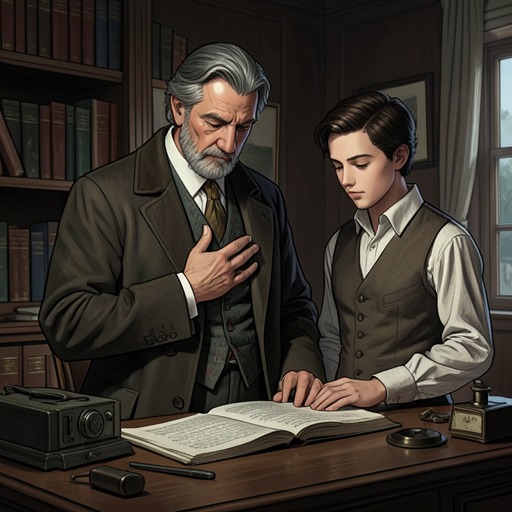
Henry and Professor Hardwigg
A Journey to the Centre of the EarthHenry and Professor Hardwigg are uncle and nephew whose expedition turns their disagreement over scientific theory into a working partnership. Their bond is tested by danger and uncertainty, and its most striking change comes when Henry, once the expedition’s persistent skeptic, becomes as committed to reaching the Earth’s centre as his uncle. The journey’s observations do not simply settle their arguments: they give the pair shared evidence, shared risks, and a public story that Henry helps make possible.
Family Bond and Intellectual Disagreement
At the outset, Henry accepts that Saknussemm found the entrance to the Earth’s interior but rejects the idea that anyone could have followed the discovery. He invokes scientific teaching and the expected increase of heat with depth, reasoning that the globe’s incandescent interior would make survival impossible. Professor Hardwigg answers that he cares nothing for theories. Their disagreement is not a division between knowledge and ignorance so much as a conflict over what should command belief: established scientific expectations or the possibility that observation may overturn them.
Their difference persists in the underground world, where Professor Hardwigg’s confidence in the expedition meets Henry’s habit of testing claims against what he sees. When Henry points out a fossil shell, the Professor identifies it as a trilobite and treats the classification as an answer in itself; Henry presses him to draw the broader conclusion. The exchange captures their distinct roles: the Professor classifies and interprets, while Henry notices when a particular object challenges the limits of accepted knowledge.
Evidence, Instruction, and Shared Observation
Professor Hardwigg’s authority within the relationship is practical as well as intellectual. On the approach to Sneffels, he explains that the volcano’s vapor vents become more active before an eruption and disappear during one, and that their ordinary activity, without heavy atmospheric pressure or dead calm, indicates no immediate danger. When Henry begins to object, the Professor cuts off the discussion by insisting that science has spoken. His confidence can be reassuring, but it also shows how readily he presents an inference as settled instruction.
The expedition’s notebook gives this method a material form. After breakfast, Professor Hardwigg takes out a notebook intended for memoranda of their travels; his instruments are already arranged, and he begins an entry dated Monday, June 29. Recording and measuring accompany the journey, even when the observations do not fit the theories with which either man began.
That mismatch becomes concrete when the pair discuss their depth. Henry recalls the scientific limit commonly assigned to the thickness of the Earth’s crust, while Professor Hardwigg does not dispute the figure but directs attention to the conditions they actually experience. Asked to read the thermometer, Henry reports 27.6 degrees, far below the temperature that the expected rate of increase would predict. The Professor treats the discrepancy as evidence against the proportional increase in temperature and invokes Humphry Davy; Henry, though still considering whether the surrounding lava might be a poor conductor of heat, refrains from prolonging the argument and accepts the observed facts. Their exchanges make the expedition a sustained contest between theoretical prediction and measurement, rather than a simple triumph of one man’s certainty over the other’s doubt.
From Skepticism to Commitment
The relationship changes most dramatically when Henry’s caution becomes zeal. At the blocked passage, he argues that a fallen mass of granite has sealed an outlet that Saknussemm once used, and insists that the explorers must clear the obstacle if they are to follow in the discoverer’s footsteps. In the force of that appeal, Henry says that he has forgotten the past and despised the future: the towns and country above, Hamburg, Koenigstrasse, and even Gretchen have vanished from his thoughts. The man who once called the journey impossible now imagines himself unworthy of Saknussemm’s example if he does not press onward. Professor Hardwigg responds by proposing pickaxes, crowbars, or anything else that might bring down the barrier; the two are aligned in purpose, even as Henry judges the rock too massive for ordinary tools.
When their situation becomes desperate, Professor Hardwigg refuses to accept despair as the only rational response. He tells Henry that as long as a person’s heart beats, life still allows hope, and that thought and will should keep a person from surrendering. Henry’s narration registers the courage required to speak that way under their circumstances. The statement is more than a reassuring maxim between relatives: it expresses the Professor’s enduring insistence on action, while Henry’s response shows that he recognizes the emotional force of his uncle’s resolve.
Public Recognition and the Unequal Aftermath
After the explorers return, the public initially finds the account difficult to believe; the presence of Hans and scattered pieces of information gradually changes opinion. The narrator says that Professor Hardwigg became a great man and that Henry became the nephew of a great man. Hamburg celebrates them, and at a public meeting of the Johanneum Institution the Professor recounts their adventures, omitting the facts connected with the compass. He deposits the document written by Saknussemm in the town archives and regrets that circumstances prevented him from following the Icelandic traveler’s track all the way to the Earth’s centre.
Recognition falls most visibly on the Professor, whose fame grows even as his theories about central heat bring him opponents among learned people. Henry, meanwhile, remains the narrator and the witness who records the expedition’s disputed evidence. His account preserves the relation’s central tension: he still believes in central heat, yet concedes that circumstances may require the laws of natural phenomena to be modified. Their partnership therefore ends not with complete agreement, but with a more complicated understanding of what the journey has established. Professor Hardwigg’s determination drives them forward; Henry’s observations and narration preserve the limits, surprises, and unresolved questions that determination encounters.