Hollow Earth
A Journey to the Centre of the EarthHollow Earth is the novel’s imagined interior world, made consequential not as a diagram of the planet but as a landscape the travelers descend through, cross, and finally leave by volcanic force. Its strata seem to arrange geological time beneath their feet; its fossil beds turn disputed scientific claims into visible remains; and its living prehistoric animals make the distinction between ancient past and present danger suddenly unstable. The journey gives the theory a physical form without making every mystery answerable: even amid extraordinary evidence, the travelers cannot explain how all of it came to be.
A World Read Through Its Strata
The interior first presents itself as a geological sequence. In a passage of rock described as belonging to the Silurian period, Henry reads the changing formations as evidence that the expedition is moving through successive stages of the Earth’s history. The strata are not merely scenery: they provide a way to orient the travelers and to imagine deep time as a passage through matter. His confidence in that reading sits beside the practical uncertainty of their route, which sometimes seems to slope downward and sometimes offers no clear indication of direction.
As they proceed, the walls reveal limestone, old red sandstone, and richly colored marble. Their surfaces bear traces of primitive life, while the fossils appear to Henry to mark an advance beyond the rudimentary trilobites seen earlier. He interprets the succession as an ascent through the scale of animal life, with humanity at its summit. Professor Hardwigg, by contrast, presses onward despite the warning Henry believes the fossils provide. The episode makes the underground journey a contest between geological inference and the Professor’s determination to continue: the rocks may suggest a history, but they do not dictate the expedition’s choices.
That itinerary of strata belongs to a nineteenth-century culture increasingly willing to imagine human beings and other life forms across immense spans of geological time. The narrative invokes the controversy over the Moulin-Quignon jawbone, discovered fourteen feet underground near Abbeville in 1863 with stone hatchets and carved flints. Many geologists accepted it as evidence of Quaternary humanity, while Elie de Beaumont disputed the age assigned to the deposit and rejected the claim that humans had lived alongside Quaternary animals. Further finds, and carved fossil bones associated with Tertiary deposits, extend the debate in the narrator’s account: some scholars were placing human history more than a hundred thousand years in the past. These are the scientific arguments the travelers carry with them, not neutral pronouncements of present-day science; underground, however, such arguments become encounters with bones and bodies rather than questions confined to learned debate.
Fossils, Human Remains, and Unanswered History
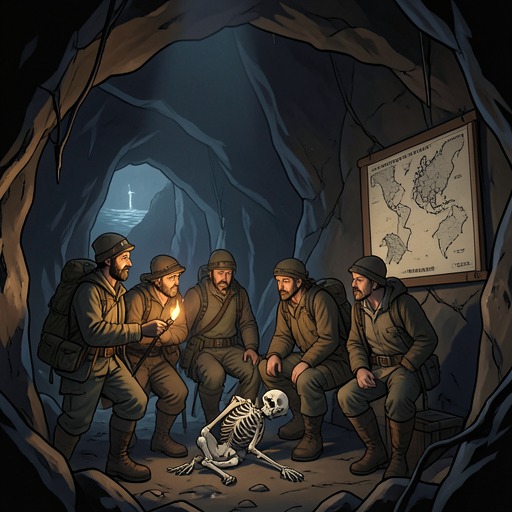
On a vast plain of bones, the expedition comes face to face with a recognizable human skull. It retains stretched, parchment-like skin, abundant hair, and intact teeth. Professor Hardwigg identifies the figure as a fossil human contemporary with the mastodons whose bones cover the surrounding amphitheater. He points to hatchets and carved flints as evidence of human workmanship, and proposes that a great convulsion of the Earth may have opened fissures and chasms through which the strata and remains entered the cavity. He cannot explain the whole process, and openly stops short of an absolute conclusion; his striking suggestion that this ancient person visited the centre of the Earth as a scientific traveler remains a supposition, not a demonstrated account.
The first body is not alone. Other remains appear across the dusty plain, generations of humans and animals confused together in what seems to be a cemetery of an extinct world. Their presence raises a question the expedition cannot settle: were the dead buried far underground by a catastrophe after their lives had ended, or had people lived in this subterranean world, under its artificial-looking sky, and died there as ordinary inhabitants? Until then, the travelers have seen living marine monsters and fish, not living humans. The fossils therefore make the interior more than a repository of the past: they create the unnerving possibility that it might also have had a human history of its own.
A Lost Past That Is Still Alive
Curiosity carries the travelers away from the Central Ocean and across the bone plain. After a long, weary hour, the Professor hurries forward without concern for whether he might lose his way; the travelers move through an evenly diffused electric light that seems to have no identifiable source and casts no shadows. The surrounding vegetation compounds the disorientation. Trees associated with widely separated regions grow together: oak beside palm, Australian eucalyptus near Norwegian pine, and northern poplar mingling with New Zealand kauri. The assemblage unsettles the classifications by which the travelers understand the surface world, just as the mixed remains on the plain unsettle any clean division between geological periods.
Then Henry sees living mastodons beneath the trees. They are not fossils but a herd of enormous animals, comparable in appearance to specimens discovered in 1801 along the Ohio’s marshy banks. Their trunks tear down branches; their tusks uproot trees, and leaves and boughs disappear into their mouths. The contrast with the fossil cemetery is decisive: the past is not simply preserved beneath the earth but, in this extraordinary landscape, visibly alive. What had been an inference from strata and bones becomes immediate danger and spectacle, extending the journey’s uncertainty from the age of human remains to the survival of prehistoric life.
Passage, Survival, and the Return
The underground world is also a physical obstacle that has to be traversed with instruments, ropes, and improvised means. Before the expedition’s departure, Professor Hardwigg packs its instruments separately from its arms, tools, and provisions. The equipment includes an Eigel centigrade thermometer rated to 150 degrees and a compressed-air manometer intended to measure pressure. These provisions make the expedition’s scientific ambition tangible, but the narrator questions whether the thermometer’s range will prove adequate: it could register too much heat if the temperature rises dangerously, or too little if they need to measure springs or molten metal precisely.
At the central shaft, the route downward appears like a savage, unguarded staircase, with projections in the near-vertical sides that might assist a climber. The difficulty is not only getting down but retrieving the rope afterward. Professor Hardwigg solves it with a cord about as thick as Henry’s thumb and at least four hundred feet long. Half is lowered and hitched around a large block of lava at the precipice; the other half follows. Each traveler can descend holding both strands, release one end after roughly two hundred feet, and pull the other so that the cord falls within reach, repeating the procedure farther down. Henry accepts the ingenuity of the arrangement while continuing to worry about the return ascent. The method captures the expedition’s larger dependence on practical invention: even a route into the interior must be made in stages, and every descent leaves the question of how to get back.
Much later, the Professor recognizes the force carrying them as an eruption. Henry understands that they are inside the volcanic shaft of a crater in full activity; the Professor, smiling, calls it the most fortunate thing that could happen to them. Their exit reverses their entry: they went into the Earth through one volcano and emerge through another, at Stromboli, more than twelve hundred leagues from Sneffels. The change in setting is startlingly complete, from Iceland’s eternal snows and gray fog to Sicily’s greenery and blue sky. After eating fruit and drinking fresh water, the travelers continue toward the port of Stromboli. They conceal how they reached the island, presenting themselves as unfortunate shipwrecked travelers because a more truthful account might make the superstitious local population regard them as demons from the infernal regions. Their safe return depends, finally, on translating an extraordinary underground passage into an ordinary public explanation.
The Interior as Scientific Imagination
Hollow Earth gathers geological sequence, paleontological controversy, and physical adventure into one narrative space. The descent makes time seem traversable; the fossil plain makes the disputed antiquity of humanity visible; and the living mastodons undo the comfort of treating deep time as safely finished. Yet the narrative preserves limits alongside wonders. Professor Hardwigg offers an explanation for the buried remains but admits that he cannot account for their full arrangement, while the travelers’ observations do not resolve whether human beings ever lived in the interior. The world is therefore powerful not because it answers every question, but because it converts scientific possibilities into encounters and leaves crucial causes unsettled.
The final volcanic escape gives the imagined interior a structural role in the expedition’s story: it is both destination and passage, entered through one volcano and abandoned through another. The return to daylight restores recognizable landscape and practical social caution, but it does not reduce what the travelers have seen to a simple proof. Their journey closes with a true geographical arrival and a deliberately guarded account of how it happened, preserving a gap between experience and what can safely be said about it.