Mastodon
A Journey to the Centre of the EarthThe Mastodon occupies two registers in the account of the underground world: it is a species recognized through fossil remains and a gigantic beast conjured in Henry Lawson’s imagination. The shift from bone to imagined living animal gives it a vivid place in the novel’s passage between scientific classification and fearful speculation about the deep past.
Fossil Evidence and Geological Time
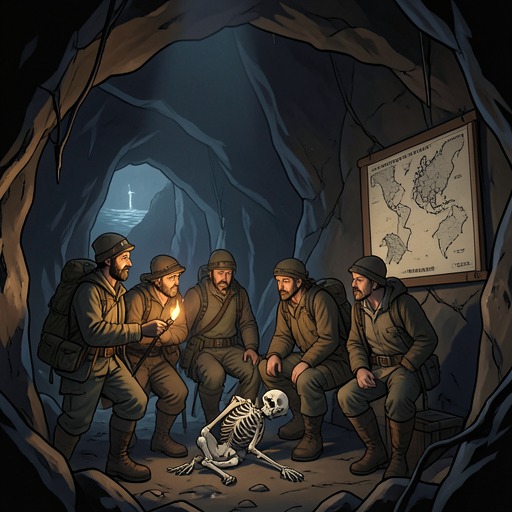
On the subterranean seashore, Henry examines enormous bones, some as large as tree trunks, and identifies a lower jaw as belonging to a Mastodon. He also points out molars of the Dinotherium and a leg bone of the Megatherium, interpreting the remains as evidence that immense animals had lived and died beside the underground sea. The scale of the bones makes the shore seem less like an ordinary landscape than a cemetery of vanished life.
That fossil-rich setting follows the expedition’s movement through successive geological formations. Henry recognizes the transition into Silurian rocks and later sees remains of more developed animal forms in the marbles, including a fish he understands as an early form of reptile. These observations frame the Mastodon among creatures whose presence in the rocks records a progression through geological time, even as the underground setting unsettles the neatness of that scientific account.
The Living Mastodon in Henry’s Vision
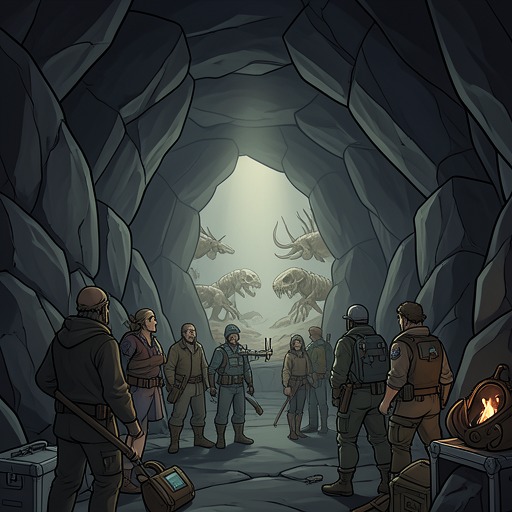
As the expedition travels by raft across the subterranean sea, Henry’s imagination supplies the animals he cannot actually see. In this waking dream, a giant Mastodon twists its trunk and crushes the shoreline rocks to powder; nearby, a Megatherium digs into the earth with enormous claws and roars across the cavern. The scene transforms fossil names into moving bodies, populating the shadowy shore with an imagined prehistoric ecosystem.
The Mastodon’s force is conveyed through the work of its trunk rather than through an encounter witnessed in waking life. It does not attack the expedition; instead, its imagined crushing of rock enlarges the scale of the underground world and gives physical expression to the power Henry associates with vanished animals. The distinction matters: this vision is a product of his imagination, not proof that a living Mastodon has appeared.
Fossils, Fear, and Scientific Uncertainty
The fossil discoveries make such visions plausible within the expedition’s extraordinary setting, but the narrative keeps observation and speculation distinct. Henry has handled a jawbone and other remains, while the Mastodon he pictures belongs to a waking dream. Elsewhere, the sight of tooth marks on an iron bar leads him to fear that a formidable prehistoric reptile may inhabit the subterranean sea; that fear sharpens his expectation of living monsters, but it does not turn his imagined Mastodon into a witnessed animal.
The book also places the Mastodon within contemporary nineteenth-century disputes about the antiquity of human life. In a retrospective account of the Moulin-Quignon jawbone, found near Abbeville on March 28, 1863, the narrator describes the argument over whether humans lived in the Quaternary period and the evidence then being used to push human history further back. The account says that some fossil animal bones bore signs of human handiwork and that leading geologists assigned the Pliocene period an age of more than one hundred thousand years; it presents these claims as part of the scientific understanding of the period, not as a modern verdict. Against that contested timeline, the Mastodon serves as a memorable measure of the ancient world the explorers are trying to read from its remains.