Megatherium
A Journey to the Centre of the EarthMegatherium is presented in two contrasting forms in the subterranean world: as a fossil bone among the remains on the shore and as a gigantic living creature in Henry’s waking vision. The shift from identifiable relic to imagined animal makes it part of the book’s effort to turn geological time into a visible, overwhelming landscape.
Fossil Remains on the Shore
Among the enormous bones scattered beside the subterranean sea, Henry identifies a leg bone as belonging to Megatherium. He groups it with a mastodon’s lower jaw and the molars of Dinotherium, reading the bones as evidence that immense animals once lived and died on the shore beneath the surrounding plants. Their scale is immediately legible—some of the remains are as large as tree trunks—but their presence in granite caverns troubles him. The fossil is therefore both a specimen he can name and a clue that raises a geological question he cannot yet resolve.
The discovery belongs to a landscape in which the expedition reads rock and fossil as records of successive life. Earlier, Henry had recognized the marks of primitive animals in marble and observed that the remains showed a more developed order than trilobites, including fish associated with the Devonian seas. The Megatherium bone extends that sequence into a later and more imposing world of extinct animals: the underground passage is not merely a route through stone but a passage through the history of life as the explorers understand it.
The Animal Reimagined
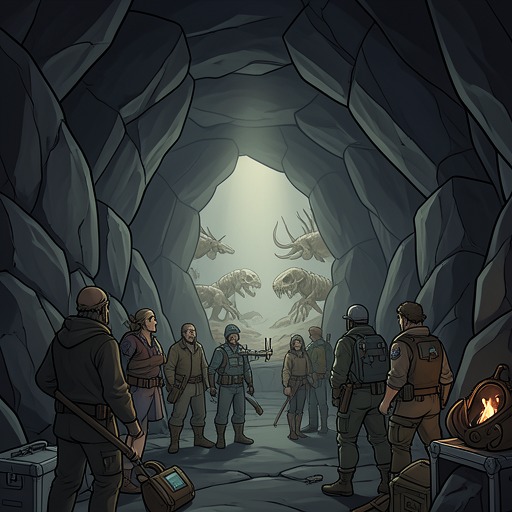
Later, during a waking dream beside the water, Henry’s imagination populates the immense underground landscape with prehistoric creatures. He pictures the giant Megatherium with its back raised like an angry cat and its enormous claws digging into the earth for food. In the same vision, a mastodon crushes shore rocks with its trunk, and the Megatherium’s roar awakens echoes across the place. These details transform the earlier fossil identification into a scene of animal movement and force; what had lain still in pieces now seems alive within Henry’s mental panorama.
The vision expands beyond the Megatherium. Henry imagines early mammals passing along the dark shores, a first monkey climbing granite hills, a pterodactyl sailing through the dense air, and great birds beating their wings against the stone vault. He experiences this world as a panorama of life before recorded history, with his own human heart apparently the only one beating in an otherwise unpeopled landscape. The Megatherium’s imagined labor—claws working the earth and a roar filling the cavern—helps give that lost world physical scale rather than leaving it as an abstract succession of periods.
Deep Time and Human Perspective
The waking vision moves beyond animal life into a rapid sequence of transformations. Henry imagines vegetation on an exaggerated scale, then sees plants disappear, rock lose solidity, and intense heat turn the globe into a mass of vapor and gas. Ages seem compressed into a single day before the vision carries him into cosmic space. His uncle’s warning that he is about to fall into the sea, followed by Hans’s firm grip, abruptly returns him from this vast imagined history to immediate physical danger. The contrast makes the Megatherium part of a passage between scientific observation and imaginative projection, while showing that such projection can distract the observer from the peril at hand.
The book also frames claims about ancient life against nineteenth-century disputes over human antiquity. It recounts the 1863 discovery of a human jawbone at Moulin-Quignon, the controversy over whether the deposit belonged to the Quaternary, and later finds that were taken to suggest an even greater antiquity for humanity. In that account, some scholars argued that humans preceded the mastodon, while others disputed the geological basis for such conclusions. Megatherium thus belongs to a narrative in which fossil remains invite bold reconstructions of deep time, but the meaning and dating of those remains remain matters of interpretation rather than settled modern fact.