Quaternary human remains
A Journey to the Centre of the EarthThe Quaternary human remains are a human skull and body encountered in the great underground cemetery, where they confront Henry and Professor Hardwigg with what seems to be a person preserved from the Quaternary period. Their force lies in the distance they collapse: paleontological controversy, previously argued over through disputed finds and geological dates, suddenly stands before the expedition as a visible and tangible human form. The discovery leaves the Professor overwhelmed, then transforms his scientific enthusiasm into an impromptu declaration before an imagined audience of scholars.
Discovery in the Underground Cemetery
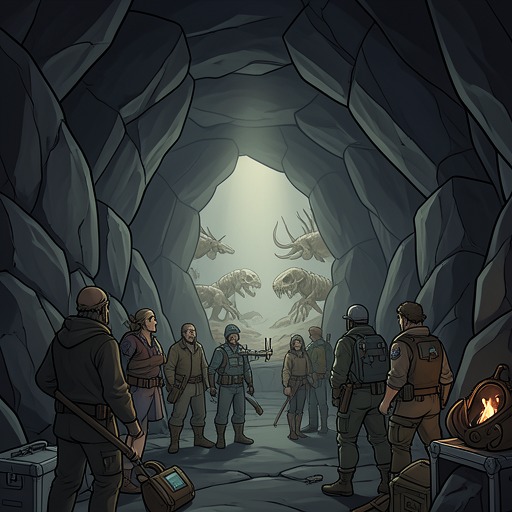
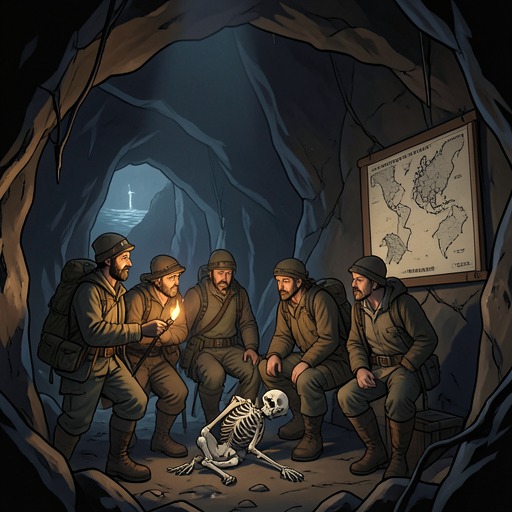
The encounter comes after the expedition has already passed through strata that Henry reads as signs of geological change. Earlier, he has identified a transition into Silurian rock and noticed that the fossil marks in the walls progress from trilobites toward more developed forms of ancient life. These observations establish a journey through geological time as well as through the Earth; the human remains make that progression startlingly personal. The pair are in the vast cemetery of the plains of the Hardwigg Ocean when Professor Hardwigg finds the skull, and he calls Henry over to identify it as a human head.
The narrative emphasizes the shock of recognition rather than a careful excavation. The skull is found amid organic remains, and the Professor is so astonished by the discovery that he stands aghast before its magnitude. As he advances about twenty yards, he comes face to face with a specimen he identifies as belonging to the Quaternary period. The remains are not presented as an anonymous trace in the rock: the scene makes them an apparent individual, whose preserved body challenges the boundary between fossil evidence and a person encountered in the present.
Appearance and Material Condition
The skull is perfectly recognizable, with stretched, parchment-like skin, intact teeth, and abundant hair. Henry describes standing mute and nearly paralyzed by the sight. The body is raised and set upright; in the observers’ excited imaginations, its hollow eyes seem to look back at them. These details make the remains both an object of scientific scrutiny and an uncanny presence. The preserved features suggest a body kept intact across ages, although Henry explicitly cannot explain what kind of soil or other conditions could have preserved it.
Professor Hardwigg insists on the distinction between this find and a mere skeleton. In his account, it is a complete, uninjured body, encrusted with shells and earthy particles, and preserved with what he calls an anthropological object. He considers washing it in sulphuric acid to remove the deposits, but has no acid available. The absence of the means to clean the body leaves its history partly concealed: Hardwigg declares that it will tell its own history, while the material that might yield further evidence remains on its surface.
The Scientific Controversy Behind the Find
The remains acquire their importance against the nineteenth-century debate over how far back human existence could be placed. Before the expedition, a human jawbone found at Moulin-Quignon near Abbeville had become the focus of controversy. Discovered fourteen feet below the soil on 28 March 1863, it was accompanied by stone hatchets and worked flints. Supporters of the find’s authenticity argued that it established the presence of humans in the Quaternary period; Professor Hardwigg had joined the majority of geologists who defended that conclusion. Elie de Beaumont opposed it, arguing that the deposit was not as ancient as its supporters claimed and rejecting the idea that humans lived alongside Quaternary animals.
The dispute had broadened as further jawbones, tools, and other objects were reported from caves in France, Switzerland, and Belgium. Claims about still older human presence rested on worked fossil animal bones from Tertiary or Pliocene deposits, rather than on human bones themselves. The narrator presents these discoveries as having pushed humanity deeper into geological time, even before the underground encounter. In that context, the apparent Quaternary body seems to settle the question more forcefully than a buried jawbone or a carved fossil: it is described as a recognizable person, not merely an artifact or isolated bone.
Evidence, Interpretation, and Aftermath
Hardwigg’s first response is emotional as well as intellectual. He is initially too astonished to speak, but scientific pride soon overcomes his silence. Forgetting the expedition’s circumstances and the immense cavern above them, he adopts the manner of a lecturer addressing pupils at the Johanneum Institution. He imagines skeptics touching the body and being compelled to believe, and appeals to the visible, tangible remains as an answer to doubt. His imagined audience reveals how urgently he wants the discovery to enter the scientific argument beyond the cavern.
Yet the account distinguishes observation from conclusion. The body’s human appearance is described in concrete terms, but its age, preservation, and full history are interpreted through the period’s scientific disputes. Henry reports the remains and his own astonishment; Hardwigg proclaims their significance. His confidence does not remove the unresolved question of how the body survived, nor does the available evidence include the cleaning he proposes. The find therefore stands at once as an extraordinary object and as a test of the expedition’s habits of reasoning: tangible evidence can unsettle established theory, but seeing a remarkable body does not by itself explain every condition that produced it.
The remains also give physical form to the narrative’s repeated tension between scientific teaching and direct observation. Henry has challenged claims by appealing to what can be measured or seen, while his uncle has often resisted theoretical objections when facts appear to favor his convictions. Here, the Professor’s delight is supported by the body before him, but his lecture moves quickly from recognition to certainty about its place in human history. The discovery’s dramatic force depends on both sides of that movement: a specimen that seems to make the past present, and the interpretive claims that gather around it.