Ruhmkorff's coil
A Journey to the Centre of the EarthRuhmkorff's coil is the light-producing instrument that lets the expedition see the underground world and that, when damaged, leaves Henry blind and disoriented. Its arc makes the practical dependence of exploration on equipment tangible: the same light that transforms mineral walls into spectacle becomes a dwindling resource whose extinction precipitates a crisis.
Equipment for the Descent
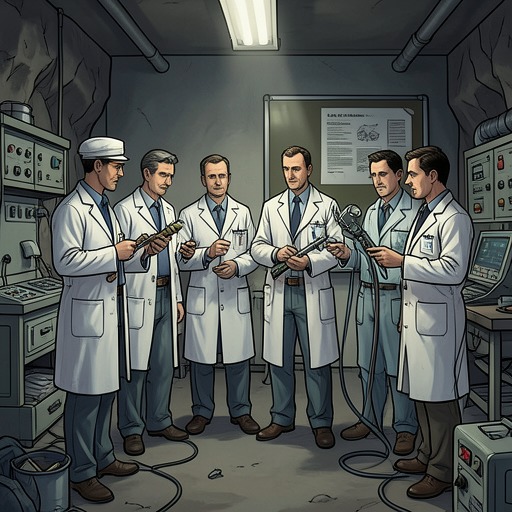
Before the expedition sets out, Professor Hardwigg assembles instruments, arms, tools, and provisions into four separate groups. The instruments are chosen as practical means of measuring and navigating an environment whose conditions are uncertain. Among them is the Ruhmkorff's coil, an instrument whose light will make it possible to inspect the subterranean passage rather than descend through it in darkness.
The coil belongs to a broader system of expedition equipment, including a thermometer and a manometer. These instruments promise observation and measurement, but the journey will also expose their limits: instruments can help the travelers encounter the unknown, yet cannot make the underground world safe or predictable.
Light in the Underground World
The lamp's light gives the travelers a vivid view of mineral formations. In one gallery, it is multiplied by countless prismatic masses of rock, sending colored rays in every direction. Henry imagines himself passing through a vast hollow diamond. The scene briefly turns the buried passage into an extraordinary display, with the lamp functioning as the condition that makes its changing surfaces perceptible.
That spectacle is temporary. As the light diminishes, the gallery's brilliance gives way to a somber, crystallized appearance; mica mingles with feldspar and quartz, and granite closes around the travelers like an immense prison. The contrast binds illumination to confinement: the coil reveals the scale and beauty of the underground landscape, but the rock remains an enclosing material reality beyond the travelers' control.
Damage and Darkness
Later, Henry's lamp falls and is put out of order. He has no means to repair it. The luminous current in the coil steadily weakens, and the last light throws moving shadows across the granite wall. Henry watches the remaining glow, afraid that lowering his eyelids might cost him the final spark.
When the flame finally disappears, the change is more than a loss of visibility. Henry distinguishes the absolute obscurity around him from ordinary darkness, in which some diffuse light remains for the eye to find. Here, he says, nothing remains; the darkness makes him blind in every sense. Unable to orient himself, he runs down the labyrinth, striking pointed rocks, falling, and injuring himself. The coil's failure thus turns an instrument problem into a bodily emergency.
Narrative and Material Significance
The coil's importance lies in its double function. While it works, it enables observation and produces the expedition's most dazzling visual impressions; when it fails, its material dependence becomes impossible to overlook. Light is not an abstract assurance but a finite current sustained by a vulnerable device, and the travelers' knowledge of their surroundings depends on that device continuing to work.
The contrast between the brilliant gallery and Henry's sudden blindness also gives the lamp's failure structural force. A tool that had made the subterranean world legible becomes the cause's opposite: without its light, the passage cannot be read, and Henry loses both direction and self-command. The coil therefore marks the boundary between seeing the underground world and being trapped within it.