Saknussemm’s document
A Journey to the Centre of the EarthSaknussemm’s document is the small, cryptic parchment that sets Professor Hardwigg’s expedition in motion and continues to shape how its journey is understood after the explorers return. First treated as a possible cipher attached to an old book, it becomes a practical warrant for entering the Earth; at the end, the Professor deposits it in the town archives, while Henry Lawson’s retrospective judgment associates it with a voyage that should never have begun.
Identification and Interpretation
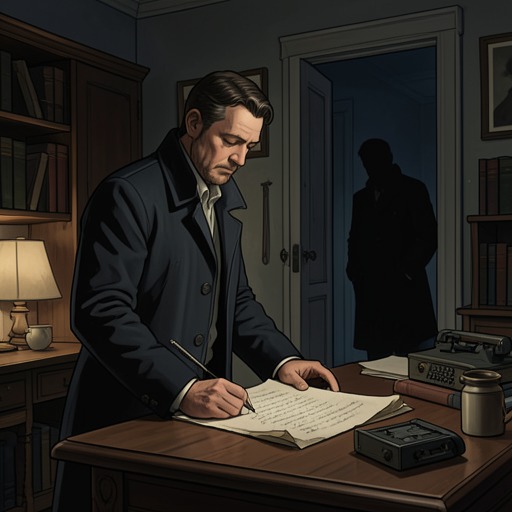
Professor Hardwigg compares the parchment with the manuscript volume in which it is found and notices that they are written in different hands. He argues that the parchment is later than the book: its first letter is a double M, a form he says entered Icelandic only in the twelfth century, making the document two hundred years posterior to the volume. That dating supplies what he calls proof that the cryptogram is genuine, but Henry Lawson regards the argument as conjecture rather than certainty. The distinction is important: the parchment’s authority rests not on a transparent account but on a chain of interpretation that the Professor finds compelling and his companion remains unsure of.
The object’s importance lies in this gap between evidence and conviction. The Professor’s reading transforms an obscure inscription into an invitation to travel, even though Henry’s doubts persist. The parchment therefore operates at once as a material clue and as a disputed claim: it can direct action without settling, for every reader, whether the inferences built upon it are secure.
From Clue to Expedition
The document’s interpretation leads Professor Hardwigg to pursue the route into the Earth. Once the expedition reaches Iceland, his priorities make the parchment’s effect plain: he tells Henry that what interests him is not what lies above the surface but what lies below. The message has redirected scholarly attention from the visible island to the hidden passage the travelers believe it can disclose.
That conversion from reading to action is reinforced by the expedition’s practical preparations. Before the final departure, the travelers sort instruments, arms, tools, and provisions into separate groups, and Professor Hardwigg records their progress in a notebook. The contrast between these carefully ordered materials and the uncertain document is revealing: equipment can be packed and measured, but the expedition’s governing direction depends on a text whose meaning has to be inferred.
At Sneffels, the route becomes a physical descent. Professor Hardwigg devises a way to lower the travelers down the shaft using a cord at least four hundred feet long, divided into successive lengths so that each person can continue downward and recover the rope. The document’s promise thus takes material form in a hazardous procedure: a written clue does not itself make the passage safe, and the descent’s practicality does not resolve the narrator’s concern about how they will climb back out.
A Journey Tested by Experience
As the explorers travel, measurement and observation complicate the confidence with which the expedition began. When the thermometer indicates 27.6 degrees, Professor Hardwigg contrasts that result with the much higher temperature predicted by the theory he had previously accepted, declaring that the evidence of experience has overturned the proportional increase in temperature and vindicated Humphry Davy. The document may have supplied the journey’s direction, but it cannot settle what the travelers encounter along the way; their conclusions must answer to instruments and observations as well as to the text.
The expedition’s distance is likewise converted into written record. After traveling 270 leagues—more than 800 miles—across the inland sea, Henry calculates that they are 620 leagues from Iceland and exactly beneath England. His journal makes their extraordinary position legible in the language of travel measurement, while the route that began with the parchment has carried the explorers far beyond the familiar geography from which they set out.
The journey’s material dangers give the document a darker retrospective meaning. In a moment of danger at sea, Hans seizes Henry before he can fall into the waves and drown. Later, hungry and reduced to the last remnant of their provisions, Henry looks back on his own folly and declares that, despite Professor Hardwigg’s enthusiasm and the “ever–to–be–hated scroll of Saknussemm,” his uncle should never have started the perilous voyage. The same object that promised a path of discovery has become, in Henry’s judgment, a symbol of the decision that exposed them to mortal risk.
Return and Public Record
After the expedition, the document remains consequential because it carries the travelers’ claim back into public life. At a meeting of the Johanneum Institution, Professor Hardwigg recounts the adventures, omitting the facts concerning the compass. That same day, he deposits the document he found written by Saknussemm in the town archives. Its placement there turns a private and hazardous prompt into a preserved public record, even as the Professor expresses regret that circumstances prevented him from following the Icelandic traveler’s track into the very centre of the Earth.
The parchment’s ending is therefore not a final proof that every promise associated with it has been fulfilled. It survives the expedition and is formally preserved, but the travelers have not reached the centre that Professor Hardwigg sought. For Henry, its force remains double: it is the clue around which the adventure was organized and the hated scroll bound to a voyage whose risks, in retrospect, outweighed the original enthusiasm.