Saknussemm's instructions
A Journey to the Centre of the EarthSaknussemm's instructions are the practical heart of the cryptogram that sends Professor Hardwigg and Henry into the Earth: a compressed Latin message identifies a particular crater of Sneffels, specifies a time of year, and makes the shadow of Scartaris the means of locating the entrance. The clue is not merely a promise of a destination. It sets a test the explorers can observe, and its fulfillment turns a disputed possibility into the expedition's point of departure.
The cryptogram and its directions
The message names the crater of Yocul of Sneffels, says it is caressed by Scartaris's shadow, and instructs the audacious traveler to descend before the Kalends of July. It concludes with the claim that the Earth's centre will be reached and with Saknussemm's assertion that he himself did it. In this form, the instructions combine a route, a deadline, a landmark, and a prior traveler's testimony. The last claim lends the descent a precedent, while the directions make it seem repeatable rather than dependent on a vanished secret path.
The wording is initially obscure enough to provoke doubt. Henry accepts that Saknussemm may have found an entrance and described it correctly, but regards the suggestion that anyone actually followed the route as madness. Professor Hardwigg, by contrast, reads the reference to Scartaris and the date as exact operational guidance. Since Sneffels has several craters, he reasons, the shadow identifies the one that opens onto the Interior of the Earth. His explanation shifts the cryptogram from a tantalizing historical claim into a problem of observation and timing.
How the shadow identifies the entrance
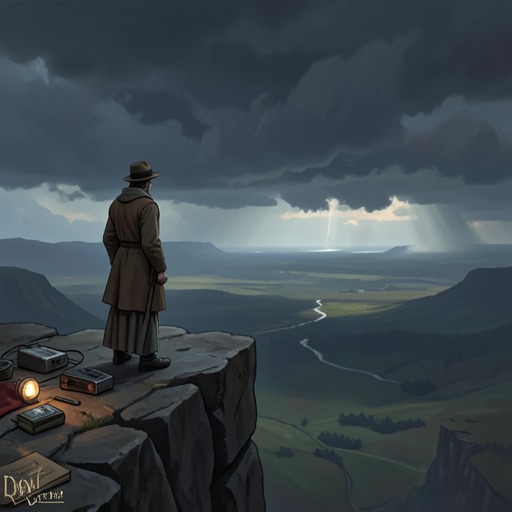
The instruction depends on a conjunction: the explorers must be at the crater when sunlight allows Scartaris's shadow to fall on the correct opening. From the summit of Sneffels, Professor Hardwigg explains that the peak acts like the stylus of a vast sundial. On a particular day near the end of June, its shadow points to the chasm that leads inward. The image makes the mountain itself an instrument: the route is encoded not in a map or a marked trail, but in the changing relation between peak, sun, and crater.
The method also imposes a real limitation. Three openings lie beneath the party, but only one can be identified by the shadow. Cloud cover can hide the sun and therefore conceal the sign. When the sky remains overcast, the explorers face the prospect of waiting another year; Henry, already weary of the undertaking, considers that delay a relief. The instruction thus creates suspense through a condition that neither confidence nor interpretation can overcome: without the visible shadow, the party cannot distinguish the intended shaft.
The instruction fulfilled
After days of cloud, the weather changes on June 28, with the sun shining down into the crater. Scartaris's shadow becomes clear and moves across the ground as the day advances. Professor Hardwigg follows it in mounting excitement until, at exactly noon, when the sun reaches its highest point, the shadow falls on the edge of the central pit. The timing and position match the instruction's essential promise: the landmark has indicated the opening.
Professor Hardwigg announces that they have found it and urges the party forward into the Interior of the Earth. Hans answers with his customary calm assent, while Henry's earlier skepticism gives way to the immediate reality of the chosen entrance. The moment confirms the clue within the story's terms, but it does not independently verify every claim in the cryptogram: the shadow identifies the shaft, whereas reaching the Earth's centre remains a goal rather than an established outcome at the point of descent.
From written clue to expedition route
The instruction's authority rests on the conversion of writing into action. A cryptogram that might have remained an antiquarian puzzle becomes a schedule and a field procedure: reach Sneffels, wait for the end of June, observe Scartaris's shadow, and descend through the pit it marks. Professor Hardwigg's interpretation supplies the reasoning; the mountain and the sun provide the visible check; the party's entry supplies the consequence. The episode makes a hidden route legible by joining textual decipherment to measurement and travel.
That method also shapes the expedition's way of knowing places. Iceland first appears to Henry through named landmarks, mapped relations, and descriptions of terrain; at the crater, those geographical observations become instructions for movement. The explorers do not simply encounter an opening and declare it significant: they use Saknussemm's words to distinguish it from two alternatives. The resulting certainty is powerful but bounded. The shadow can select a route, not guarantee what lies below or prove in advance that Saknussemm's promised destination will be reached.
Significance
Saknussemm's instructions bind mystery to a public, repeatable sign. The cryptogram withholds its meaning until Professor Hardwigg interprets the references, but the decisive confirmation is visible to the entire party: at noon, Scartaris's shadow touches the central pit. That transition from difficult text to observable event gives the expedition its threshold and makes the clue more than a boast about a previous journey.
The rule's precision carries a counterpoint. The directions appear authoritative, yet their use depends on a narrow window of light and weather; cloud can suspend the journey for a year, and the promised centre remains beyond the entrance. The instructions therefore function both as a solution to the immediate riddle and as a limit on what the explorers know. They establish where and when to begin, while leaving the meaning and outcome of the descent open.