Silurian Period
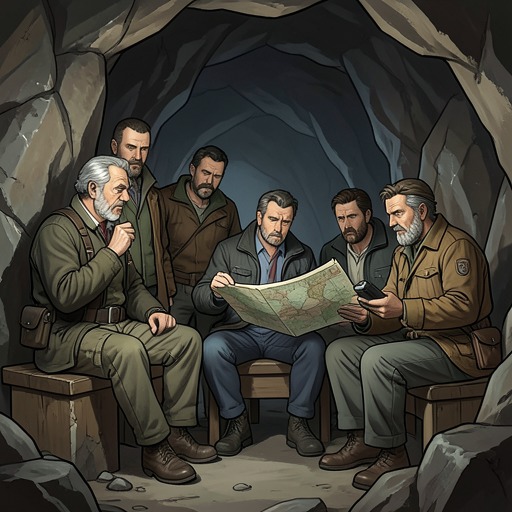
A Journey to the Centre of the EarthThe Silurian Period is presented as an early chapter in the Earth’s history that the explorers appear to encounter beneath the surface. Its importance lies in the way geological time becomes tangible: strata and fossil impressions invite classification, but the observations also expose disagreement between Henry Lawson’s confidence in what he sees and Professor Hardwigg’s resistance to conclusions drawn too quickly. The sequence makes the period both a scientific category and a stage in the expedition’s changing understanding of the world below.
Geological setting and interpretation
As the gallery changes from shining lava to living rock, Henry identifies the formation as a transition into Silurian strata. He explains the name by reference to the Silures, the Celtic people associated with the English counties where this early formation is common. The change in the tunnel’s walls thus prompts a change in his account of their route: the explorers seem to have left granite behind and entered rocks formed from sediment deposited beneath ancient waters.
Henry connects the exposed calcareous rocks and slate strata with a decisive threshold in the history of life. In his interpretation, they mark the time when the first plants and animals appeared. His account turns the descent into a journey not simply through space but backward into successive ages of the planet. Yet he presents this geological reading as an inference to be tested, not merely as a description of the stone.
Fossils as evidence
To test his interpretation, Henry searches for traces of primitive life. After walking about a hundred yards, he finds the ground has changed from hard, arid lava to soft dust composed of plant and shell remains. He notes that Silurian seas contained fifteen hundred animal and vegetable species, giving the fossil-bearing material a context within the abundance of ancient life.
The walls provide more specific evidence: Henry recognizes outlines of fucus and lycopods, impressions that appear as clear as a picture. He believes these forms support his reading of the rocks, but Professor Hardwigg continues walking with an unaltered step. Henry suspects that his uncle is deliberately refusing to look; the disagreement is therefore not only about what the strata mean, but about whether the visible evidence should be allowed to interrupt the expedition’s progress.
Henry then secures a nearly perfect shell and presents it to the Professor. Hardwigg identifies it as belonging to the extinct crustacean order of trilobites, but treats that identification as the limit of what can be concluded. Henry wants the specimen to confirm a larger account of the geological period; his uncle’s composed response separates the reliable act of classification from the broader historical inference Henry hopes to draw.
A sequence of geological time
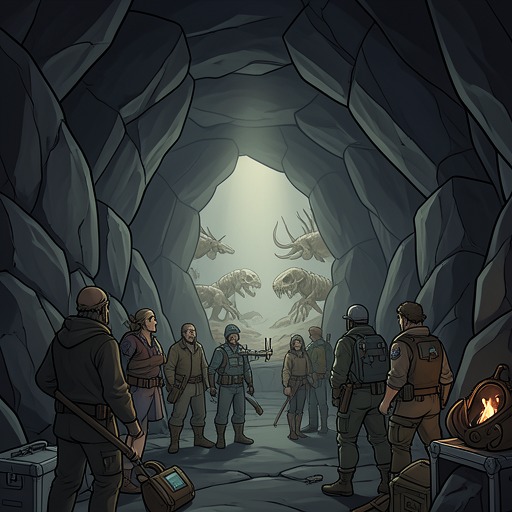
The route continues beyond the deposits Henry associates with the Silurian Period. Farther along, the walls display the remains of more developed forms of life, including fish that Henry recognizes as an advance beyond rudimentary trilobites. He interprets this succession as an ascent through the scale of animal life, with humanity at its summit, while Professor Hardwigg presses onward without responding to what Henry regards as warnings in the rocks.
That progression gives the Silurian material a structural role in the journey. The fossil plants, shells, and trilobites establish an early point in a sequence that the explorers appear to traverse through exposed strata. Geological classification becomes the narrative’s means of making immense spans of time legible: a change in rock, followed by a change in fossil form, suggests that the underground route passes through more than a succession of tunnels.
Scientific certainty and deep time
The book sets Henry’s observations within nineteenth-century disputes over how far back human existence could be placed. In its account of the Moulin-Quignon discovery, a human jawbone found fourteen feet below the ground near Abbeville in 1863, together with stone tools, becomes the focus of a controversy over whether people lived during the Quaternary Period. Professor Hardwigg is described as a committed supporter of the jawbone’s authenticity, while Elie de Beaumont disputes the age assigned to the deposits and rejects the conclusion that humans were contemporary with Quaternary animals.
Further finds in France, Switzerland, and Belgium strengthen the case for human presence in the Quaternary, while carved fossil bones from still older, Tertiary deposits lead some scholars to argue for a much greater human antiquity. The narrative presents these positions as part of the scientific context in which the explorers confront prehistoric remains. It does not make the Silurian Period itself proof of those claims; rather, the deep geological sequence gives the later debate about human time its larger scale.
The period’s literary force comes from the friction between a named scientific framework and the sensory objects that seem to confirm it. Henry moves from layered rock to plant impressions and a trilobite shell, building an argument step by step; Hardwigg recognizes the fossil but declines Henry’s wider conclusion. That contrast keeps observation, classification, and interpretation distinct, even as the underground journey makes geological time appear traversable.