Stapi
A Journey to the Centre of the EarthStapi is a small settlement on the southern slope of the Sneffels peninsula, at the foot of the volcano that Professor Hardwigg intends to explore. The expedition reaches it after a difficult journey across Iceland, and leaves from there with provisions, tools, and hired porters for the crater. Stapi marks the change from overland travel through inhabited country to a descent into the unknown: a practical staging ground whose ordinary arrangements—lodging, transport, water, and provisions—make the extraordinary expedition possible.
Setting and arrival
Stapi is described as thirty huts spread over a broad lava plain, where the volcano reflects the sun’s heat. The settlement lies at the end of a small fjord and is enclosed by a remarkable wall of basalt. The regular forms of the rock strike the narrator as almost architectural, a sharply ordered contrast with nature’s more irregular accumulations elsewhere. The village’s setting makes the geology that draws the travellers onward part of its everyday surroundings.
The party reaches the presbytery after four hours of steady travel from Budir. The arrival follows an exhausting journey whose estimated duration had expanded when Professor Hardwigg learned that Hans’s twenty-two miles were Danish miles, each eight thousand yards long; on the bad roads, he had allowed eight or ten days. The horses carry the travellers and baggage until they can go no farther, and Stapi becomes the point at which the expedition must reorganize for the climb.
Lodging and preparations
The presbytery offers the travellers a room that the narrator finds narrow, dirty, and offensive. Its rector proves a poor host, and Professor Hardwigg, disappointed in the man, decides not to linger. The expedition’s stay is therefore brief: instead of resting for several days, as the narrator would have preferred after the road, the professor presses on with his plan to explore the volcano as far as possible.
The next day Hans hires three Icelanders to replace the horses as carriers, since the animals can no longer bear the baggage. The arrangement is carefully bounded: the men agree to carry the loads only as far as the bottom of the crater, where they will turn back and leave the explorers to continue alone. That negotiated limit makes Stapi the last point at which the expedition can rely on local assistance.
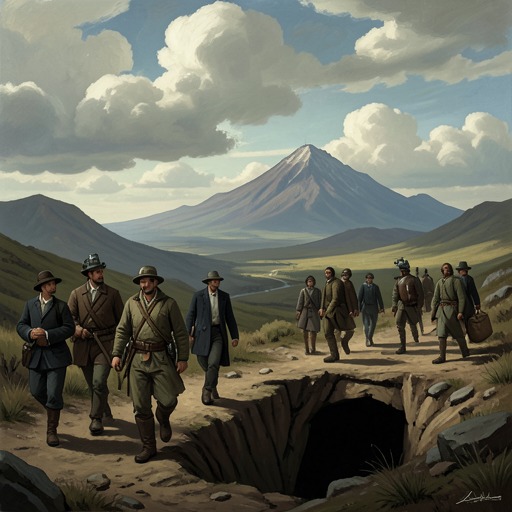
On June 23, Hans waits outside the presbytery with the three porters and the expedition’s provisions, tools, and instruments. Two iron-shod poles, two guns, and two large game bags are set aside for Professor Hardwigg and his nephew, while Hans adds a large skin of water to their gourds, enough, he judges, for eight days. The scene presents the departure not as a leap into the unknown without preparation but as a carefully equipped undertaking, dependent on the guide’s attention to practical details.
The guide and the route
Hans Bjelke is the expedition’s guide, recommended to Professor Hardwigg by M. Fridriksson. A hunter of the eider duck, he is taciturn and unhurried, in marked contrast to the professor’s impulsive energy. Their temperaments differ, but they reach an understanding without difficulty: Professor Hardwigg is willing to offer what Hans asks, and Hans is prepared to accept what is offered. Hans agrees to lead the party to Stapi and onward toward Sneffels, knows the coast intimately, and promises the shortest route.
The professor’s purpose is not concealed from Hans indefinitely. At Stapi he gives the guide to understand that he means to pursue his exploration of the volcano to the last possible limits. The porters’ agreement, the water supply, and the choice to leave the horses behind all follow from that ambition. Stapi thus gathers the expedition’s human and material arrangements into one point before the route narrows toward the crater.
Departure and narrative significance
The departure is preceded by an unpleasant reckoning with the presbytery’s hosts, who present a large bill that includes the use of their lodging. Professor Hardwigg pays without bargaining; his commitment to reaching the Interior of the Earth outweighs the expense. Once the payment is settled, Hans gives the signal, and the party leaves Stapi.
The village’s importance lies in this role as a threshold rather than a destination. It is at once a place of shelter, a last inhabited stop, and the point where the expedition’s dependence on local labour is explicitly limited. The travellers leave with Hans, three carriers, and provisions intended to sustain them underground; beyond the crater, they will be on their own. Stapi therefore gives the descent a concrete beginning, grounding the professor’s immense scientific ambition in the small but essential logistics of a journey.