The Central Sea Storm and the Reversal of the Voyage
A Journey to the Centre of the EarthThe Central Sea storm and the Reversal of the Voyage is the catastrophe that turns the expedition’s crossing of the underground sea into an involuntary return. A storm overwhelms the raft, an electrical globe disrupts its metal equipment, and the survivors are cast onto a shore. Only after the immediate danger has passed does the compass reveal the full reversal: a sudden change in the wind has carried them back to the coast they had left, apparently for good.
Warning and the Decision to Keep Sailing
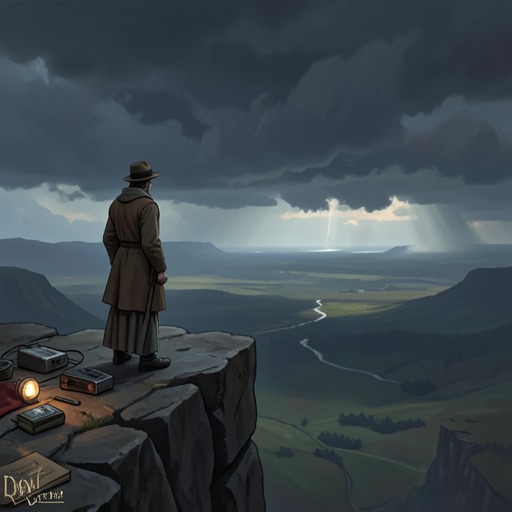
On Friday, August 21, the great geyser had disappeared from sight, and the expedition was moving away from Henry's Island. The wind had freshened, while vapors gathered above the saline waters and the clouds descended toward the sea. Their darkening appearance foreshadows not merely a change in weather but a new contest with the elements, replacing the earlier spectacle of animals fighting beneath the surface.
Henry recognizes the danger and proposes lowering the sail as a prudent precaution. Professor Hardwigg refuses. He would rather let the storm carry the raft toward some visible coast, even at the risk of its destruction, than abandon the chance of finding land. The exchange establishes the expedition’s immediate conflict: caution might protect the raft, but keeping the sail up preserves the possibility of reaching shore. Almost as soon as Hardwigg insists on continuing, the accumulated vapors turn to rain and the air becomes a tempest.
The Storm and the Electrical Globe
The storm strikes from every direction within the cavern. The raft rises and falls on the waves, while the darkness deepens; later, lightning flashes through the clouds and thunder reverberates across the sea. The scene reverses the apparent security of the earlier crossing. The explorers are afloat, but neither sail nor navigation can give them control over the forces surrounding them.
By Monday, August 24, the storm has continued for days, and the raft has traveled two hundred leagues from the newly discovered island while running southeast. The party is exhausted. They lash the cargo to the deck and secure one another, yet waves repeatedly sweep over them. For three days and nights they cannot make themselves heard, even when they put their mouths close to one another’s ears. The storm thus isolates the travelers within their own small group as well as separating them from any visible coast.
When Hardwigg finally agrees to take in the sail, a globe of fire appears at the raft’s edge. It carries away the mast and sail, then moves across the raft, passing over the provisions before landing on the powder barrel. The discharge also turns the iron objects aboard into loadstones: tools, weapons, and instruments are drawn together, and Henry’s boot nails adhere to an iron plate set into the raft’s wooden flooring. He manages to wrench his foot free just before the globe bursts. The explosion fills the space around the raft with light; afterward, darkness returns. Henry sees Professor Hardwigg apparently senseless and Hans at the helm, affected by the electrical discharge. The storm has not simply carried the raft off course: it has stripped away its sail, threatened its stores, and made its metal fittings part of the danger.
Wreck and Rescue
The storm’s shock ends Henry’s journal of the raft voyage, which survives the wreck. In the narrative that follows, he cannot recall the precise moment the raft was thrown onto the rocky shore. He remembers being cast into the waves and then saved by Hans, who seizes his arm and pulls him from danger. Hans carries him beyond the reach of the water and lays him on a sandy expanse; some time later, Henry finds himself there with Professor Hardwigg. The change from the journal’s dated record to Henry’s retrospective account marks a break in what he can remember, while the saved journal preserves the voyage that led to the wreck.
The Compass and the Reversal
The party’s landing does not immediately tell them where they have been carried. The decisive evidence comes when Professor Hardwigg points Henry toward the compass. Its needle indicates north in the direction they had expected to be south, pointing toward the shore rather than out to sea. Henry tests it, but the instrument appears undamaged, and the needle returns to the same unexpected direction when moved.
The compass turns the storm’s consequence into a geographical fact. The explorers conclude that a sudden shift in the wind during the tempest, unnoticed while they struggled against it, has driven the raft back to the shore they had left days before. Their apparent progress across the sea has therefore been reversed. The instrument that might ordinarily guide their course instead exposes how little they knew of it: the storm concealed the change, and the compass reveals the return only afterward.
Narrative Significance
The episode converts forward motion into a return without the explorers choosing to retrace their route. Hardwigg’s determination to keep the sail up expresses the hope of finding a coast, but the storm delivers the party to a coast they have already departed. The distinction between intention and outcome gives the reversal its force: they seek new ground and reach familiar ground again, carried there by a change they never observed.
The passage also changes how the expedition’s progress is recorded. Henry’s journal stops at the storm’s electrical climax; the surviving account resumes retrospectively after the wreck, where gaps in memory reflect the violence of the interruption. The compass then supplies what memory cannot: not an account of every movement, but clear evidence that the expedition’s route has turned back. The crossing has ended, yet its outcome is not a new destination but the discovery that the travelers have been returned to their earlier shore.