The Descent into Sneffels's Central Shaft
A Journey to the Centre of the EarthThe Descent into Sneffels's Central Shaft marks the point at which Professor Hardwigg’s expedition leaves preparation behind and begins its dangerous descent into the unknown. The shaft is both a physical threshold and a test of resolve: Harry nearly falls while looking into its immense depth, Hans saves him, and the Professor’s practical ingenuity turns an apparently impossible descent into a sequence of controlled stages. The explorers reach the bottom, but not the Interior of the Earth itself; an oblique tunnel promises the next leg of the journey.
The Threshold and the Abyss
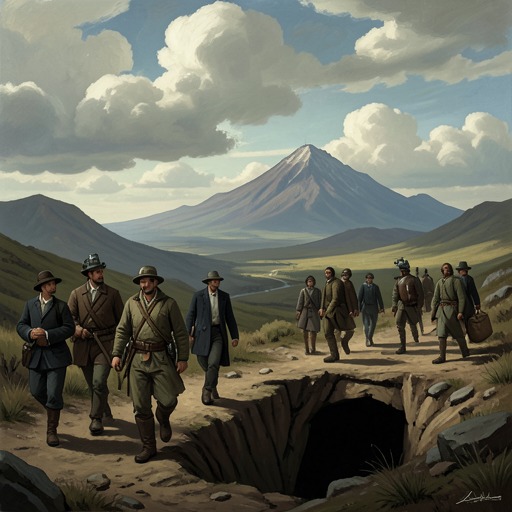
The expedition’s “real journey” begins after earlier difficulties have tested its courage and determination but caused only fatigue. Ahead lie unknown dangers. Harry still has the option of refusing to take part, yet the calmness of Hans, the Icelandic guide, makes Harry ashamed to display more fear than he does. Rather than debate the decision with his uncle, Harry thinks briefly of his cousin and advances toward the central shaft.
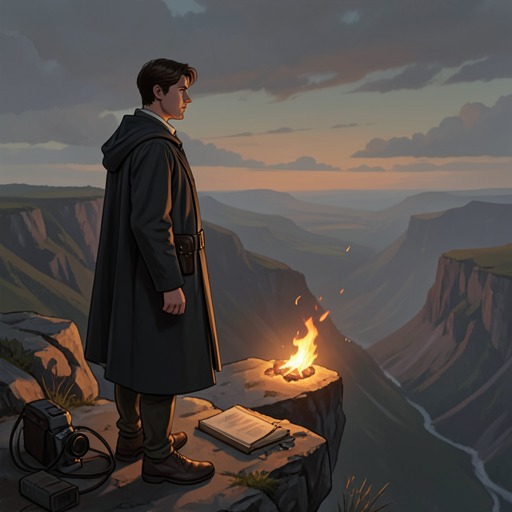
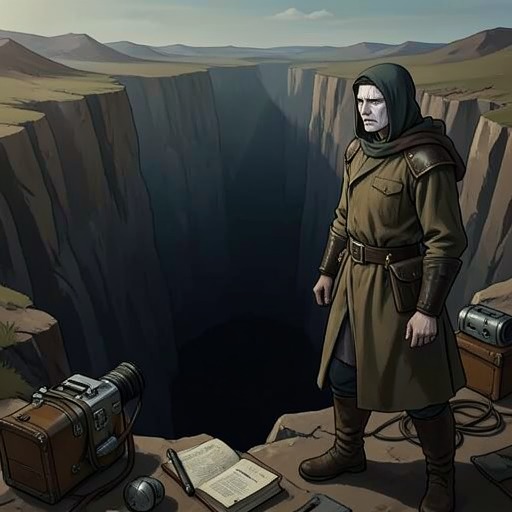
The opening measures about a hundred feet across and roughly three hundred feet in circumference. Leaning over its rim, Harry feels his hair rise, his teeth chatter, and his limbs tremble; he loses his sense of balance and nearly falls headlong into the abyss. Hans catches and pulls him back with a firm hand. Harry’s fear is not simply a judgment that the route is hazardous: he describes the abyss as exerting a powerful attraction, so that looking down threatens to become a physical fall.
After recovering, Harry studies the shaft enough to make out its nearly perpendicular sides and their projecting ledges. The rock offers what looks like a wild staircase, but no railing or barrier protects the descent. A rope anchored above might support the explorers on the way down, yet Harry immediately sees the practical problem: once they reach the bottom, they would need a way to release it from its upper fastening. The scene turns on the difference between seeing a possible route and having a workable means of using it.
The Rope and the Baggage
Professor Hardwigg answers the problem with a cord about as thick as Harry’s thumb and at least four hundred feet long. He lays one half down the shaft and catches it over a large block of lava at the edge, then drops the second half after it. The doubled cord gives each explorer a handhold; after descending about two hundred feet, a climber can release one end and pull the other until the cord drops to his feet. The method can then be repeated farther down. It solves the immediate problem of advancing in stages without leaving the rope fixed above them.
The Professor’s confidence in the descent does not entirely reassure Harry, whose attention turns to the difficulty of returning upward. Meanwhile, the expedition’s equipment has to be divided among the three travelers. Hardwigg assigns Hans the tools and some provisions, Harry another share of food and the arms, and himself the remaining provisions and the delicate instruments. He also orders the nonfragile baggage bundled together and, rather than carrying it down by hand, has the packet thrown over the edge. The sudden rush of displaced air and falling stones accompanies its disappearance into the depths.
The explorers follow in a different order from the one in which the baggage is sent down: Hans goes first, Hardwigg after him, and Harry last. The Professor carries his instrument case, Hans the tools, and Harry the arms. Their descent depends on both the cord and the shaft’s own irregular rock ledges. Harry clings to the doubled line with one hand and uses his iron-shod pole to keep himself away from the walls, while fearing that the upper support may fail under the combined weight of the men and their luggage. He tries to rely as little as possible on the rope, trusting his balance and the projecting shelves of lava instead.
A Descent in Stages
The descent proceeds in profound silence, broken by pieces of rock snapping off the jagged sides and roaring down below. When a slippery foothold gives way beneath Hans, he warns the others in Icelandic; Hardwigg repeats the warning for Harry. The guide’s brief alert makes the danger immediate, while the order of descent leaves him in front to encounter the unstable footing first.
After about half an hour, the three reach a small terrace formed by a rock projection. There Hardwigg’s method requires the cord to be hauled up on one side while the other end runs down. When it finally drops, it brings a shower of small stones, lava, and dust onto the waiting explorers. The ledge offers a pause, but Harry looks down again and still cannot see the bottom. The scale of the shaft remains uncertain even after the descent has begun.
They repeat the operation and, after another quarter of an hour, reach a further depth of two hundred feet. The measured intervals give the descent a rhythm of improvised ascent-by-stages: find a foothold, lower or recover the cord, and continue. Harry admits that he pays little attention to the geological layers surrounding him; whether the explorers are among carbon, Silurian formations, or primitive soil is of little concern to him. Hardwigg, by contrast, continues to observe and take notes, maintaining the scientific purpose of the expedition even as Harry concentrates on the immediate demands of survival.
The Bottom of the Shaft
At a later halt, Hardwigg declares that they have reached the end of their journey. Harry mistakes this for the Interior of the Earth, but his uncle clarifies that they have reached only the bottom of the well. Harry asks hopefully whether further progress is impossible. It is not: Hardwigg can dimly see a tunnel turning obliquely to the right. He proposes that they investigate it the next day, after supper and sleep.
The arrival therefore resolves one immediate question without ending the expedition. The explorers have crossed the crater’s vertical shaft, but the bottom is a stopping place, not their destination. Harry recognizes that he is already committed to a desperate course and can only go forward, hoping and trusting. Even at the bottom, it is not wholly dark; light filters down in an extraordinary way, leaving the shaft’s upper world perceptibly connected to the route below.
Significance in the Expedition
The descent establishes the practical conditions that will govern the underground journey. Progress depends on adapting tools and materials to the terrain: a cord, a lava block, iron-shod poles, ledges, and carefully divided loads make movement possible, while loose rock and uncertain footholds threaten it. The equipment is not incidental scenery; the rope system determines the pace and form of the descent, and the baggage arrangements distribute essential supplies and responsibilities among the travelers.
The episode also sets Harry’s anxious perspective against the contrasting composure of his companions. Hans’s steady manner and quick rescue expose the gap between Harry’s resolve and his fear, while Hardwigg’s confident improvisation keeps the expedition moving. The narrative’s measured stages—two hundred feet, a terrace, another two hundred feet—give structure to a space whose bottom is initially invisible. Reaching it is a consequential advance, but the oblique tunnel prevents that apparent endpoint from becoming a conclusion: the descent ends only to open onto a new passage.