The Eastern Tunnel
A Journey to the Centre of the EarthThe Eastern Tunnel is the ill-chosen branch that turns the descent beneath Sneffels into a prolonged detour. Selected at a junction with no signs to guide the explorers, it carries Professor Hardwigg, Henry, and Hans away from the lava route and eventually into a coal-bearing passage that ends at a solid wall. The tunnel’s changing geology makes the mistake legible, but only after the journey has imposed exhaustion and a dangerous shortage of water.
The junction and the choice
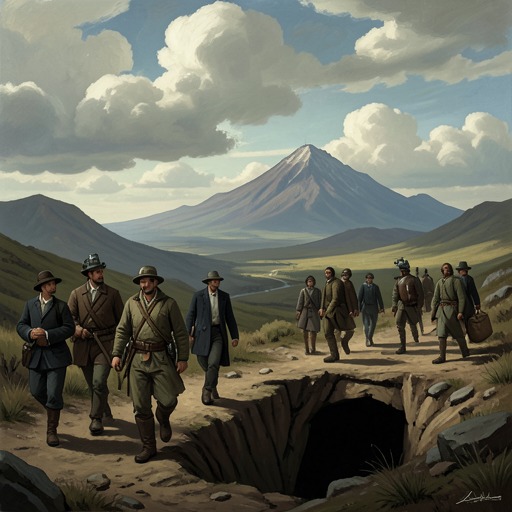
On Tuesday, June 30, at six in the morning, the party resumed its descent along a natural gallery of lava, an inclined passage easy to walk down. At seventeen minutes past twelve, it rejoined Hans, who had gone ahead and stopped. The explorers had reached the end of the shaft and stood at the center of four narrow, somber tunnels. Nothing in the junction indicated which passage to take.
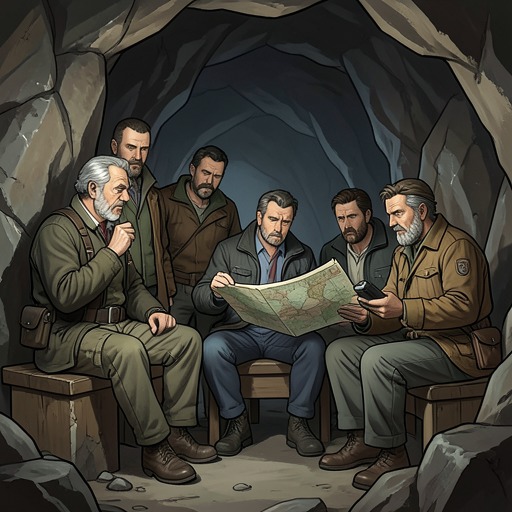
Professor Hardwigg chose the eastern branch without delay. Henry’s account suggests that the decision was made partly to avoid showing hesitation before his nephew or their guide; in any case, the lack of distinguishing clues left them to trust to chance. The tunnel thus begins not with evidence that it is the correct route, but with an unverified choice presented as necessary because the landscape offers no readable direction.
A passage that misleads
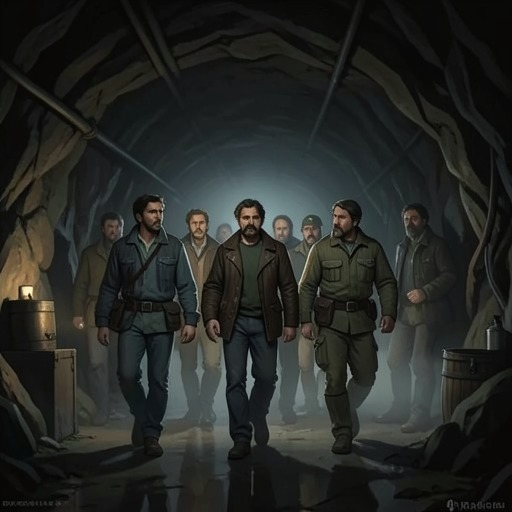
The Eastern Tunnel descended gradually along a winding course. Its galleries opened into successive arches that reminded Henry of the aisles of a Gothic cathedral; farther on, about a mile from the earlier passage, a square Roman-style arch projected from the solid rock to support the roof. These forms made the underground route seem almost constructed, inviting comparison with familiar architectural traditions even though the passage was a natural feature.
That resemblance could not establish where the tunnel led. As the party continued, Henry concluded that it had left the lava region and could not return them to the great crater of Sneffels. The change in the rock offered a stronger indication than the arches had: the explorers were no longer on a route that could plausibly take them back to the crater. Professor Hardwigg did not answer Henry’s attempt to draw his attention to the evidence. Henry could not tell whether his uncle understood the warning, was unwilling to admit that his choice had been wrong, or meant to pursue the passage to its end.
The coal strata and the dead end
The tunnel’s geology changed again after the explorers pushed onward. Following roughly ten more hours of monotonous progress, Henry noticed that the lamps no longer reflected brightly from the walls. Marble, schist, limestone, and red sandstone had disappeared, replaced by a dark, dull surface. When he braced his left hand against the rock and pulled it away, it was black: the party had reached the coal strata of the Central Earth.
The coal passage extended the detour rather than resolving it. The party spent the day crossing the mine-like gallery, while Professor Hardwigg grew impatient that the route continued horizontally instead of descending. Darkness made it impossible to judge how far the passage ran; Henry began to fear that it might continue indefinitely. At six o’clock, the tunnel abruptly terminated at a wall. There was no opening to the right or left, above or below. Hans folded his arms, Henry stood stunned, and Professor Hardwigg fell silent.
The retreat and its cost
The wall settled the question the junction had left open: this was not the route followed by Saknussemm. Professor Hardwigg therefore proposed turning back, resting for the night, and returning within three days to the point where the galleries divided. His confidence in the timetable contrasted with Henry’s concern that their strength might not last through the return.
The danger was already physical, not merely navigational. During the night before the party reached the coal seam, Henry had felt the gnawing agony of thirst, which diminished his appetite. The long, silent march through the winding gallery had left the explorers gloomy, and Henry believed even his uncle had gone too far. The Eastern Tunnel’s dead end therefore forced a reversal at the point when endurance was already in question; reaching the junction again would require retracing the same route that had consumed their time and strength.
A route measured by uncertainty
The tunnel is a test of the expedition’s methods as much as a geographic obstacle. At the junction, Professor Hardwigg has no reliable basis for choosing a branch, and the party’s progress initially supplies suggestive but inconclusive signs: natural arches, changes in rock, and finally the black mark left on Henry’s hand. The route turns geological observation into practical evidence, but only after the explorers have committed themselves to the wrong passage.
Its sequence of apparent order and actual failure sharpens the contrast between description and direction. The Gothic and Roman architectural analogies make the cavern legible to Henry’s imagination, yet neither can tell the party where it is going. The coal seam, by contrast, is identified through direct contact, and the terminal wall makes the route’s failure undeniable. The Eastern Tunnel is therefore remembered not as a way deeper into the earth, but as a costly detour whose final certainty is that the explorers must go back.