The Expedition to Iceland
A Journey to the Centre of the EarthThe Expedition to Iceland is the opening overland-and-sea passage of Henry Lawson and Professor Hardwigg’s journey toward Sneffels, the volcano through which they intend to enter the Interior of the Earth. It converts the Professor’s reading of Saknussemm’s cryptogram into action: papers, equipment, hurried arrangements, and a dangerous voyage carry the explorers out of Europe and bring them within sight of their destination. Through Henry’s account, the departure is at once a feat of logistical preparation and a steady displacement of familiar life by the unknown.
From decipherment to departure
The expedition becomes inevitable when Professor Hardwigg treats the parchment not as meaningless writing but as a historical document. Comparing it with the manuscript book, he argues that the two were written in different hands and that the parchment is later: its initial double M, he says, entered Icelandic only in the twelfth century, making the document two hundred years posterior to the volume. Henry finds the reasoning plausible but still speculative. The Professor presses on, proposing that the sentence was written by an owner of the book and looking for a name elsewhere in the volume. The distinction between proof and surmise is present at the expedition’s origin: the Professor’s conviction supplies the force to act before Henry shares his confidence.
The decision is announced amid domestic disorder. When Henry returns, workmen and porters are packing the house, while his uncle tugs impatiently at a bell and complains that Henry’s portmanteau is not ready, his papers are out of order, and his clothes and carpet-bag key are missing. The Professor gives the departure date without hesitation: they will leave at daybreak the day after tomorrow. Henry retreats to his room and locks himself in, then spends a terrible night knowing that his uncle’s resolution has not changed. Gretchen, Henry’s cousin and affianced wife, supports her father’s plan as firmly as he does. At five the following morning, she and the old cook receive the house keys; after scarcely pausing to say goodbye, Henry and the Professor set out.
The urgency of that departure is not merely a matter of temperament. The garden has become a staging ground, filled with ropes, rope ladders, torches, gourds, iron clamps, crowbars, alpenstocks, and pickaxes—equipment enough, Henry observes, to load ten men. The scene contrasts the Professor’s purposeful preparations with Henry’s shock: the ordinary household is being dismantled and its contents redirected toward an undertaking Henry has not chosen with equal confidence.
Across northern Europe
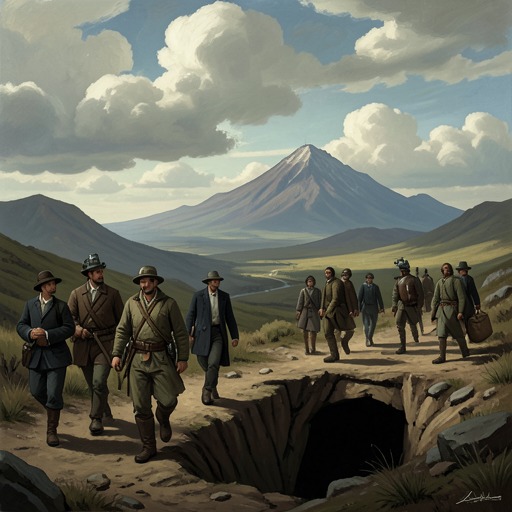
At Altona, a suburb of Hamburg, the travelers take the Kiel railway toward the Belt. The Professor says little, absorbed in his papers, including the parchment and letters of introduction from the Danish consul intended to open a way to the Governor of Iceland. Henry watches the passing country instead. At Kiel, their luggage is transferred to a steamer, but a ten-hour delay angers his uncle. They eventually cross the Great Belt at night in rough weather, continue by rail to Copenhagen, and arrive with scarcely time for refreshment before the Professor hurries to present his letter to the director of the Museum of Antiquities.
Henry briefly hopes that no ship is bound for so distant a destination. That hope fails: a small Danish schooner, the Valkyrie, is due to sail for Reykjavik on June 2. Its captain, M. Bjarne, treats the voyage as routine, while the Professor greets the prospect with extraordinary enthusiasm; the sailor takes advantage of that enthusiasm to double the fare. The contrast makes the expedition’s scale visible in miniature. For the captain, Iceland is a passage on a working route; for the Professor, it is the gateway to a discovery of overwhelming importance.
Before sailing, the travelers receive cordial letters of introduction from Mr. Thompson for Baron Trampe, Governor of Iceland, M. Pictursson, the bishop’s coadjutor, and M. Finsen, mayor of Reykjavik. Their cargo goes aboard the Valkyrie at two in the morning on the second of the month. The cabin assigned to them has two standing bed places and little comfort or ventilation; Henry accepts the discomfort as part of the demands of science. The letters and the packed equipment are complementary instruments of the journey: one set secures access to people and institutions, while the other equips the travelers for physical hazards.
The sea passage
The schooner’s route carries it past Cape Skagen, across the Skagerrak, around the southern point of Norway, and into the Northern Seas. Near the coast of Scotland it turns toward the Faroe Islands, where shifting winds and heavy waves make progress difficult. On the eighth day the captain sights Myganness, the westernmost of the islands, and then steers toward Portland on Iceland’s southern coast. The geography arrives in successive bearings rather than as a single leap: each headland and island marks another stage between the travelers’ settled world and the volcanic land they seek.
The voyage also reverses the apparent balance between uncle and nephew. Henry bears the crossing well, but Professor Hardwigg suffers badly from seasickness, to his annoyance and shame. Unable to question Captain Bjarne about Sneffels, communications, or transport, he has to postpone these practical inquiries until landfall; for much of the passage he lies groaning in bed and anxiously awaits its end. Henry admits that he does not pity him. The usually commanding scholar is temporarily confined by his own body, and the delay frustrates the very investigations he had meant to begin at sea.
On the eleventh day, Cape Portland appears beneath Mount Myrdals Yokul. The schooner keeps offshore, passing sights Henry records as part of Iceland’s strange approach: schools of whales and sharks, a solitary rock hollowed into a mighty vault by the waves, and the low Westman islets, scarcely visible until the vessel nears them. The Valkyrie turns west to round Cape Reykjanes. Heavy seas then prevent the Professor from crawling on deck, depriving him of his first view of the land he has called the Land of Promise. After a storm drives the schooner far out to sea under bare poles, land is sighted again forty-eight hours later. A pilot boards and, after three hours of dangerous navigation, brings the vessel safely to anchor in Faxa Bay before Reykjavik.
Landfall and the threshold of the expedition
Professor Hardwigg emerges from his cabin pale, haggard, and thin, but his pleasure is undiminished. Before leaving the schooner, he takes Henry by the hand, leads him to the quarterdeck, and points inland across the bay toward a snow-covered, double-peaked mountain. He identifies it as Mount Sneffels in an awed whisper, then puts a finger to his lips and frowns before descending into the waiting boat. The gesture turns the sight into a guarded threshold: the destination is at last visible, but the Professor does not explain himself further. Henry follows him ashore, and the two stand on Icelandic soil.
Their arrival immediately links the travelers to the island’s officials. Baron Trampe, a civil servant despite his military-style dress, receives the letters from Copenhagen and converses with the Professor in Danish; Henry understands none of the exchange, but later learns that the governor has placed himself at Hardwigg’s disposal. Mayor M. Finsen also receives the Professor graciously. M. Pictursson is away on an episcopal visit, while M. Fridriksson, professor of natural science at the college in Reykjavik, becomes a crucial intellectual and linguistic contact. He speaks Icelandic and Latin but no other languages; because he addresses Henry in Latin, the two understand one another. In Henry’s account, Fridriksson is the only person he thoroughly understands during his residence on the island. The travelers are given two of the three rooms in Fridriksson’s house, and their great quantity of baggage astonishes the town’s inhabitants.
Henry’s walk through Reykjavik establishes a sharp difference between the place as observed and the place as valued by the Professor. Hardwigg says he has no interest in what lies above the surface; what matters to him is what lies below. Henry, meanwhile, describes a small town on a flat, marshy plain between two hills, with a lava field falling in terraces toward the sea and Faxa Bay bounded to the north by the glacier of Sneffels. The Valkyrie is the only ship at anchor, while the English and French gunboats usually present to watch the fisheries are away. The town’s longest street follows the shore among red-painted wooden huts; another runs toward a small lake between the bishop’s residence and the homes of other noncommercial officials. Henry finds the streets weary and dismal, with scant turf and small kitchen gardens. His measured inventory gives the expedition a real Icelandic setting even as his uncle’s attention is already directed beneath it.
Preparations and the road ahead
The expedition’s departure from Reykjavik requires another forty-eight hours of preparation. Instruments, arms, tools, and provisions are packed into four separate groups, a practical arrangement that makes the journey’s dependence on material equipment explicit. Among the instruments are a centigrade thermometer made by Eigel, graduated to 150 degrees, and a compressed-air manometer for measuring atmospheric pressure. Henry questions whether the thermometer’s range will be adequate: it might be too low if underground heat rises enough to cook them, or too high to give useful readings of springs or molten metal. He also explains why the Professor considers an ordinary barometer inadequate: pressure may increase with descent below the surface. Scientific ambition is thus carried forward by instruments whose limits Henry already notices.
The route’s defining method is to transform places into measurable and usable stages. The travelers follow introductions through Copenhagen and Reykjavik, identify their volcanic destination from the bay, and prepare tools for a descent whose dangers cannot yet be fully assessed. At the summit of Sneffels, Hardwigg explains that they are only thirty-five leagues from Greenland and identifies the mountain’s two peaks; Hans names the peak beneath them Scartaris. Later, as they reach the central sea, Henry records in his journal that the expedition has traveled 270 leagues—more than 800 miles—from Port Gretchen and is 620 leagues from Iceland, exactly under England. These later bearings reveal the scale of what the voyage from Europe initiates: a progression from named, visible landmarks toward increasingly radical claims about the spaces below them.
The same impulse to record and name persists throughout the journey. When the travelers construct a raft from the peculiar wood found on a sandy shore, Professor Hardwigg proposes naming it and suggests Henry’s name among the possibilities. Henry offers another proposal, continuing the negotiation over who gets to designate the expedition’s objects and spaces. Yet the journey repeatedly makes knowledge contingent on people and things beyond the Professor’s command: the captain controls passage, Icelandic officials facilitate access, Fridriksson supplies a shared language, Hans guides and builds, and the weather can deny Hardwigg even a first view of shore. The expedition to Iceland is therefore both a geographical approach and a change in authority. Its confident leader can set the destination, but reaching and understanding it depend on cooperation, equipment, and conditions that do not obey his will.