The Whispering Gallery
A Journey to the Centre of the EarthThe Whispering Gallery is an acoustically unusual passage in the underground labyrinth that enables Harry, alone and badly weakened after a fall, to communicate with Professor Hardwigg and Hans despite a separation of about five miles. Its importance is both practical and structural: a voice heard in the darkness becomes evidence that Harry’s companions are alive and searching, a means of telling them where he is, and a guide for his difficult journey toward them. The reunion remains distant, but the gallery changes solitude from an absolute condition into a problem of direction and endurance.
Situation and Discovery
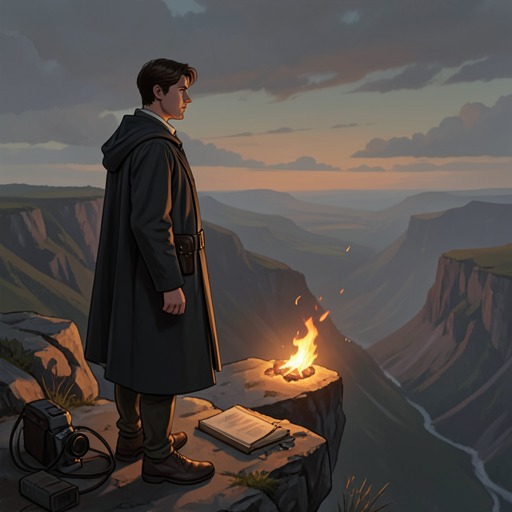
The gallery comes into focus after Harry regains consciousness in a state of extreme isolation. He has lost much blood in his fall, cannot tell how long he has been insensible, and has no means of measuring time. Wet with tears, he crouches against the granite wall, overwhelmed by pain and grief. His survival gives him a reason to keep acting, but at first he has neither a clear course nor evidence that anyone can hear him.
The first signs of company are uncertain. Harry hears a rolling noise like thunder and catches the word “forlorad,” but the darkness and the vast distance make him doubt whether his voice could reach the others. He fears that illness and suffering have weakened it too much. Listening closely, he moves his ears along the wall and identifies what seems to be a precise point where the sound grows strongest. The word comes distinctly again, followed by the thunder-like noise. Instead of treating the sounds as proof that the granite itself is transmitting voices, Harry recognizes that the route must run along the gallery.
A voice then speaks his name, and Harry recognizes it as Professor Hardwigg’s. The professor is talking with Hans; Harry understands that the Danish word he has heard means “lost.” This recognition resolves the immediate uncertainty: his companions are not merely nearby in an indistinct acoustic sense, but are actively speaking and searching for him. Harry infers that he must place his own voice along the same acoustic line, so that the gallery will carry it as a wire carries an electric current.
How the Gallery Works
The connection depends on position. Harry finds a point at the wall where the voices reach maximum intensity and presses himself close enough to speak along it. He warns himself that the effect could disappear if his companions move only a few feet from their position. The gallery is therefore not a general channel through which the separated party can converse from anywhere in the labyrinth; contact relies on a particular alignment within the passage.
The narrative offers a natural explanation after the exchange. Harry recalls that the phenomenon arises from the “conductibility” of rock and compares it with other places where sound travels in unusual ways: the interior gallery of St. Paul’s, curious caverns in Sicily, and, most remarkably, the Ear of Dionysius. These examples place the underground communication within a recognizable acoustic phenomenon rather than presenting it as supernatural. The explanation also sharpens the scene’s contrast: what first seems like an impossible voice traversing an immense mass of earth becomes a consequence of the gallery’s particular acoustic properties.
The exchange takes place while the speakers remain far apart. Professor Hardwigg tells Harry that the party has searched in both upward and downward directions. They had supposed that Harry might still be on the road beside Hansbach, and had descended again while firing guns as signals. The gunshots had not ended the separation; the gallery’s voices finally establish contact. Hardwigg estimates that it may still be a long time before they can meet, and describes their conversation as the product of an extraordinary acoustic arrangement in the labyrinth. Hearing one another is already a gain, even though it is not yet a physical reunion.
Contact and the Search
Once Harry recognizes the gallery’s effect, he calls to his uncle. The first contact is fragile: he can hear, but his strength is too limited for sustained speech. He asks Professor Hardwigg to keep talking, explaining that complete silence would feel like annihilation. The request turns the acoustic link into more than a way to exchange information. The professor’s continuing voice helps Harry maintain contact at the moment when exhaustion threatens to return him to isolation.
Professor Hardwigg answers with reassurance and an account of the search. He tells Harry not to speak because he is so weak, recounts how the party looked in both directions, and admits that he had nearly given up hope. He also describes the sorrow and regret he felt while believing Harry lost. The account makes the rescue bid a shared ordeal: Harry has experienced abandonment, while his companions have been searching without knowing whether he is alive. Their voices bridge that gap in knowledge before they can bridge the physical distance.
Harry uses the opportunity to establish what he needs to know, leaning his head against the wall and speaking close to it. The scene thus turns listening into an active, physical task: he must locate the point where sound carries, remain near it, and use the narrow opening it gives him before the acoustic effect is lost. Communication does not remove his weakness or bring the party together immediately, but it lets the separated travelers coordinate their hope and orient the next stage of the search.
Direction, Distance, and Significance
The conversation ends with Professor Hardwigg’s farewell to Harry, framed as a promise of welcome when they meet again. The words reach Harry before he begins his weary, almost hopeless journey. He gives thanks, believing that he has been led to the one place where his friends’ voices can reach him. The gallery therefore marks a reversal without pretending that the danger is over: the abandoned traveler has found a line of contact, but still has to move through the labyrinth to reach the people on the other end.
Harry reasons that if his uncle’s voice can reach him across such a distance, no serious obstacle need separate them. He decides to follow the direction from which the sound came. Yet his body makes that inference costly: when he rises, he discovers he cannot walk and must drag himself along the rapidly descending slope. The sound provides a route, not strength; its promise of reunion is measured against the physical effort required to pursue it.
As a setting, The Whispering Gallery makes an otherwise hostile underground space briefly communicative. Granite, darkness, and distance still separate Harry from the expedition, but the same rock that appears to seal him away carries the voices that prove he has not been abandoned. Its acoustic law turns an isolated point in the labyrinth into a meeting place in sound, and its role in Harry’s rescue begins not with a sudden reunion but with the fragile, directional fact that someone can hear him.