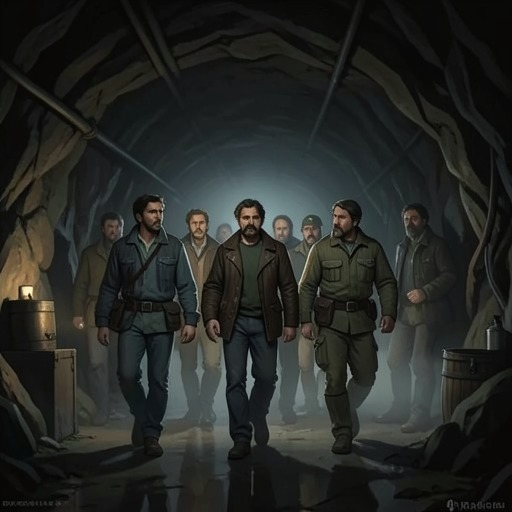
The Wrong Turn into the Eastern Tunnel
A Journey to the Centre of the EarthThe Wrong Turn into the Eastern Tunnel is the expedition’s consequential choice of an unmarked passage: a confident decision made without evidence, followed by a geological journey that seems to offer a way back toward the surface before ending at a wall. The detour turns the underground landscape into a record of deep time, but its final dead end establishes that the travellers have lost the route they meant to follow and must retrace their steps.
Choosing Without a Guide
On Tuesday, June 30, the travellers resumed their descent at six in the morning along a lava gallery that formed a natural, gently inclined pathway. At seventeen minutes past twelve, they caught up with Hans, who had stopped ahead of them. Professor Hardwigg declared that they had reached the end of the shaft. In front of them lay four somber, narrow tunnels crossing one another, with no sign to indicate which route to take.
Hardwigg pointed to the eastern tunnel and entered it without delay. His choice was not based on a marker or a demonstrated connection to Saknussemm’s route: the narrator makes clear that there was no indication by which to decide, leaving chance and good fortune as the only guides. Hardwigg’s promptness presents uncertainty as resolved in action, though not in fact. Once the party has committed to the passage, the tunnel supplies a succession of striking observations but no reliable direction.
The way narrowed and wound gradually downward. Its arches first suggested the aisles of a Gothic cathedral; farther on, a square system of arches recalled Roman construction, projecting from solid rock to support the roof. Such comparisons make the passage appear almost designed, although its forms are geological rather than human. The path’s visual variety gives the travellers material to read, but none of it answers the practical question that opened the detour: whether this is the correct way.
The Rocks as Evidence
As the party continued, the passage’s character changed. The narrator noticed that the lamp’s reflections diminished: shining lava gave way to living rock, with sloping walls that sometimes became vertical. He identified the formation as a geological transition and, more particularly, as Silurian stone. The shift matters to the route as well as to his scientific account: the travellers are no longer moving through the same lava landscape in which they began.
The narrator initially treats his geological reading as a hypothesis rather than a certainty. He reasons that, if he is right about the strata, remains of primitive plants should provide evidence. Within about a hundred yards, the hard, arid lava underfoot gives way to soft dust made up of the remains of plants and shells. He sees outlines of fucus and lycopods on the walls and picks up an almost perfect shell, which he takes to resemble an animal of the present day. The fossils give tangible support to his interpretation of the rocks; they do not, however, tell the party which tunnel would lead toward its destination.
The layers continue to change. The narrator describes calcareous rock, red sandstone and striking marbles—some grey with white veins, others yellow with red, or crossed by cherry-coloured seams. These deposits bear the marks of primitive animals. In his reading, the fossil record also shows a progression: trilobites, which he calls rudimentary, give way to remains of a more developed order, including fish associated with the early forms of reptiles. He interprets these strata as a climb through the scale of animal life, even while the physical route offers no dependable indication that the expedition is approaching its goal.
That mismatch deepens the tension with Professor Hardwigg. The narrator sees the changing fossils as warnings that the journey is not proceeding as expected, but Hardwigg continues. The distinction is not simply between knowledge and ignorance: the narrator’s observations are specific and increasingly supported by what he finds, while the practical question of direction remains unresolved. Geological evidence can identify the world around them without giving them a map through it.
Apparent Ascent and the Coal Strata
The route’s upward tendency is uncertain. At times the party seems to be descending, and the strata continue to show the transition that troubles the professor. After a night in which the narrator feels the gnawing effects of thirst and loses his appetite, the travellers continue through the twisting passage. Ten more hours of monotonous progress bring another abrupt geological change: the marble, schist, calcareous rock and red sandstone disappear, replaced by a dark wall that scarcely reflects their lamps.
When the narrator braces his left hand against the rock and looks at it, it is black. That simple mark identifies the coal strata of the Interior of the Earth. The observation supplies a concrete answer to the question of what formation they have reached, but still not whether the passage is taking them toward the surface, deeper underground or along Saknussemm’s route. The professor calls it a coal mine without miners, an image that distinguishes the natural subterranean formation from any work made by people.
The next morning, at six, they start again. Twenty minutes later they enter a vast excavation, about a hundred feet wide and a hundred and fifty feet high. Its scale convinces the narrator that human mining cannot account for it: a human-made cavity would have caused the vault to collapse. He understands it instead as a gap opened by a violent subterranean upheaval. The walls display the coal period in layers, with coal seams separated by sandstone and compact clay apparently crushed by the weight above. The detour thus becomes an encounter with a landscape whose scale and structure exceed human construction.
The travellers explore this coal cavern until evening, but its horizontal course frustrates Hardwigg, who had hoped for a more promising direction. The darkness makes it impossible to judge how far the gallery extends; the narrator begins to fear it may continue in the same fashion for months. The passage’s immense geological history contrasts with their immediate predicament: the strata preserve the record of ages, while the expedition cannot even establish how long its present corridor will last.
The Dead End and the Return Plan
At six o’clock, the gallery ends at a wall. There is no passage to the right or left, above or below. The narrator is stupefied; Hans folds his arms; Professor Hardwigg says nothing at first. The unambiguous barrier settles what the changing rocks and uncertain inclines could not: this passage cannot carry the party onward.
Hardwigg then identifies the consequence of the wrong choice. They are not on Saknussemm’s road, he says, and must go back to the point where the galleries divided. He proposes resting for the night and promises that within three days they will regain the junction. The plan is a reversal from forward exploration to retracing their route, and the promise rests on the party having enough strength to carry it out. The narrator immediately voices that qualification, fearing they may not last that long; Hardwigg answers with confidence rather than evidence that the return will be easy.
The episode ends with the expedition’s route problem exposed but not solved. The eastern tunnel yielded an extraordinary geological sequence—lava, fossil-bearing strata, marble, coal and a natural cavern—but its discoveries could not compensate for the absence of a navigable way forward. Hardwigg’s original choice had been made where no sign distinguished one passage from another; only the wall establishes beyond doubt that this one is wrong. The detour’s central contrast is between what the travellers can learn by examining the underground world and what they still cannot know about the way through it.