Trilobites
A Journey to the Centre of the EarthTrilobites are the expedition’s first tangible fossils in the underground strata: their remains turn geological time into material evidence, while the disagreement over what they prove exposes the difference between the narrator’s excitement and Professor Hardwigg’s restraint. The fossils also serve as a measure of the ancient life revealed as the explorers move through successive formations.
Discovery in the Silurian Strata
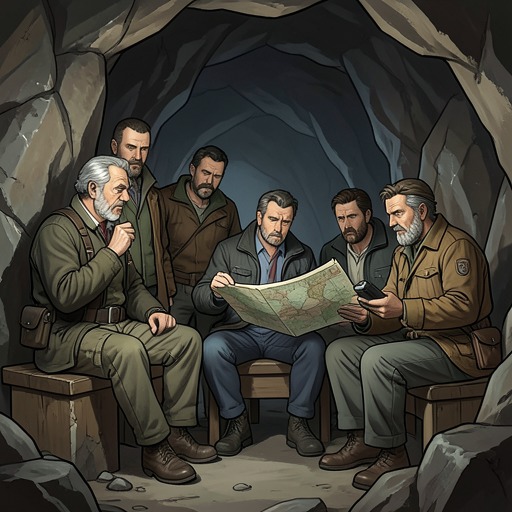
As the explorers enter what the narrator identifies as a transitional formation associated with Silurian stone, the gallery’s shining lava gives way to living rock. He expects the changing strata to yield traces of early life and soon finds soft dust made up of plant and shell remains. Fucus and lycopod outlines mark the walls, and he picks up an almost complete shell that he believes belongs to an animal resembling one of the present day.
Professor Hardwigg identifies the specimen more narrowly: it is the shell of a crustacean from the extinct order of the trilobites. The narrator wants this find to support a larger inference about the ancient world beneath the surface, but Hardwigg’s calm classification does not settle what conclusions should follow. Their exchange makes the fossil both an object of scientific identification and a point of friction between observation and interpretation.
A Marker in the Changing Fossil Record
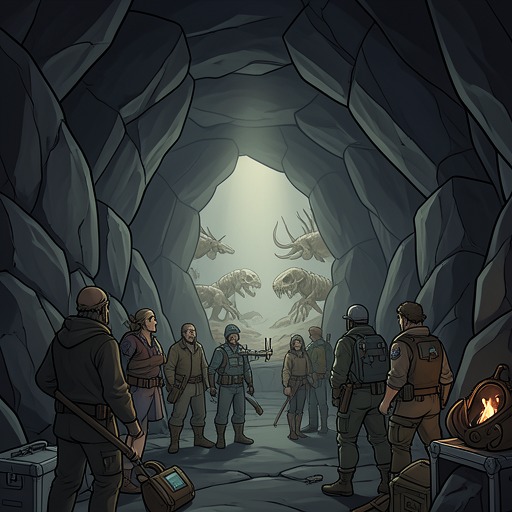
The trilobite appears at an early point in the sequence of fossil life described underground. Later, the narrator observes that the marbles bear marks of primitive animals and that remains of a more developed order have appeared. He contrasts these newer fossils with the rudimentary trilobites and reads the progression as an ascent in animal life. The trilobites therefore establish a point of comparison: the strata are not merely different kinds of stone, but a record that seems to the narrator to show life changing over geological time.
That reading belongs to the narrator’s account of what the expedition encounters, not to a modern scientific explanation. The novel turns geological succession into a route through the earth, allowing a shell in the explorers’ path to connect their immediate movement through a gallery with immense spans of natural history. Hardwigg’s determination to proceed, even when the narrator sees fossils as warnings and evidence, keeps discovery in tension with the urge to press onward.
Scientific Time and the Human Past
The fossil encounter sits within a wider nineteenth-century dispute about how far back human existence reaches. Before the expedition, a human jawbone discovered in 1863 at Moulin-Quignon, near Abbeville, had become the focus of arguments over whether people lived during the Quaternary period. Its supporters regarded the find as authentic; Elie de Beaumont disputed the dating of the deposit and rejected the claim that humans were contemporaries of Quaternary animals. Other discoveries and interpretations were then extending the proposed antiquity of humanity still further.
Against that historical background, the trilobite is not itself evidence of ancient humans. Its role is different: it gives the explorers a fossil point of reference for the deep past, while the later human remains confront them with the far more startling question of humanity’s place in geological time. The movement from trilobite-bearing strata to the prospect of human antiquity links the expedition’s physical descent to the period’s unsettled effort to read the history of life from what the earth preserves.