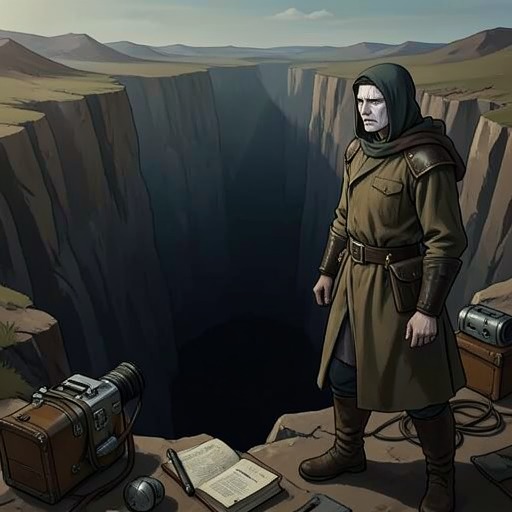
Whispering-gallery acoustic phenomenon
A Journey to the Centre of the EarthThe Whispering-gallery acoustic phenomenon is the natural effect that allows Henry to hear and answer his companions across a great distance underground. In the cavernous labyrinth, sound travels not through the solid rock separating them but along a gallery whose acoustic properties carry voices to a precise point of maximum intensity. The phenomenon turns an apparent mystery into a practical lifeline: Henry can use it to establish contact with Professor Hardwigg and orient himself toward the people searching for him.
Discovery in the darkness
Weak and isolated, Henry first hears what seems to be a faint echo of distant, incoherent voices. He cannot tell what they are saying, and at first fears that the sound may be an illusion—or merely his own words returning to him. To test that possibility, he closes his lips and presses his ear against the granite wall. The voices persist, confirming that someone else is speaking, though their words remain indistinct.
Henry drags himself along the cavern’s sides, seeking a position where he can hear more clearly. The effort brings him to a point at which the murmurs grow stronger. Among the unfamiliar sounds, he repeatedly makes out the word “forlorad,” spoken with anguish. He recognizes the voices as potentially belonging to Professor Hardwigg or Hans, but the sound’s source and path are still uncertain. The repeated word gives the distant conversation a human urgency before Henry can understand its meaning.
The gallery as a sound path
By moving his ear along the wall, Henry identifies what he describes as a mathematical point where the voices reach their greatest intensity. At that point, “forlorad” becomes distinct, and the rolling noise that had awakened him returns. His observations lead him to reject the idea that the voices have penetrated the solid granite: even a tremendous explosion, he reasons, could not carry sound through the rock in that way. Instead, the sound must be following the gallery itself, whose unusual acoustic properties direct it toward his hiding place.
The geometry of the effect makes communication possible but precarious. Henry concludes that he must speak along the side of the gallery, just as sound can travel from point to point along a wire. If his companions move only a few feet, he fears, they may leave the position where the acoustic effect works. He crawls back toward the wall and calls to Professor Hardwigg, turning his discovery from passive listening into an attempt at contact.
Contact across the labyrinth
Professor Hardwigg’s voice confirms that the phenomenon connects the separated party. Henry learns that Hardwigg and Hans have been searching in both directions along the gallery, including upward and downward. They had returned toward the road beside the Hansbach and fired guns as signals, but the acoustic connection does not mean that the men are physically close: the speakers are about five miles apart. Their voices reach one another through what Hardwigg calls an extraordinary acoustic arrangement of the labyrinth, even though meeting may still take a long time.
The conversation is itself difficult to sustain. Henry is so weak that answering questions exhausts him; he asks Hardwigg to keep speaking because silence feels annihilating. Hardwigg tells him to conserve his strength and offers reassurance, explaining the search and the sorrow he had felt after fearing Henry lost. The acoustic effect therefore carries more than intelligible information: it allows the searchers to assure one another that they are alive and that contact has been made, while the distance and Henry’s condition remain real obstacles.
Natural explanation and narrative consequence
The phenomenon is eventually explained through the conductibility of rock: sound can propagate along a particular route and become audible in positions where it would not be perceptible elsewhere. Henry connects the effect with familiar examples, including the interior gallery of St. Paul’s, caves in Sicily, and the celebrated Ear of Dionysius. These comparisons place the underground episode within a recognizable class of acoustic effects rather than leaving it as supernatural intervention. The extraordinary scale of the setting makes the occurrence startling; the explanation rests on natural laws.
Once he understands how the voices reach him, Henry reasons that no serious obstacle need separate him from his companions. He believes that he can follow the direction from which the sound comes and reach them if his strength holds. The conversation ends with Hardwigg’s farewell and a hopeful promise of welcome, after which Henry begins the arduous journey by dragging himself along the steep slope. The gallery does not reunite the party instantly, but it transforms isolation into a route: hearing becomes evidence of connection, and connection gives Henry a direction in which to move.
Function in the episode
The acoustic phenomenon structures the rescue as a sequence of observation, interpretation, and action. Henry first hears what he cannot explain, tests whether the sound is his own echo, searches for the point where it grows strongest, and infers the gallery’s role before calling to Hardwigg. Each step depends on listening closely under conditions of physical weakness. The reader learns the explanation alongside Henry, so the suspense comes not from a hidden supernatural cause but from whether he can make sense of the sound and use it before the fragile contact disappears.
The episode also makes the underground passage function like a communications channel. The granite seems at first to seal Henry away from the others, yet the structure of the gallery carries their voices across a distance of about five miles. The contrast between separation and audibility sustains the scene’s emotional tension: the men can speak and reassure one another, but they cannot yet meet, and Henry must still travel while barely able to walk. The phenomenon matters both as a natural acoustic curiosity and as the condition that makes renewed contact, and therefore the prospect of reunion, possible.