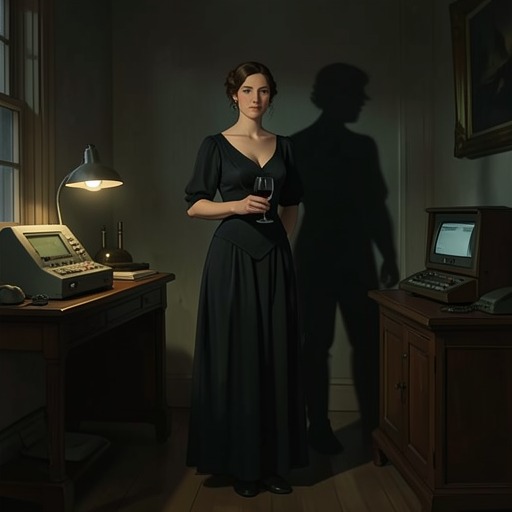
“She wasn’t there”
A Murder Is Announced“She wasn’t there” is the phrase that turns Miss Murgatroyd’s fragmentary memory into evidence against Letitia Blacklock. Its meaning depends not only on the words but on their emphasis: Jane Marple hears in them not the identification of an absent woman, but the recollection of a place that should have been occupied and was empty. The distinction resolves the apparent contradiction at the centre of Miss Murgatroyd’s account of the staged hold-up.
The phrase in Miss Murgatroyd’s recollection
Miss Murgatroyd calls after Miss Hinchcliffe as the latter leaves, insisting that “she wasn’t there.” Later, Miss Hinchcliffe recounts the sentence to Jane Marple, but is uncertain how her friend said it. That uncertainty matters. Miss Hinchcliffe first understands the words as pointing to one of three women still under consideration: Mrs Swettenham, Mrs Easterbrook, or Julia Simmons. If one of them had been absent from the drawing-room, she reasoned, that woman might have slipped through the other door into the hall.
The phrase therefore initially appears to be a clue about a person’s movements. Miss Hinchcliffe tells Jane Marple that she intends to discover which of the three women was missing. But Jane asks whether Miss Murgatroyd said the sentence in precisely the same way Miss Hinchcliffe has repeated it. The question shifts attention from the suspected women to the sound and structure of the remembered words.
Emphasis changes the meaning
Jane distinguishes between three possible deliveries. With personal emphasis, the sentence would point accusingly to a particular woman. With a confirming emphasis, it would suggest that an existing suspicion had been settled. The version Jane thinks she hears in Miss Hinchcliffe’s account is different: comparatively blank, with the emphasis, if any, falling on “there.” Miss Hinchcliffe cannot reliably recover the original intonation, but Jane regards even this slight indication as significant.
The difference is subtle but decisive. If Miss Murgatroyd had meant that a particular woman was absent, she would have identified a person by their failure to appear. Instead, Jane interprets the sentence as referring to an expected presence that was missing from a specific place. The words do not simply report that someone was elsewhere; they preserve the shape of a gap in the room.
From the room to the absent person
Miss Murgatroyd was positioned behind the door during the hold-up and, as Miss Hinchcliffe explains, was the only person able to see what was happening clearly. In Jane’s reconstruction, Miss Murgatroyd’s memory follows the path of the torch from the mantelpiece past the two windows and the people between them. She recalls Mrs Harmon with her hands over her eyes, Miss Bunner staring, and then a wall, a table, a lamp, and a cigarette-box. The recollection moves through visible objects and people before arriving at the shots and the wall where the bullet holes were later found.
At that point, Miss Murgatroyd remembers that Letitia Blacklock had been standing where she was supposedly shot—but that, when the revolver fired, Letitia was not there. The crucial absence is thus not one of the three women Miss Hinchcliffe had been considering. It is the missing person at the place where the supposed victim should have been. Jane explains that Miss Murgatroyd had not immediately understood what her observation meant; she had remembered the empty place before she could make sense of it.
The clue’s resolution and significance
The phrase’s two readings encode two different kinds of attention. A person-centred reading asks which woman was absent from the room. A place-centred reading asks who should have occupied a particular spot at the decisive instant. Jane’s sensitivity to Miss Hinchcliffe’s uncertain emphasis allows her to move from the first question to the second, and from there to Letitia Blacklock.
The clue also shows why Miss Murgatroyd’s apparently incomplete sentence could carry more weight than a straightforward accusation. Her words register an observation before they form a conclusion. Jane later connects that recollection with other isolated details, including the lamp’s fusing, and says that the separate pieces came together into a coherent pattern. “She wasn’t there” is therefore both a fragment of testimony and a demonstration of how the investigation recovers meaning from the difference between what a witness saw and what she initially understood it to mean.