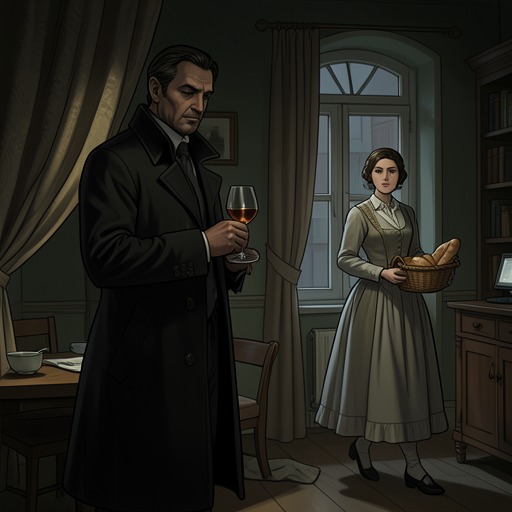
Charlotte Blacklock—Dora Bunner
A Murder Is AnnouncedCharlotte Blacklock and Dora Bunner are old school friends whose reunion becomes central to Charlotte’s deception and its human cost. Dora is among the few people who know that Charlotte has assumed her dead sister Letitia’s identity; she initially approves of the deception and helps keep it secret. But Dora’s affection, loyalty, and failing memory make her both Charlotte’s companion and an increasing danger. Charlotte eventually poisons her, then mourns her with apparently genuine grief, leaving their relationship defined by the terrible coexistence of love and murder.
School Friendship and Reunion
After years without contact, Dora sees Letitia Blacklock’s name in a newspaper report about a luncheon benefiting Milchester Hospital. Facing poverty and difficulty finding work, she writes to her old school friend to ask for help. Dora explains that she hopes a friend who knew her when they were young will understand that she is not simply asking as a stranger. Her recollection of Letitia as clever and successful draws on the real friendship of their schooldays, but also reflects the identity Charlotte has taken over.
Charlotte answers Dora’s appeal in person. Dora had written to Letitia and is surprised when Charlotte, the sister, arrives instead. Charlotte does not pretend to be Letitia to Dora: she admits who she is and brings her into her life at Little Paddocks. This is an exception to the concealment on which Charlotte otherwise depends. The two women share memories of their youth, and Charlotte treats Dora as an old friend admitted to her lonely and unhappy circumstances.
Shared Secret and Mutual Loyalty
Charlotte tells Dora that she has assumed Letitia’s identity. Dora wholeheartedly approves. In Dora’s understanding, Charlotte has suffered patiently and deserves the inheritance; it would be unjust for the money to go to an unknown person after Letitia’s death. Her support is not merely silence: she regards the impersonation as a morally understandable way to prevent Charlotte from losing what she believes Charlotte deserves.
Dora also understands that their knowledge must remain private. The story likens the secret to an extra pound of butter in a period of scarcity: something that cannot be discussed openly, though Dora sees nothing wrong in having it. Her loyalty makes her willing to move to Little Paddocks and share Charlotte’s household. The intimacy of the friendship thus protects Charlotte’s secret, but it also brings a witness to the history Charlotte must keep concealed.
Affection Becomes a Risk
Dora’s memory is unreliable in everyday matters, and she admits that she muddles things, makes mistakes, and says foolish things. Charlotte is patient with her and makes a point of letting her feel useful. Yet the very history that binds them creates a danger: Dora has always called the sisters by their familiar names, Letty and Lotty, rather than their full names. Although she tries to call Charlotte Letty, the old name sometimes slips out.
Her recollections also bring the sisters’ distinct lives into the same conversation. Dora may describe her friend as not especially pretty but full of character, then speak of a pretty, carefree young woman; she remembers Letty as clever and successful, but also invokes a life of suffering that does not fit Letitia’s history. What can sound like mere confusion to others carries a more precise threat: Dora is unconsciously drawing on memories of both sisters, while Charlotte must ensure that nobody recognizes the distinction.
Charlotte initially can tolerate Dora’s muddles because she cares for her and believes, on medical advice, that Dora does not have long to live. But Dora becomes increasingly forgetful and talkative, and Charlotte must watch for inadvertent references to the past. Her kindness in rescuing Dora has therefore turned into a source of constant strain. The friend who knows the secret can expose it without intending to do so.
Poisoning and Grief
Dora’s conversation with Jane Marple in the Bluebird Café sharpens the danger. Marple notices that Dora seems to be speaking of two people rather than one, and concludes that Charlotte must have overheard enough to understand the risk. Dora also mentions that the shepherd and shepherdess lamp had been changed, a detail connected to the staged shooting at Little Paddocks. Marple believes that this conversation sealed Dora’s fate, even if she thinks Charlotte might eventually have acted against her for the same reason.
Charlotte poisons Dora using tablets placed in the aspirin bottle by Charlotte’s bed. When Dora cannot find the new aspirin bottle she has bought, she goes to Charlotte’s bottle instead. The arrangement makes it appear that the tablets were intended for Letitia, rather than Dora. Charlotte gives Dora a happy birthday party, with foods and treats her friend likes, while also trying to keep others from saying anything that might upset her. Marple interprets this as Charlotte persuading herself that the poisoning is almost an act of kindness, not as evidence that Charlotte has ceased to care.
After Dora dies in her sleep, Charlotte feels safe again, but the security comes at the cost of the friend whose affection and loyalty she depended on. She misses Dora and their conversations about the old days. When Jane Marple later brings a note from Julian, Charlotte cries bitterly; Marple describes her grief as genuine, even though Charlotte herself killed Dora.
Exposure and Contradictory Attachment
When Charlotte realizes that the concealed truth has been exposed, she sits down and cries. She objects particularly to Jane Marple making Dora’s voice come back, and insists that she loved Dora. Her words do not undo the murder; instead, they reveal the attachment that survived alongside the decision to eliminate the person who endangered her secret.
Miss Hinchcliffe, furious over the murder of Amy Murgatroyd, demands to get at Charlotte. Charlotte says that she did not want to kill anyone, but felt she had to, and singles Dora out as the loss she minds most. She says that after Dora died she was alone. The confession brings the relationship’s central contradiction into focus: Dora was not merely a liability Charlotte disposed of without feeling. She was the old friend Charlotte had welcomed, trusted with her identity, and grieved after killing. Their bond deepens the mystery’s account of murder by showing that genuine love and loyalty do not prevent violence when a person’s security becomes paramount.