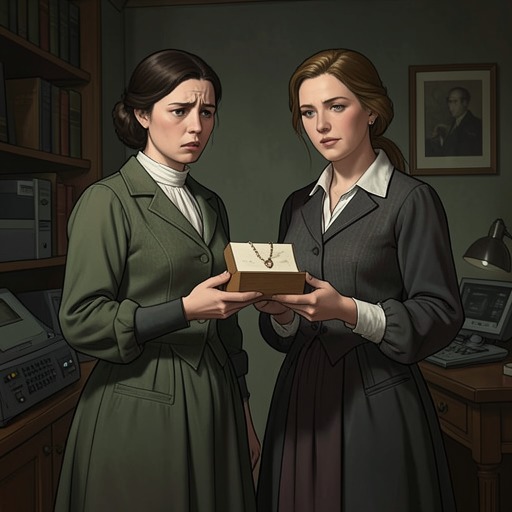
Charlotte Blacklock’s impersonation of Letitia Blacklock
A Murder Is AnnouncedCharlotte Blacklock’s impersonation of Letitia Blacklock transforms a thwarted inheritance into a deception built on resemblance, intimate knowledge, and selective concealment. After Letitia’s sudden death, Charlotte assumes the identity of the sister whose fortune was expected to pass to her, burying Letitia under Charlotte’s name and moving to England as Letitia. The scheme initially succeeds because few people knew Charlotte well enough to recognize her; it becomes vulnerable when old ties and an unexpected encounter bring her former identity back into view.
Inheritance and the sisters’ reversed fortunes
Letitia’s connection to the fortune came through her work as Randall Goedler’s faithful secretary. Randall left his wealth in trust for his wife, Belle, for her lifetime, with the estate to pass to Letitia after Belle’s death. The inheritance therefore depended on a sequence of deaths: Belle had to die while Letitia remained alive. Letitia understood the arrangement as a future benefit, but said the money mattered less to her in old age than it once might have. She had no children, and initially supposed that if she died before Belle, the money might go to Pip and Emma.
The alternative beneficiaries were the children of Randall’s sister, Sonia, who had married Dmitri Stamfordis against Randall’s judgment. Randall had regarded his brother-in-law as a crook and refused to let him inherit; it was Belle who proposed that Sonia’s children, Pip and Emma, should receive the estate if Letitia died first. Randall reluctantly put that provision into his will. Belle later confirmed that she had raised the possibility herself, while admitting that she and Randall had heard nothing of Sonia or her children for years. The will thus made family identity and the order of deaths financially consequential, even when the possible heirs were absent from the sisters’ lives.
Charlotte’s own expectations were bound to Letitia’s inheritance. Letitia had been strong and healthy, while Charlotte was comparatively fragile; then Letitia contracted influenza, developed pneumonia, and died within a week. Charlotte lost both her sister and the future life she had imagined with the expected money. In Jane Marple’s reconstruction, Charlotte may have resented the timing of Letitia’s death, coming when Belle was thought unlikely to live much longer. The fortune had been intended for Letitia, and Charlotte treated herself and her sister as nearly one, allowing her to regard taking Letitia’s place not as a wholly wrongful act but as a way of retaining what she believed would soon have come to them.
The identity change and its practical protections
Charlotte’s substitution may have begun as an impulse rather than a fully developed plan. The sisters had often appeared publicly as two elderly, well-bred Englishwomen who dressed much alike and strongly resembled one another. Once Charlotte realized how easily acquaintances might confuse them, she reversed the names attached to their lives: Letitia was buried as Charlotte, and Charlotte went to England as Letitia. In Jane Marple’s account, the reversal also changed Charlotte’s social position. As Charlotte, she had lived as the less prominent sister; under Letitia’s name, she assumed the authority and command associated with Letitia.
She took precautions to make the change sustainable. Charlotte bought a house in a part of England unfamiliar to her, avoiding the few people in her Cumberland hometown who might have known her as Charlotte. She also had to avoid Belle, who had known Letitia too well for the impersonation to withstand close scrutiny. The sisters’ resemblance was not the only safeguard: Charlotte knew the details of Letitia’s London life, including the people she had met and places she had visited, and she could refer to Letitia’s letters when she needed to maintain the appearance of a shared past. If someone who had known Letitia noticed a change, that person might attribute it to the passage of ten years; if Charlotte failed to recognize someone, her short sight could offer an explanation. Her arthritic hands likewise accounted for difficulties with handwriting.
The deception depended not on convincing every person who had known Letitia that nothing had changed, but on preventing anyone from identifying Charlotte as Charlotte. People might believe that Letitia had altered with age without suspecting that she had been replaced. Charlotte settled at Little Paddocks, made neighbours, and accepted two young cousins as visitors when a letter asked her to be kind. Their willingness to accept her as Aunt Letty reinforced her security: the new identity was being taken for granted in the very household where it needed to hold.
Dora Bunner and the return of the past
Charlotte’s relationship with Dora Bunner created the most intimate breach in her concealment. Dora, an old school friend who had fallen on hard times, wrote for help. Charlotte responded in person rather than maintaining the distinction between the sisters, and Dora discovered that the sister who came to her was Charlotte, not Letitia. Charlotte had known Dora during her own lonely and unhappy period and remembered her as part of a happier, carefree past. Jane Marple suggests that loneliness as well as affection may have contributed to Charlotte’s decision to bring Dora close.
Charlotte disclosed the identity exchange, and Dora approved. In her confused understanding, Charlotte had endured patiently and deserved not to lose the inheritance because Letitia had died at an inconvenient time. Dora treated the secret much as she might have treated an unspoken extra pound of butter in a time of scarcity: something not to be discussed, but not, in her view, something wrong to possess. Her loyalty gave Charlotte an apparent confidante, yet her presence also made the household more dangerous. Dora had known the sisters as Letty and Lotty, abbreviations she found difficult to keep from using, and memories of their former lives would sometimes surface in her conversation.
At first, Charlotte could try to manage those slips, and she expected little attention to be paid to Dora’s inconsistencies. But the old names and recollections repeatedly brought the concealed history close to the surface. Dora’s muddled memory and bungling were not, by themselves, the decisive threat: Charlotte cared for her and knew from the doctor that Dora was not expected to live long. The strain came from having to monitor a friend whose unguarded familiarity could undo the careful distance that had protected the false identity.
Recognition and the collapse of security
The encounter with Rudi Scherz at the Royal Spa Hotel posed a different danger from Dora’s accidental slips. Dora knew the truth because Charlotte had told her; Rudi recognized Charlotte without being aware that he had discovered anything with which to blackmail her. Charlotte feared recognition as herself, not merely the possibility that someone might notice a change in the woman they knew as Letitia. Jane Marple and Inspector Craddock suspect that Charlotte may have supplied money to Rudi to replace earlier losses at the hotel, while rejecting the idea that he initially approached her with a deliberate blackmail scheme. In Craddock’s account, Rudi knew only that a personable young man could sometimes obtain money from an older woman by telling a convincing hard-luck story.
The impersonation therefore contains a double reversal. Charlotte’s success depends on being recognized as Letitia by strangers and acquaintances who accept the familiar name, while the danger comes from someone who recognizes the hidden person but does not understand the secret he has encountered. Rudi’s recognition makes the past materially threatening; the later investigation traces that vulnerability back to the mistaken confidence that the disguise could keep working so long as Charlotte controlled who knew her history.
Narrative significance
The scheme is at once an inheritance maneuver and an act of self-recasting. Charlotte does not merely wear Letitia’s name: she takes up the social authority that had belonged to her sister, while explaining the transfer to herself through their closeness and the expectation that the money would soon have been Letitia’s. But the practical supports of the impersonation—physical resemblance, distance from Cumberland, knowledge of Letitia’s correspondence and acquaintances, and excuses for altered handwriting or failed recognition—cannot erase the people who remember Charlotte directly.
The will’s contingent provisions make that vulnerability more than a matter of disguise. If Letitia died before Belle, the estate could pass instead to the legal descendants of Sonia, Randall’s estranged sister; Belle had secured that alternative for Pip and Emma despite Randall’s hostility to their father. Charlotte’s assumed identity is thus tied to a particular claim on a fortune, while the existence of other possible heirs clarifies why the sisters’ deaths and names matter. The plot exposes the gap between an inheritance’s formal conditions and Charlotte’s moral story that the money was, in substance, already meant for her. Her confidence rests on making those two accounts appear identical, even as Dora’s memories and Rudi’s recognition threaten to separate them.