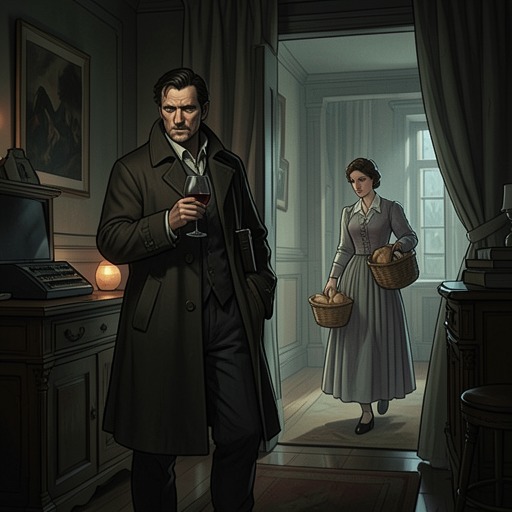
Dora Bunner’s increasing forgetfulness
A Murder Is AnnouncedDora Bunner’s increasing forgetfulness is both a vulnerability and an unintended source of evidence. Her lapses blur the distinction between Letitia Blacklock and Charlotte Blacklock in everyday conversation, alarming Charlotte because they threaten the identity she has assumed; yet the details Dora lets slip help expose that deception. The novel’s contrast between her fading grasp of names and her accurate recollection of what she has seen also sets up the later recovery of a decisive clue by Miss Murgatroyd.
Forgetfulness and the Two Women
As Miss Marple reconstructs the case, Dora’s talk sometimes seems to describe one friend and sometimes another. She recalls a woman who was not pretty but had great character, then speaks of a pretty, light-hearted girl. She praises Letitia as clever and successful, but also describes a sad life and invokes stern affliction bravely borne—an account that does not fit Letitia’s life. These contradictions are not random noise: Dora has, in effect, allowed the separate histories of Letitia and Charlotte to run together in her conversation.
The distinction surfaces in a small, repeated slip. Dora calls Charlotte “Lotty” again, using the familiar name associated with Charlotte rather than Letitia. What appears to others to be a harmless mistake frightens Charlotte, who understands that Dora’s confused speech may reveal the substitution. Miss Marple identifies the slip as evidence of the danger Charlotte perceived: as Dora becomes more forgetful, she also becomes more talkative, and she cannot reliably keep the two women’s identities apart in conversation.
A Danger Created by Talk
Dora’s remarks become dangerous not because she sets out to expose anyone, but because they bring together facts that others have treated separately. Her shifting descriptions point to two lives rather than one, while the mistaken name brings Charlotte’s concealed past into the present. The everyday quality of the disclosures helps explain why their significance is initially missed: each detail can seem like an isolated lapse, yet together they undermine Charlotte’s assumed identity.
Miss Marple also connects Dora’s conversation at the Bluebird Café to a specific danger. Charlotte had come into the café and must have overheard Dora discussing the changed lamp, including the distinction between the shepherd and the shepherdess. That practical detail, alongside Dora’s confused talk about Letitia and Charlotte, made Dora a threat to Charlotte’s security. The conversation thus had consequences beyond what Dora intended or understood.
Memory Under Pressure
The story does not treat memory as a single ability that simply works or fails. Dora is increasingly forgetful and mixes up names and personal histories, but the shooting investigation presents another problem: witnesses are under intense strain, the lights go out, and a powerful torch is directed at the people in the room. One witness describes being dazzled and blinking. Craddock expects witnesses to have seen different things, while Miss Marple challenges the assumption that those who confidently report a masked gunman could actually have seen him clearly.
Miss Murgatroyd’s later recollection makes the distinction sharper. At Miss Hinchcliffe’s urging, she tries to remember the scene rather than simply accept an explanation of it. Miss Marple compares this kind of recall to retaining an incidental detail—a blister of paint beside a railway carriage or mismatched stockings noticed amid the shock of a flying-bomb incident. A person may remember a particular visual fact without having understood its meaning at the time. The scene therefore distinguishes memory for detail from the interpretation attached to that detail; Dora’s muddled speech and Miss Murgatroyd’s recovered observation are different forms of imperfectly understood evidence.
The Clue and Its Consequences
Miss Murgatroyd reconstructs the torch’s path across the room: from the mantelpiece to the windows, past the people and the furniture, and finally to the wall where the bullet holes were later found. In recalling that wall, she realizes that Letitia had not been standing there at the moment she was supposedly shot. Her words, “She wasn’t there,” first sound ambiguous, but Miss Marple checks how Miss Murgatroyd said them and explains that the absent thing was a person from a place where someone should have been. The recovered observation points to Letitia’s apparent position as the essential absence.
Dora’s forgetfulness belongs to the same pattern of delayed meaning, though it produces a different kind of clue. Her words about “Lotty,” the two conflicting descriptions, and the changed lamp only become coherent when Miss Marple joins them to the identities and circumstances behind the case. Dora’s lapses help make Charlotte’s secret unsafe; Miss Murgatroyd’s recovered visual memory helps clarify the staging of the shooting. Together, the two strands show how a detail can escape notice when first spoken or seen, then acquire force when it is placed in a coherent pattern.